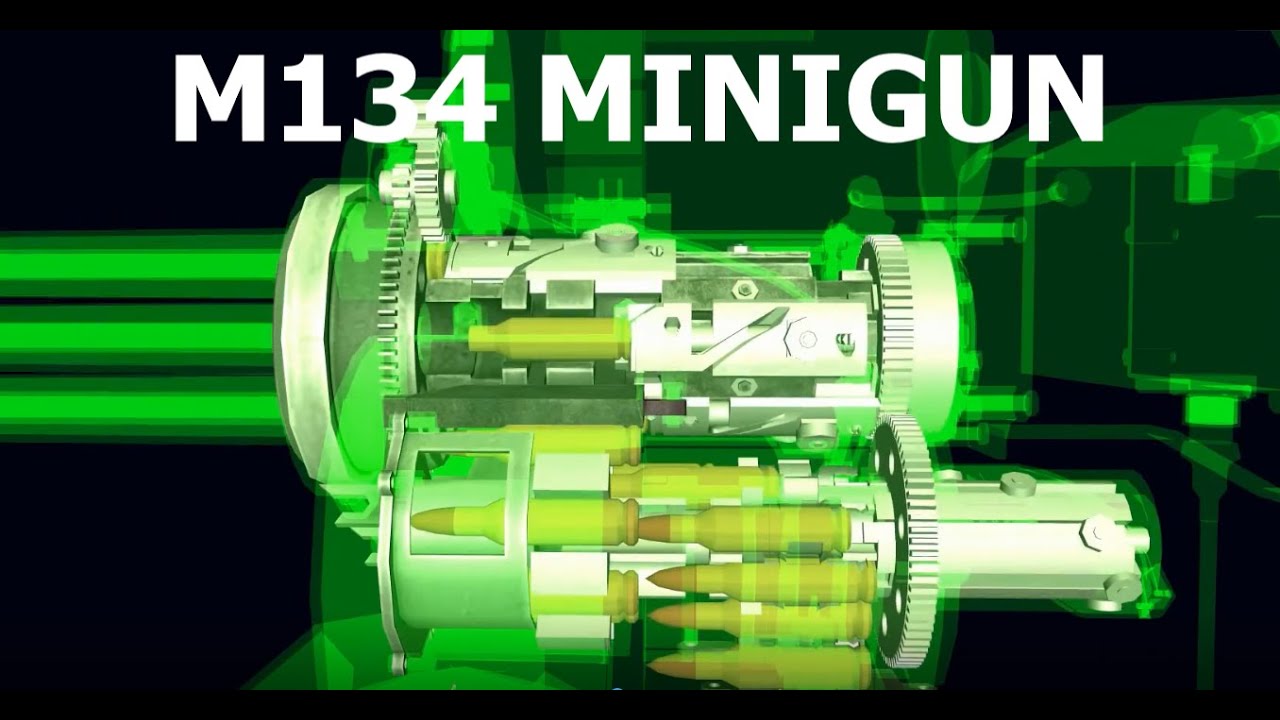
M134D Minigun - Step By Step Disassembly & Reassembly
Автор: TheGreenLing
Загружено: 2020-08-05
Просмотров: 1064
Описание:
The M134 Minigun is a 7.62×51mm NATO six-barrel rotary machine gun with a high, sustained rate of fire (2,000 to 6,000 rounds per minute). It features a Gatling-style rotating barrel assembly with an external power source, normally an electric motor. The "Mini" in the name is in comparison to larger-caliber designs that use a rotary barrel design, such as General Electric's earlier 20 mm M61 Vulcan, and "gun" for the use of rifle ammunition as opposed to autocannon shells.
"Minigun" refers to a specific model of weapon that General Electric originally produced, but the term "minigun" has popularly come to refer to any externally powered rotary gun of rifle caliber. The term is sometimes used loosely to refer to guns of similar rates of fire and configuration, regardless of power source and caliber.
The Minigun is used by several branches of the U.S. military. Versions are designated M134 and XM196 by the United States Army, and GAU-2/A and GAU-17/A by the U.S. Air Force and U.S. Navy.
The ancestor to the modern minigun was a hand cranked mechanical device invented in the 1860s by Richard Jordan Gatling. Gatling later replaced the hand-cranked mechanism of a rifle-caliber Gatling gun with an electric motor, a relatively new invention at the time. Even after Gatling slowed down the mechanism, the new electric-powered Gatling gun had a theoretical rate of fire of 3,000 rounds per minute, roughly three times the rate of a typical modern, single-barreled machine gun. Gatling's electric-powered design received U.S. Patent #502,185 on July 25, 1893. Despite Gatling's improvements, the Gatling gun fell into disuse after cheaper, lighter-weight, recoil and gas operated machine guns were invented; Gatling himself went bankrupt for a period.
During World War I, several German companies were working on externally powered guns for use in aircraft. Of those, the best-known today is perhaps the Fokker-Leimberger, an externally powered 12-barrel rotary gun using the 7.92×57mm Mauser round; it was claimed to be capable of firing over 7,000 rpm, but suffered from frequent cartridge-case ruptures due to its "nutcracker", rotary split-breech design, which is fairly different from that of conventional rotary gun designs. None of these German guns went into production during the war, although a competing Siemens prototype (possibly using a different action), which was tried on the Western Front, scored a victory in aerial combat. The British also experimented with this type of split-breech during the 1950s, but they were also unsuccessful.
In the 1960s, the United States Armed Forces began exploring modern variants of the electric-powered, rotating barrel Gatling-style weapons for use in the Vietnam War. American forces in the Vietnam War, which used helicopters as one of the primary means of transporting soldiers and equipment through the dense jungle, found that the thin-skinned helicopters were very vulnerable to small arms fire and rocket-propelled grenade (RPG) attacks when they slowed down to land. Although helicopters had mounted single-barrel machine guns, using them to repel attackers hidden in the dense jungle foliage often led to overheated barrels or cartridge jams.
To develop a more reliable weapon with a higher rate of fire, General Electric designers scaled down the rotary-barrel 20 mm M61 Vulcan cannon for 7.62×51mm NATO ammunition. The resulting weapon, designated M134 and known as the "Minigun", could fire up to 6,000 rounds per minute without overheating. The gun has a variable (i.e. selectable) rate of fire, specified to fire at rates of up to 6,000 rpm with most applications set at rates between 3,000–4,000 rounds per minute.
The Minigun was mounted on Hughes OH-6 Cayuse and Bell OH-58 Kiowa side pods; in the turret and on pylon pods of Bell AH-1 Cobra attack helicopters; and on door, pylon and pod mounts on Bell UH-1 Iroquois transport helicopters. Several larger aircraft were outfitted with miniguns specifically for close air support: the Cessna A-37 Dragonfly with an internal gun and with pods on wing hardpoints; and the Douglas A-1 Skyraider, also with pods on wing hardpoints. Other famous gunship airplanes are the Douglas AC-47 Spooky, the Fairchild AC-119, and the Lockheed AC-130.
Повторяем попытку...

Доступные форматы для скачивания:
Скачать видео
-
Информация по загрузке: