AH or UH? Stop Saying These 10 Common Verbs Incorrectly
Автор: Английский с Ронни · EngVid
Загружено: 2026-02-25
Просмотров: 4474
Описание:
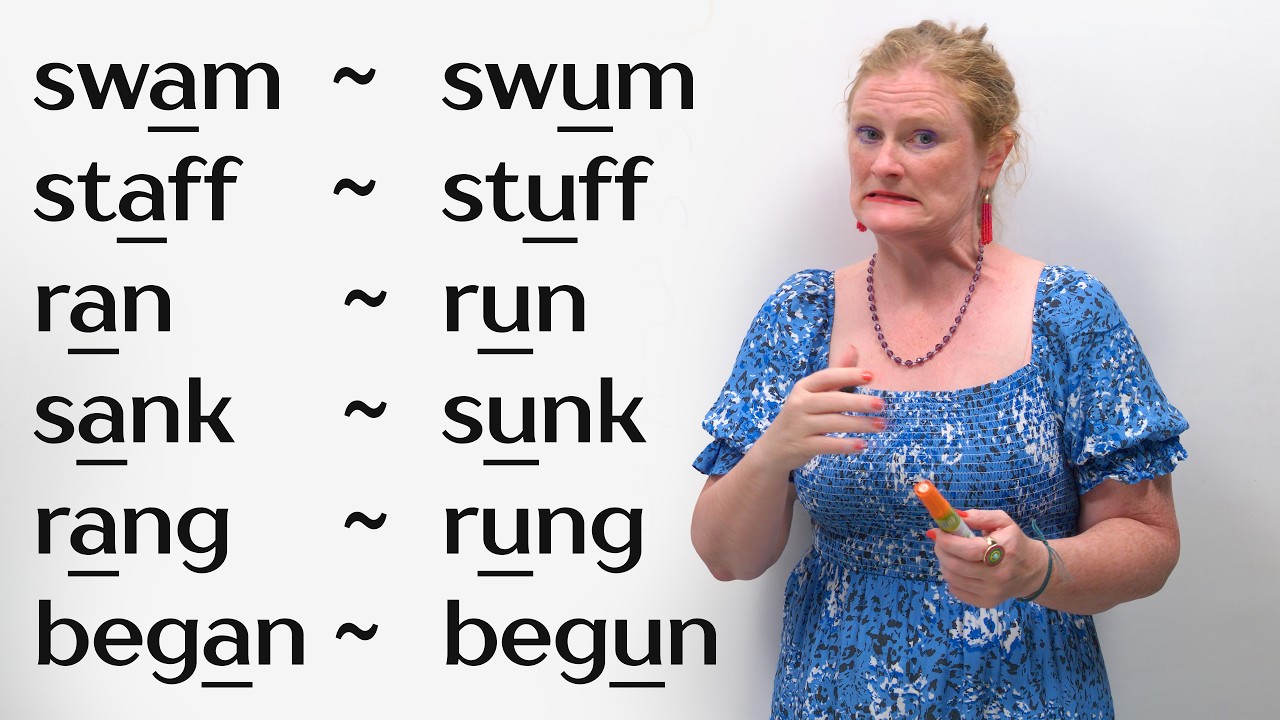
The “ah” and “uh” vowel sounds in English sound similar, but mixing them up can completely change your meaning. I will show you the difference between the “ah” sound and the “uh” sound in English, and how important this small vowel difference can be. We will look at common minimal pairs like swam/swum, sang/sung, ran/run, staff/stuff, and more. I explain how to open your mouth for the “ah” sound (like at the dentist!) and how the “uh” sound comes more from the throat. Listen to me and then practice with me. Let’s fix this vowel problem once and for all. https://www.engvid.com/ah-or-uh-10-co...
Need more help? Sign up for tutoring on my website! https://www.englishwithronnie.com
More of my English pronunciation videos:
Say & Spell "-CH" and "-TCH" • Learn English: Say & spell -CH and -TCH wo...
The Silent "U" • English Pronunciation & Spelling: Silent ‘...
In this lesson:
0:00 "Ah" & "uh" sounds in English
4:00 Pronouncing verbs correctly
4:20 How these words sound
10:22 Pronunciation practice
Transcript:
Yeah, yeah. It's Ronnie, back with another pronunciation lesson. Do you know what? I finally pronounced pronunciation properly. I'm so proud of myself. 15 years later. Okay. This lesson is... Miriam, this is for you because you're awesome, and thank you. Here we go. Differences between the "ah" in English and the "uh" sound in English. I don't know why English is so hard. I'm sorry. I didn't make the rules; just got to teach them to you. But this is a very complicated kind of pronunciation with... Because of the stupid vowel.
So, if you guys are down with the phonetic mystery of the alphabet, the "a" and the "e" together makes, like, a "uh" sound. As I say, open your mouth like you're at the dentist. So when you want to say this word, you say "st-a-th", okay? So, if I was going to make my own phonetic alphabet, which I probably will, I would make this a big-a— "a". So you would say "st-a-th". Easier than an "a" in any... Yeah, I was like, this is an upside-down "v" and it symbolizes a "uh" sound, maybe because it's like "uh". I would... My phonetic alphabet would be like "uh", like this, because why would you put an upside-down "v"?
Anyways, here we go. "Ah", "uh". Think of the position of your head. "Ah", your mouth is open, and "uh", it comes more from your throat. You're at the dentist, "ah". You know when you're at the dentist and you... You want to swallow, but you can't because there's 10,000 things in your mouth. So you're like... You're breathing out. One is a "ah", breathing in, and "uh" is a breathing out technique. We're doing yoga now. This is awesome. So, first word, "staff". "Staff". You're opening your mouth like you're at the dentist. "Staff". Next word is "stuff". "Stuff". It's kind of like you're dumb. "Do you like stuff? I like stuff."
But there is another point to this lesson, and it's a trick of wonderfulness. The importance of pronunciation... Of course, you know you don't want to be embarrassed by saying the wrong word at the wrong time, but there's something really special about these words that I've written on the board. Have a look at them. I'm going to give you 2.3 seconds. That's it. Done. I want you to tell me what kind of words these are. Are these nouns, verbs, adjectives, or adverbs? If you chose the answer of... Verbs, you're correct. It's super important in English when you are pronouncing the verbs that you make sure you're saying them in the past tense if you're speaking about the past. And this is one of the biggest problems that I encounter with my private students, is "You guys are great speakers. Oh my god, you can talk so well." But when it comes to using the past tense properly, I don't know what happens with the verbs, especially the negatives, but I can help you with this. If you want to take private lessons with me, www.englishwithronnie.com, I'll hook you up. We're going to have so much fun. But let's get to this lesson first.
So, these are all verbs, past tense, present tense. You can confuse people if you're speaking like, "Yesterday, I did this." But you use the present tense, you're like, "I'm so confused. Did they mean they did it already, or is it yesterday?" So, be clear. "Began" means to start. "I began learning English with Ronnie yesterday." Past participle, "begun". This is the "a" and this is the "uh". "Began", "began", "begun", "un". This is the "un" sound. You're breathing out, okay? "Began", "begun". You try. Good. "Swam", past tense of "swim", "swam". Past participle, "swum". "Swam", "swum". Do you know what verb this is in the present tense? The past tense is "sang". Oh, "sang", "sang", "sang", "sang". And the past participle is "sung", like Alfred's song. Hi, Alfred. What's up? Yeah, the present tense is "sing". So, we have "sing", "sang", "ung". The clue to the "ung" sound is you've really got to make it breathing out, "ung", "ung", "sung". And this can be tricky, too. I put these in on purpose. […]
Повторяем попытку...
Доступные форматы для скачивания:
Скачать видео
-
Информация по загрузке: