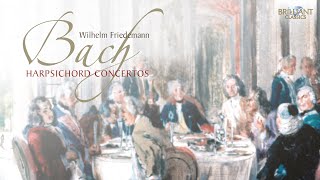
Johann Philipp Kirnberger (1721-1783) - Concerto per il Cembalo Obligato (c.1770)
Автор: Pau NG
Загружено: 2022-04-25
Просмотров: 14844
Описание:
Alles Gute zum Geburtstag Johann Philipp Kirnberger! 🎹🍷
Composer: Johann Philipp Kirnberger (1721-1783)
Work: Concerto (c-moll) per il Cembalo Obligato (c.1770) previously attributed to Johann Sebastian Bach
Performers: Luciano Sgrіzzі (1910-1994, cembalo); Orchestre Jeаn-Frаnçois Pаllаrd
Painting: Johann Heinrich Tischbein (1722-1789) - Herzog Karl I. und Herzogin Philippine Charlotte von Braunschweig-Wolfenbüttel mit Familie (1762)
Image in high resolution: https://flic.kr/p/2jJmt3P
Painting: Christoph Friedrich Reinhold Lisiewski (1725-1794) - Portrait of Johann Philipp Kirnberger
Image in high resolution: https://flic.kr/p/2ngspGu
Further info: https://www.amazon.com/Around-J-S-Bac...
Listen free: No available
---
Johann Philipp Kirnberger [Kernberg]
(Saalfeld, bap. 24 April 1721 - Berlin, 26 or 27 July 1783)
German theorist and composer. All information relating to his career before 1754 is based on F.W. Marpurg’s biographical sketch (1754), an autograph album described by Max Seiffert (1889) and comments found in letters Kirnberger wrote to J.N. Forkel in the late 1770s. He received his earliest training on the violin and harpsichord at home, and attended grammar school in Coburg and possibly Gotha. He studied the organ with J.P. Kellner in Gräfenroda before 1738, and then the violin with a musician named Meil and the organ with Heinrich Nikolaus Gerber in Sondershausen in 1738. According to Marpurg, Kirnberger went in 1739 to Leipzig, where he studied composition and performance with Bach for two years (the autograph book shows that he was in Sondershausen in 1740 and Leipzig in 1741, which does not preclude his period of study with Bach). In June 1741 Kirnberger travelled to Poland, where he spent the next ten years in the service of various Polish noblemen. He also held a position as music director at the Benedictine convent at Reusch-Lemberg. In 1751 Kirnberger returned to Germany apparently stopping at Coburg and Gotha before going to Dresden, where he studied the violin for a short time. He was then engaged by the Prussian royal chapel in Berlin as a violinist. By 1754 he had resigned that post and obtained permission to join the chapel of Prince Heinrich of Prussia, and in 1758 was given leave to enter the service of Princess Anna Amalia of Prussia, a position he retained to the end of his life. Kirnberger was among the most significant of a remarkable group of theorists, centred in Berlin, which included J.J. Quantz, C.P.E. Bach and Marpurg.
Almost without exception his contemporaries described him as emotional and ill-tempered, but dedicated to the highest musical standards. Criticized for being inflexible, conservative, tactless, and even pedantic, his detractors still acknowledged his devotion to his students and friends. These included his employer Princess Anna Amalia (whose famous library he helped to assemble), and such eminent musicians as C.P.E. Bach, J.F. Agricola, the Graun brothers, J.A.P. Schulz (his most important pupil) and the encyclopedist J.G. Sulzer, to whose Allgemeine Theorie der schönen Künste (1771-74) he contributed articles. Most accounts agree that he was a middling performer and that his compositions were correct if uninspired. Many are in a galant style similar to that of C.P.E. Bach; others are in the older ‘strict’ style in the manner of J.S. Bach, but in neither category does Kirnberger display the harmonic or melodic imagination of his models. Although his musical knowledge was wide and profound, it was, according to his contemporaries, disorganized. He found it so difficult to express his ideas in writing that he had to call on others to edit or even rewrite his theoretical works (Die wahren Grundsätze (1773), for example, was written by J.A.P. Schulz under Kirnberger’s supervision). Nonetheless, even his most severe critics, such as Marpurg, considered his theoretical and didactic works to be invaluable. Kirnberger regarded J.S. Bach as the supreme composer, performer and teacher. He regretted that Bach left no didactic or theoretical works and tried through his own teaching and writing to propagate ‘Bach’s method’. His devotion to this cause is reflected in 14 years’ intermittent effort to obtain the publication of all Bach’s four-part chorale settings.
Повторяем попытку...

Доступные форматы для скачивания:
Скачать видео
-
Информация по загрузке: