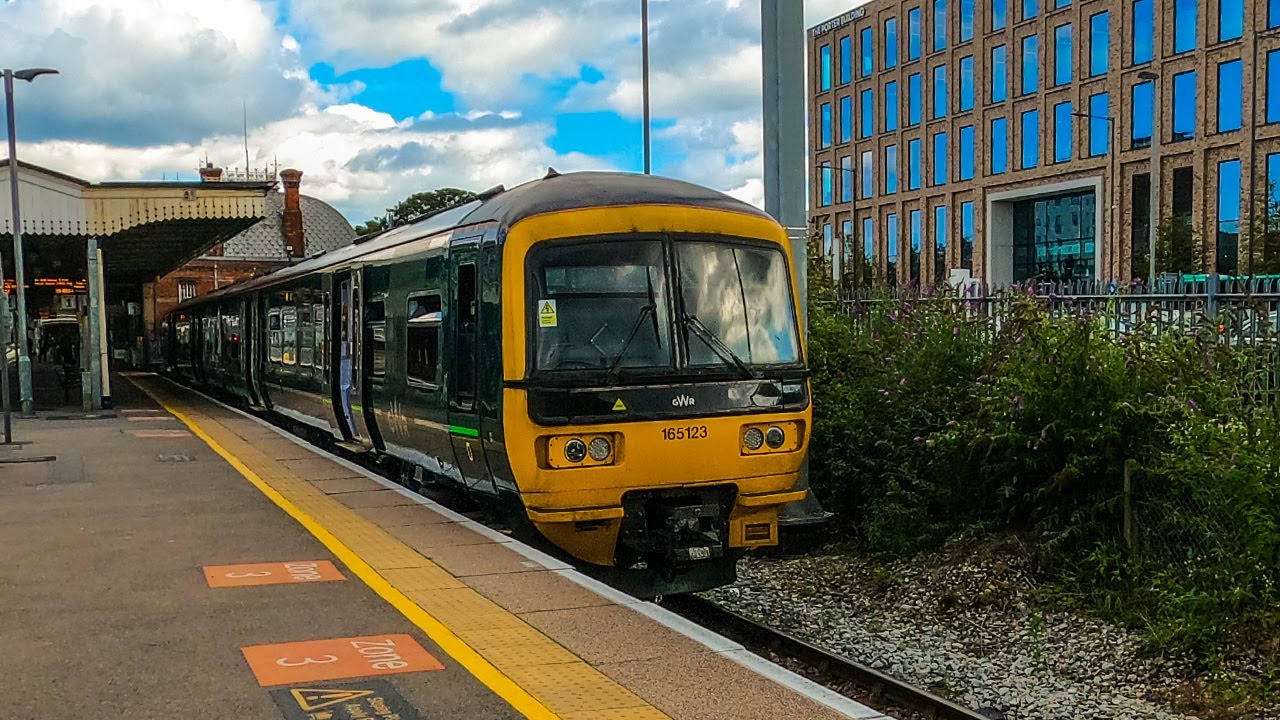
British Rail Class 165/1 Networker Turbos departing GWR train
Автор: Железнодорожное депо
Загружено: 2021-10-22
Просмотров: 1146
Описание:
The British Rail Class 165 Networker is a fleet of suburban diesel multiple-unit passenger trains (DMUs), originally specified by and built for the British Rail Thames and Chiltern Division of Network SouthEast. They were built by BREL York Works between 1990 and 1992. An express version was subsequently built in the form of the Class 166 Networker Turbo Express trains. Both classes are now sometimes referred to as "Networker Turbos", a name derived some three years later for the project that resulted in the visually similar Class 365 and Class 465 EMUs.
👉If you like it, please follow this channel❤️:
🎥Youtube: / @traindepot
Gear used GoPro Hero8: https://amzn.to/3w4YuSJ
The class is still in service, now operated by Great Western Railway and by Chiltern Railways. When operated originally by Network SouthEast, along with that operator's Class 166 trains, the Paddington suburban units were initially known as Thames Turbos, while the units operated on the Marylebone suburban network were known as Chiltern Turbos.
The Class 165/1 fleet were built for local services from London Paddington along the Great Western Main Line; their main destinations included local trains to Reading, Greenford, Newbury, Bedwyn, Oxford, and Banbury, and services along the branch lines to Windsor & Eton Central, Henley-on-Thames, Marlow and Bicester Town.
Following the privatisation of British Rail, the franchise was won by the Go-Ahead Group, who operated it as Thames Trains from 1996 to 2004 and inherited all the Class 165/1 Turbo trains as well as the first five Class 165/0 Turbo trains that had been transferred from the Chiltern lines. In April 2004, operation of the Thames Trains franchise passed to First Great Western Link. In 2004, due to deliveries of new Class 180 Adelante units on sister company First Great Western, the five Class 165/0 Turbo units became redundant and were transferred to Chiltern Railways.
In January 2010, First Great Western announced an £8 million refurbishment programme for its fleet of Classes 165 and 166 Turbo DMU trains:
seats re-trimmed
interiors repainted
Passenger Information Displays replaced with a GPS-based system
upgraded lavatory facilities
flooring stripped and replaced
In 2012, First Great Western took delivery of Class 180 Adelante units for Cotswold Line services, and three-car Class 150 Sprinter units for Reading to Basingstoke Line services, allowing Class 165 and 166 units to be used to reinforce Thames Valley services.
In late 2015, as part of the rebranding to GWR, the Class 165 fleet had all first-class sections removed to increase capacity.
Following the electrification of the Great Western Main Line up to Didcot Parkway, as well as the Reading-Taunton line as far as Newbury, services between London Paddington and Didcot Parkway, as well as between Reading and Newbury, have been operated by new Class 387 electric multiple units, allowing much of the existing Class 165 fleet to move to the Bristol area. Class 165s continue to service the aforementioned branch lines, but no longer run to London Paddington except during peak hours.
Bristol area
Following the transfer of the 166 units to St Philip's Marsh depot in July 2017, some of the 165 services have since followed on with the first 165 operating in the Bristol area in July 2018. Since then and alongside the 166s, they have rapidly been introduced on other services such as the Weston-super-Mare to Filton Abbey Wood / Bristol Parkway services, the Cardiff Central to Taunton services, the Golden Valley Line, the Heart of Wessex Line and also some services on the Wessex Main Line as far as Warminster and Southampton Central. In January 2019, they began operating the regional service between Cardiff Central and Portsmouth Harbour which allowed more of the Class 158 units that solely operated this service to move more west.
The transfer of the 165 (and 166) units to services in and around Bristol and Exeter have overall allowed units that previously operated these services to move further west, such as the Class 150 and Class 158 units. More so than the 166 units, a lot of the 165 units remain to be based at Reading TMD where they continue to operate Thames Valley services until they are replaced by Class 769 units. Once all of the units are replaced in this area, it is planned that they will all be refurbished internally with improved interiors that are better suited for the longer journeys they are doing now.
#BritishRailClass165 #Class165 #Networker
Повторяем попытку...
Доступные форматы для скачивания:
Скачать видео
-
Информация по загрузке:






![[Beast] Class 166 Networker Turbo leaving Guildford platform 4](https://image.4k-video.ru/id-video/oRjyiqCj1Fc)
