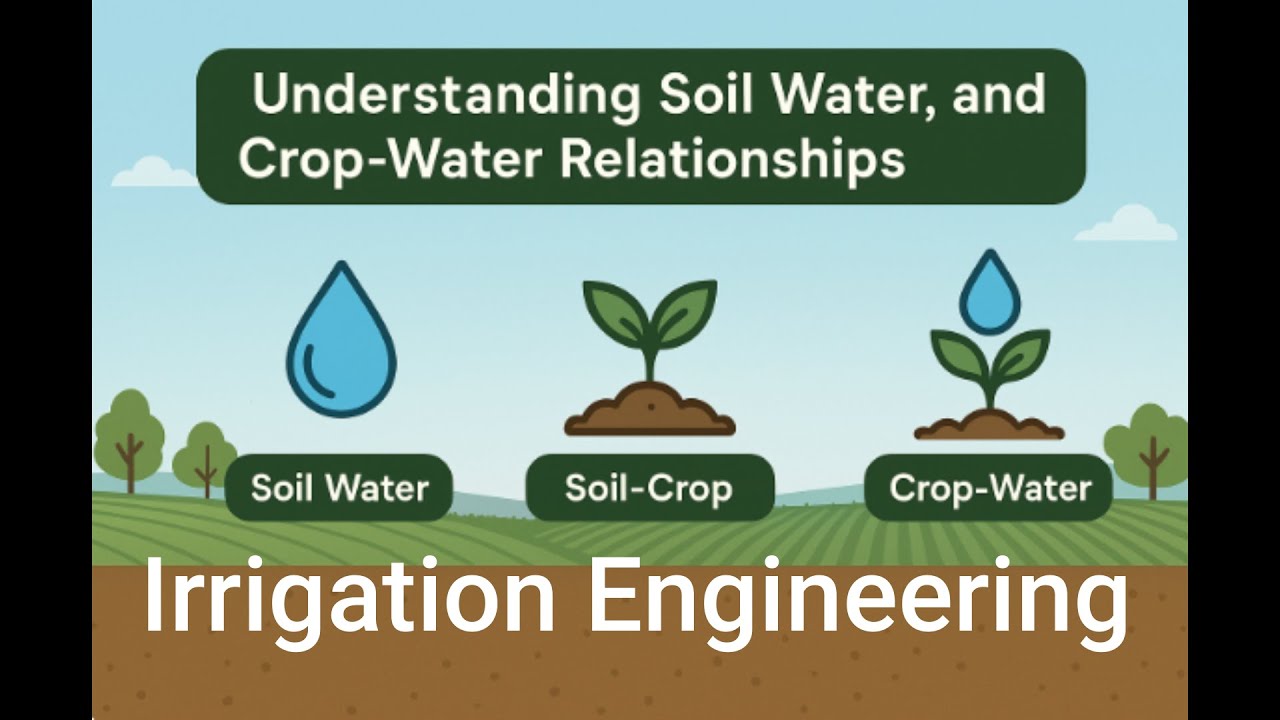
Understanding Soil water,and crop water relations
Автор: Engineer's India Solution
Загружено: 2025-04-12
Просмотров: 52
Описание:
Soil-water relations are crucial for understanding how water interacts with soil, which affects plant growth, irrigation strategies, and overall ecosystem health.
Key Concepts in Soil-Water Relations
Soil Water Composition:
Soil water exists within the soil above the water table and plays a critical role in supporting plant life. The moisture in the soil affects physical, chemical, and biological processes
2
.
Water Holding Capacity:
The ability of soil to retain water is influenced by soil texture (proportions of sand, silt, and clay) and structure (how soil particles aggregate). Clay-rich soils generally hold more water due to their fine texture and high surface area
2
.
Field Capacity: The amount of water soil can retain after excess water has drained. It is the water available for plant uptake and is typically at a tension of about -0.01 to -0.03 MPa
2
.
Permanent Wilting Point: The stage at which the soil moisture is so low that plants cannot extract it, occurring at a tension of about -1.5 MPa
1
.
Plant Available Water:
This is the water that plants can readily absorb and is calculated as the difference between field capacity and the wilting point. Soils with good structure and texture can maximize plant available water
2
.
Soil-Water Potential:
Soil water potential is a measure of the energy status of water in soil, influencing its movement. Water moves from areas of higher to lower potential, largely dictated by gravity, matric forces (adhesion), and osmotic forces
2
.
Water Movement in Soil:
Gravitational Water: Water that drains freely due to gravity, not readily available to plants.
Capillary Water: Water retained in soil pores that plants can use. The size of these pores (macro, meso, micro) determines how water is held and released within the soil matrix
2
.
6 Sources
Practical Implications for Agriculture
Understanding these relationships is essential for effective water management in agriculture. For instance, knowing the water holding capacity can inform irrigation practices to prevent over or under-watering
2
.
Farmers need to monitor soil moisture levels accurately to manage crops effectively. Tools such as tensiometers can aid in this process by measuring the soil water potential and indicating when irrigation is necessary
1
.
3 Sources
Conclusion
Soil-water relations encompass a range of factors that determine how water interacts with soil environments, significantly influencing agricultural outcomes and ecosystem sustainability. By understanding these dynamics, farmers can make informed decisions regarding crop management, irrigation practices, and soil conservation strategies.
Повторяем попытку...
Доступные форматы для скачивания:
Скачать видео
-
Информация по загрузке: