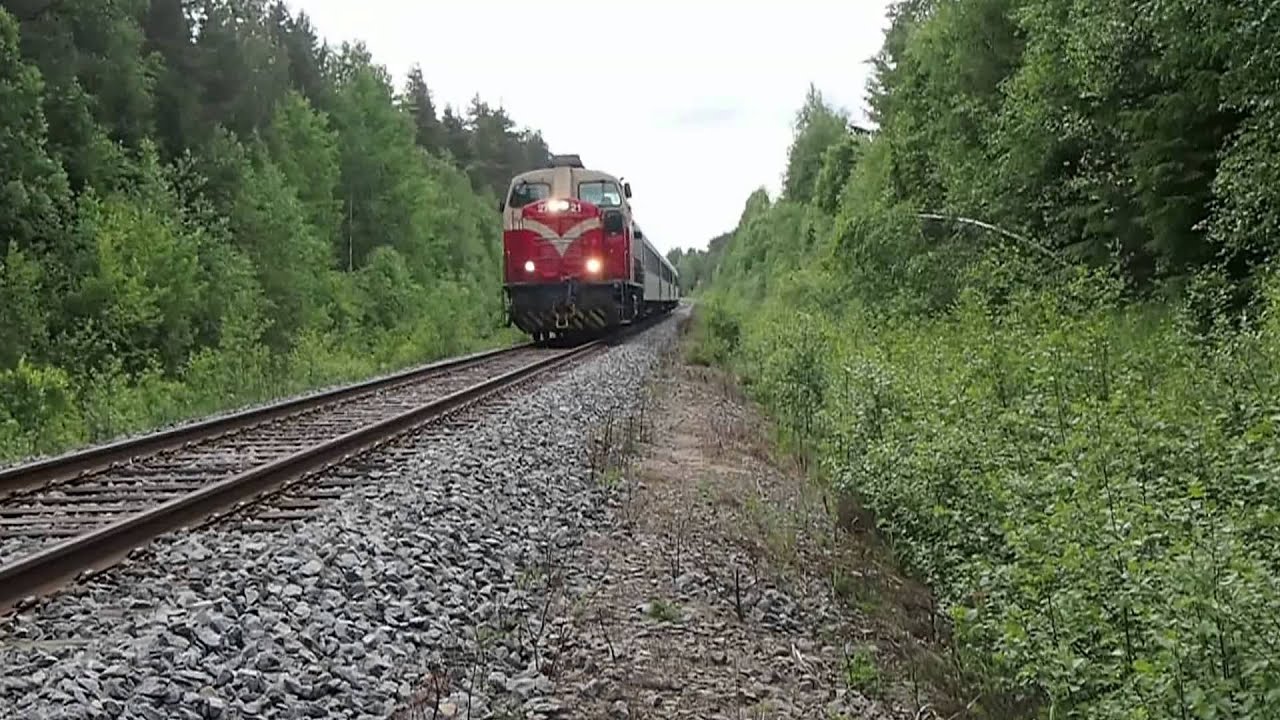
Finland: 2x VR Class Dv12 locomotives on passenger service H443 at Seinajoki & Vassa (Ostrobothnia)
Автор: FrontCompVids
Загружено: 2013-07-11
Просмотров: 5222
Описание:
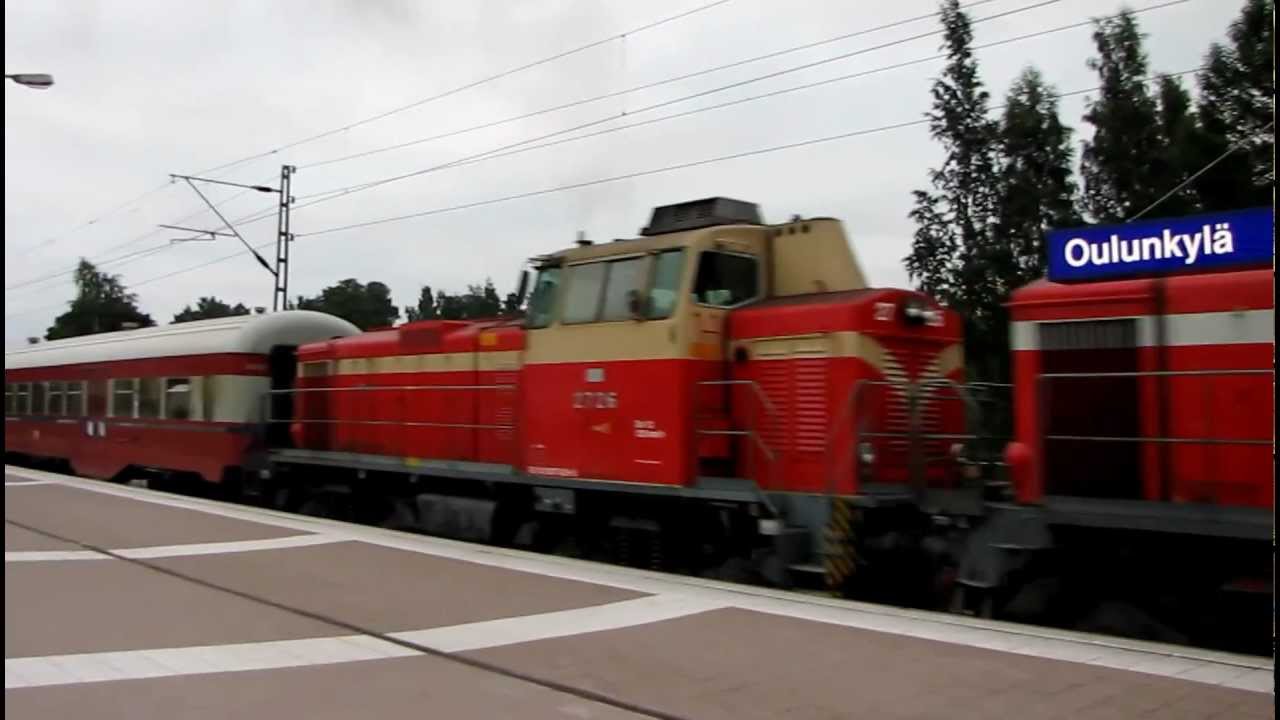
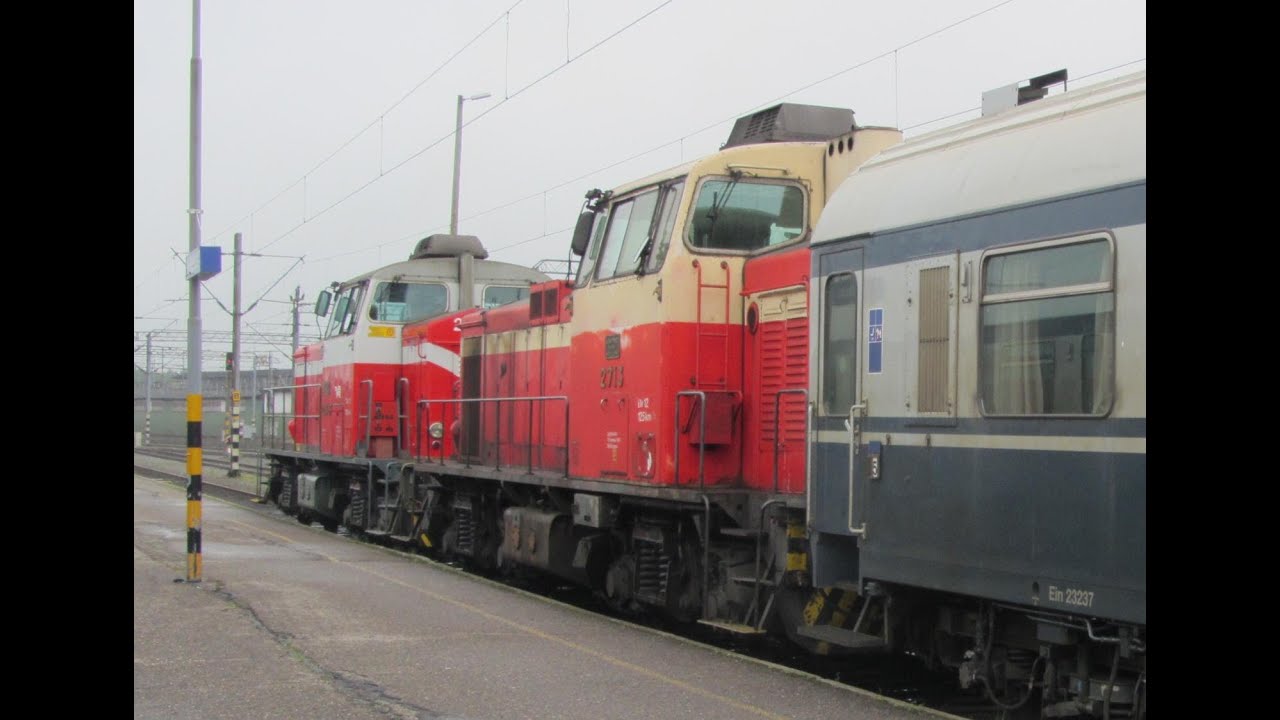
Finland: 2x VR Class Dv12 locomotives on passenger service H443 at Seinajoki & Vassa (Ostrobothnia).
Clips recorded on Sunday 30th June 2013, locomotive numbers are 2543 & 2713.
Clip1 - Ahead of departure at Seinajoki
Clip2 - Onboard during journey from Seinajoki to Vassa
Clip3 - Running round stock after arrival at Vassa
Clip4 - Running round stock after arrival at Vassa
Clip5 - Rear facing view departing Vassa on the return to Seinajoki behind 2713 (solo).
-+-+-+-+-+-+-+-+-+-+-+-+-+-+-+-+-+-+-+-+
The Dv12 (Sv12 and Sr12 until 1977) is the standard Finnish medium-weight diesel-hydraulic road locomotive operated by VR. As all the main lines of Finnish railway network have been electrificied, the locomotive is designated mostly to unelectrified, less frequently used side lines. Occasionally it may still pull cargo trains on main lines. It has also been put in service as a shunter, replacing older classes Dv15 and Dv16 as they were retired. A total of 192 locomotives were built by Lokomo and Valmet between the years 1963 and 1984. As of 2011, the oldest Dv12 units are 48 years old.
The Dv12 is a general purpose locomotive which was designed for both passenger and cargo train use. Its 1000 kW power is somewhat low by current standards, but it is capable of multiple-unit operation with only one train crew and doublets and triplets are common. It has a low axle load of 15.6 tonnes, which makes it very well suited for branch lines that allow only smaller axle loads. All the axles are interconnected with shafts and universal joints to the Voith L 216 rs hydraulic transmission. Because all axles must rotate at the same speed, the individual slipping of axles is impossible. This translates into a very good tractive effort for a 62 tonne locomotive. The main engine is a Finnish-built Tampella SACM MGO V16 BSHR Diesel with two Brown Boveri-VTR 200 M turbochargers.
The Dv12 has two speed ranges, 85 km/h (53 mph) for cargo use and 125 km/h (78 mph) for passenger use. This mechanical gear can only be switched with the locomotive at standstill.
-+-+-+-+-+-+-+-+-+-+-+-+-+-+-+-+-+-+-+-+
Seinäjoki is a city located in Southern Ostrobothnia, Finland. Seinäjoki originated around the Östermyra bruk iron and gunpowder factories founded in 1798. Seinäjoki became a municipality in 1868, market town in 1931 and town in 1960. In the beginning of 2009, the neighbouring municipalities of Nurmo and Ylistaro were consolidated with Seinäjoki.
The Town library, Lakeuden Risti church and central administrative buildings are designed by Alvar Aalto.
The asteroid 1521 Seinäjoki bears the town's name.
Seinäjoki was historically called Östermyra in Swedish. Today this name is very seldom used even among the Swedish speakers. Literal translation for Seinäjoki is "Wallriver".
There are many kinds of cultural events in Seinäjoki nowadays. For example, Seinäjoki is known for hosting three large summer events: Tangomarkkinat, which is a tango festival attracting more than 100,000 visitors annually, Vauhtiajot, which is a motor racing event/music festival, and Provinssirock, which is one of the largest and oldest rock festivals in Finland.
-+-+-+-+-+-+-+-+-+-+-+-+-+-+-+-+-+-+-+-+
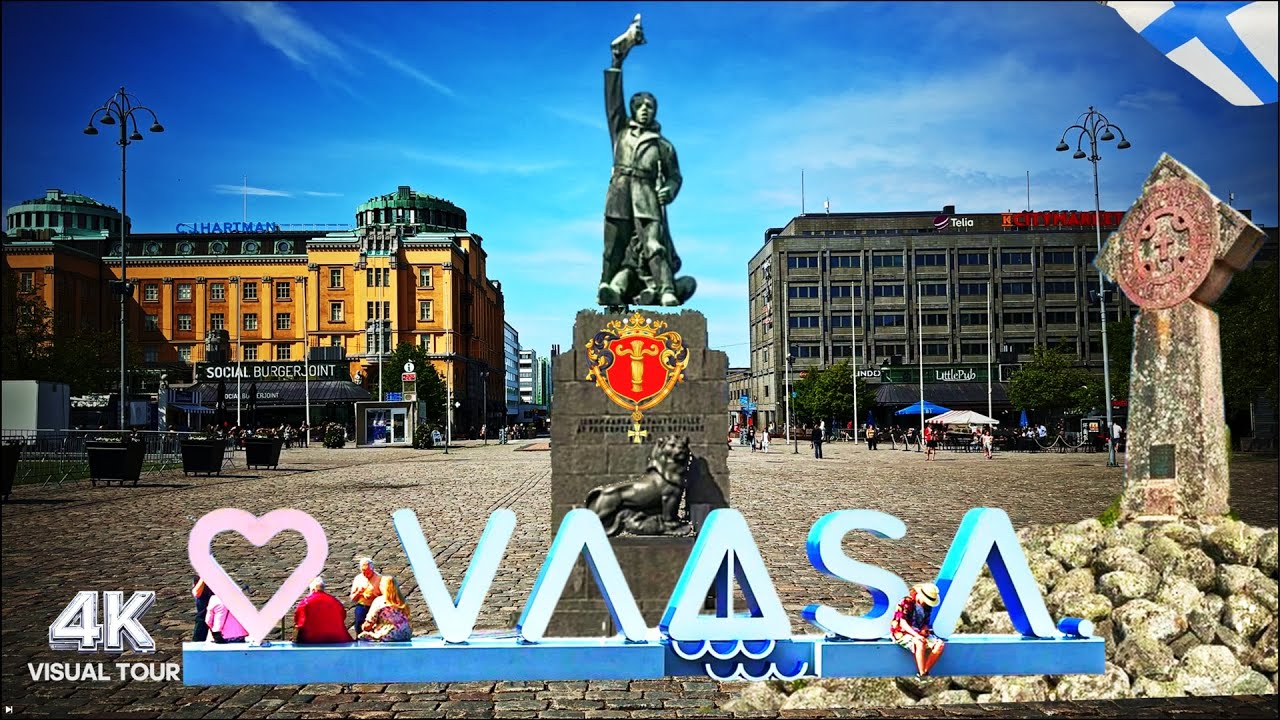
Vaasa (Swedish: Vasa) is a city on the west coast of Finland. It received its charter in 1606, during the reign of Charles IX of Sweden and is named after the Royal House of Vasa. Today, Vaasa has a population of 65,768 (28 February 2013) [2] (approximately 90,000 in the Vaasa sub-region), and is the regional capital of Ostrobothnia (Swedish: Österbotten, Finnish: Pohjanmaa).
The city is bilingual with 69.8% of the population speaking Finnish as their first language and 24.8% speaking Swedish,[3] but the surrounding municipalities have much higher rates of Swedish-speakers than that. These circumstances make the region as well as the city an important centre for Finland-Swedish culture.
The mainly wooden and densely built town was almost utterly destroyed in 1852. A fire started in a barn belonging to district court judge J.F. Aurén on the morning of August 3. At noon the whole town was ablaze and the fire lasted for many hours. By evening, most of the town had burned to the ground. Out of 379 buildings only 24 privately owned buildings had survived, among them the Falander--Wasastjerna patrician house (built in 1780--1781) which now houses the Old Vaasa Museum.
Vaasa has three universities. The largest one is the University of Vaasa, which is located in the neighbourhood of Palosaari. Palosaari is a peninsula near the center of Vaasa, connected to it by bridges. The other two universities are Åbo Akademi, headquartered in Turku, and the Swedish School of Economics and Business Administration, or Hanken, headquartered in Helsinki.
-+-+-+-+-+-+-+-+-+-+-+-+-+-+-+-+-+-+-+-+
More FrontCompVidsclips are regularly added to so don't forget to Like and Subscribe!
Click / frontcompvids for more details :-)
Повторяем попытку...
Доступные форматы для скачивания:
Скачать видео
-
Информация по загрузке: