The Toll of the Sea (1922)
Автор: UCLA Film & Television Archive
Загружено: 2025-09-29
Просмотров: 6845
Описание:
The Toll of the Sea (1922)
Director: Chester M. Franklin. Screenwriter: Frances Marion. With: Anna May Wong, Kenneth Harlan, Beatrice Bentley, Priscilla Moran, Etta Lee. New music score: Martin Marks, piano.
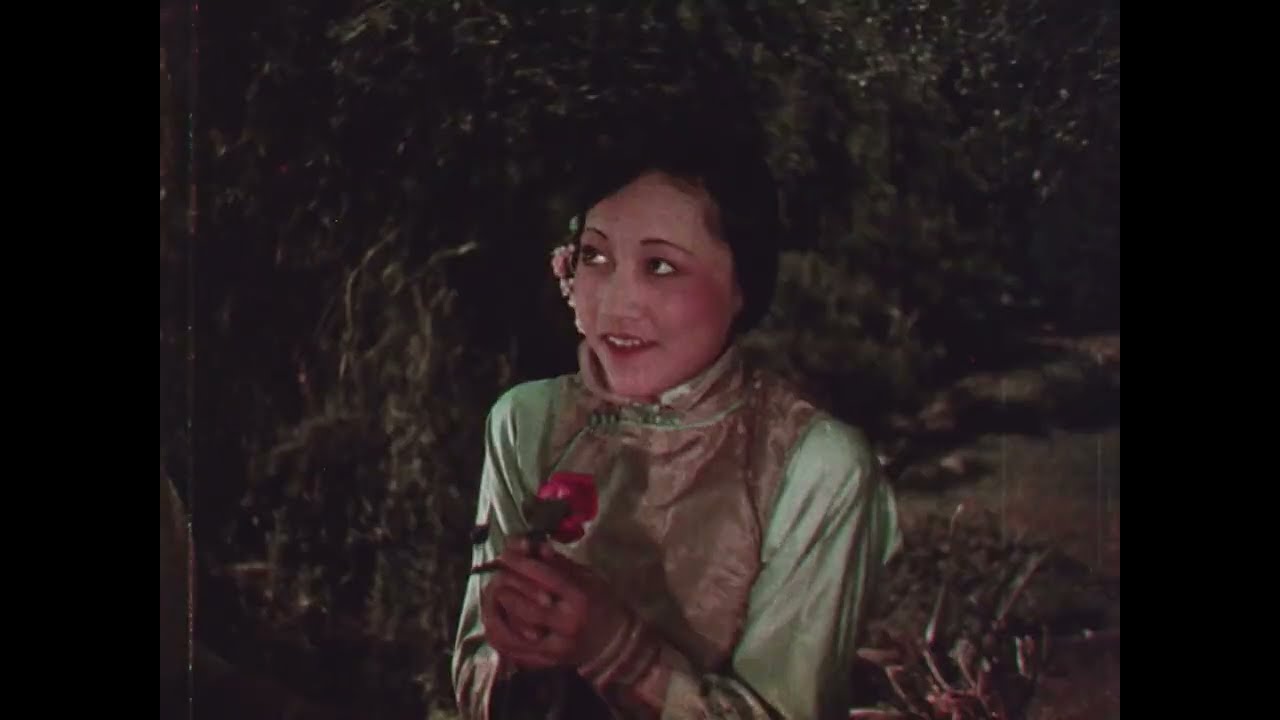
"'The Toll of the Sea' is one of the great technical achievements of film preservation. This earliest surviving feature in the two-color Technicolor process was restored by UCLA Film & Television Archive from a rare camera negative. (Most silent films survive only through copies from projection prints.) Also surviving at the Library of Congress is the film’s 1922 music score (discussed below), accompanying the film here for the first time since its original release.
Color was part of movie exhibition from the earliest days, when a few films were colored by hand. By the 1920s, more than 80 percent of U.S. feature films were artificially colored by less labor-intensive processes that added uniform tints to certain sequences.
The Technicolor Motion Picture Corporation was the most successful early company to take a more sophisticated approach. Through complex optical engineering, its cameras captured natural colors during filming. 'The Toll of the Sea' was the company’s first feature using a process that produced color prints for standard projectors. The camera’s beam-splitting prism separated the green and red portions of the spectrum, recorded on alternate frames of a double-length, black-and-white negative. For each release print, two thin strips of film were dyed the correct colors and cemented back-to-back. The limitations included the loss of the blue scale (incorporated after 1932 into Technicolor’s three-color system). Exhibitors complained that the sandwiched prints tended to buckle and go out of focus. Nevertheless, for 1922 it was a remarkable color process.
For all its technical virtuosity, 'The Toll of the Sea' is hampered by its scenario, by Frances Marion, then Hollywood’s highest-paid writer. In fairness, she was working under the requirement that the story first show off the color process. (The colorful Far East was created in Santa Monica and Hollywood.) 'The only person, in fact, who seems to have had anything against the picture is the title writer,' complained the New York Times about intertitles that spell out emotions conveyed with more complexity by the actors. About her 'original' story Marion acknowledged, 'I must admit that it was practically the step-daughter of Madame Butterfly.'
The exotic orientalism of Madame Butterfly’s Japan migrated to China for 'The Toll of the Sea.' [...] 'The Toll of the Sea' pares down to essentials the story as popularized on the stage by Belasco and elevated to operatic tragedy by Puccini: An American man marries a young Asian but leaves her for a woman of his own race back in the United States. After he learns of his mixed-race son, his understanding white wife urges adoption. In an act of self-sacrifice, the Asian woman kills herself for her child’s future. (The problematic mixed-race adoption is evaded in 'The Toll of the Sea' by making the son appear wholly Caucasian.)
In outline, there are few uglier tales of the (male) West exploiting (female) Asia. But, as in so many melodramas about a woman’s sacrifice for family love—of the sort once labeled 'women’s weepies'—the performance of the actress can elevate the Madame Butterfly tale into a critique of Western cultural assumptions and male sexual prerogatives.
[...]
The hackneyed story and the technical need for intense lighting make the subtle performance of Anna May Wong all the more remarkable. Motion Picture News noted that the heroine was played 'by a real Chinese girl,' as opposed to the usual casting of whites for lead Asian roles. Born in Los Angeles’s Chinatown, Anna May Wong was just seventeen in this first starring part. 'She never repels one by an excess of theatrical feeling,’ said the New York Times. 'She has a difficult role, a role that is botched nine times out of ten, but hers is the tenth performance. Completely unselfconscious of the camera, with a fine sense of proportion and remarkable pantomimic accuracy, she makes the deserted little Lotus Flower a genuinely appealing, understandable figure. She should be seen again and often on screen.' This prophecy was fulfilled even though substantial roles for Chinese Americans were scarce in Hollywood. Anna May Wong found success also in British and German films. In her most celebrated American sound film, Josef von Sternberg’s 'Shanghai Express '(1932), she is refreshingly unself-sacrificing."—Scott Simmon (source: https://www.filmpreservation.org/pres...)
Restored by the UCLA Film & Television Archive from the original 35mm nitrate two-color Technicolor camera negative. Restoration by Richard Dayton and Pete Comandini (YCM Laboratories) and Robert Gitt. Funding provided by the AFI/NEA Film Preservation Program.
Special thanks to the National Film Preservation Foundation.
Повторяем попытку...
Доступные форматы для скачивания:
Скачать видео
-
Информация по загрузке: