Crossing Continents: Ancient Lizard and Snake Dispersal on a Dynamic Planet
Автор: Royal Tyrrell Museum of Palaeontology
Загружено: 2026-03-05
Просмотров: 501
Описание:
Presented by Dr. Ian V. Wilenzik, George Washington University, February 12, 2026.
Determining where groups of organisms originated is an active area of research in evolutionary biology. Methods have been developed to identify where a group first appears and to understand how said group spread across the planet over time. Fossils are a critical source of information for this work, as they provide the only direct evidence of where extinct species once lived. This is especially true for large, ancient, and widely dispersed clades. Utilizing the group that includes lizards and snakes, Dr. Ian V. Wilenzik explores different methods for determining the geographic origin of a group. The first approach uses fossils as a source of geographic data. This method suggests that lizards and snakes originated in Eurasia, with dispersal south only occurring about 100 million years after their initial evolution. However, this approach does not account for the evolutionary history of the fossils or the variable positions of the continents over geological time. The second approach uses fossils as a source of geographic and evolutionary information, with variables that account for continental movement. Using this more comprehensive method, Dr. Wilenzik finds that lizards and snakes originate more specifically in northeastern Asia. Building on these results, he examined the formation of the geographic connection between North American and Asia (between 100 and 65 million years ago). Preliminary results indicate a major migration from Asia to North America amongst several independent groups. However, very few groups migrate from North America to Asia. The cause of this asymmetrical dispersal remained unclear, highlighting an important direction for further research.
Please see the below references for uncited figures in the presentation:
Slide 3: Biogeographic map from Encyclopaedia Britannica.
Slide 4: Gondwana species from the US Geological Survey (public domain).
Slide 10: Biogeographic reconstruction of camels from Wilson & Brainard. Biogeography, CK-12 Foundation 2026.
Slide 12: Figure 1 from Crisp et al., 2011.
Slide 13: Pictures of squamates by MathKnight under Creative Commons Attribution-Share Alike 4.0 International license.
Slide 14: Images of squamates from Max Seldes, used with permission.
Slide 17: Image of a mosasaur by MCDinosaurhunter under Creative Commons Attribution-Share Alike 3.0 Unported license.
Slide 17: Image of a polyglyphanodontian By Johnathan Chen under Creative Commons Attribution-Share Alike 4.0 International license.
Slide 17: Image of a paramacellodid from Evans and Chure 1998.
Slide 25: Phylogeny from Berkeley University of California. Understanding Evolution: Evolution 101. Creative Commons Attribution-NonCommercial-Share Alike 4.0 license. © UC Museum of Paleontology Understanding Evolution, www.understandingevolution.org.
Slide 25: Biogeographic map from Holt et al., 2012.
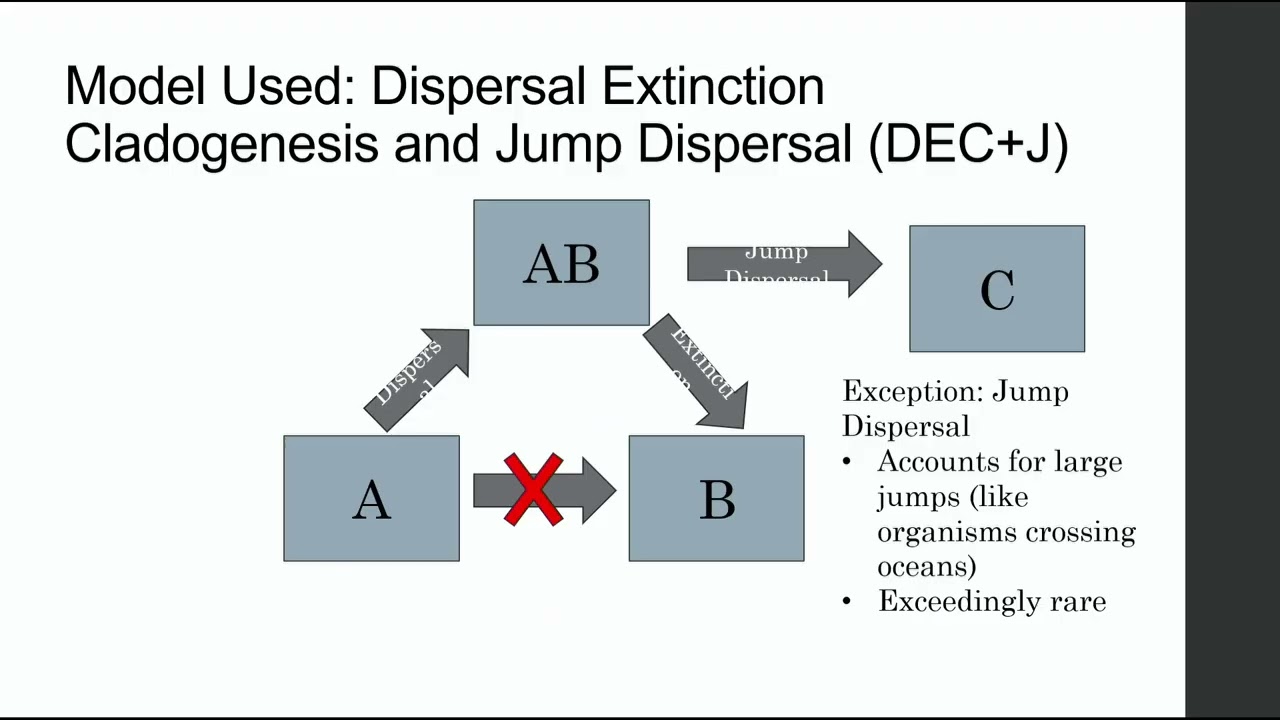
Slide 25: Model description of DEC+J by Landis and Swiston, 2024, Introduction to phylogenetic biogeography with the DEC model.
Slide 25: Biogeographic reconstruction from Ghanealmeleh et al., 2021.
Slide 52–55: Image of the Triassic from the Encyclopedia of Physical Science and Technology (Third Edition), 2003.
Slide 60: Biogeographic map from Landis, 2017.
Slide 89: Map of Cretaceous Laurasia from Sanmartin et al., 2001.
Slide 95: Image of a pachycephalosaur by IJReid under Creative Commons Attribution-Share Alike 4.0 International license.
Slide 98: Figure from Dalman et al., 2024.
Slide 101–102: Image of Great American Interchange by Woudloper under Creative Commons Attribution-Share Alike 1.0 Generic license.
Slide 104–105: Image from Sampson et al., 2010.
Slide 107: Image of Hutchinson’s ratio by Jbadcock under Creative Commons Attribution-Share Alike 4.0 license.
Повторяем попытку...
Доступные форматы для скачивания:
Скачать видео
-
Информация по загрузке: