ycliper

Популярное

Музыка Кино и Анимация Автомобили Животные Спорт Путешествия Игры Юмор

Интересные видео

2025 Сериалы Трейлеры Новости Как сделать Видеоуроки Diy своими руками

Топ запросов

смотреть а4 schoolboy runaway турецкий сериал смотреть мультфильмы эдисон
Скачать

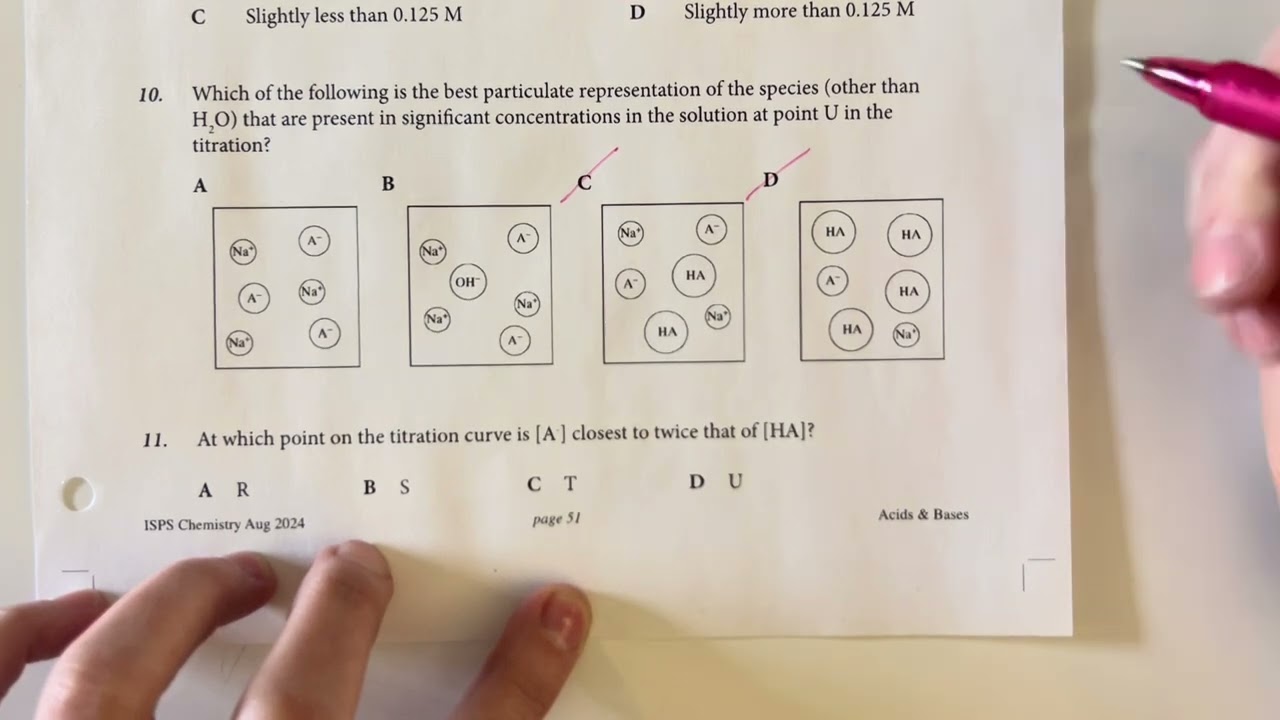
AP Chemistry Unit 8.5 Practice Problems - Acid-Base Titrations

Автор: Christine McKenna

Загружено: 2025-02-21

Просмотров: 1574

Описание: Explain results from the titration of a mono- or polyprotic acid or base solution, in relation to the properties of the solution and its components.
An acid-base reaction can be carried out under controlled conditions in a titration. A titration curve, plotting pH against the volume of titrant added, is useful for summarizing results from a titration.
At the equivalence point for titrations of monoprotic acids or bases, the number of moles of titrant added is equal to the number of moles of analyte originally present. This relationship can be used to obtain the concentration of the analyte. This is the case for titrations of strong acids/bases and weak acids/bases.
For titrations of weak acids/bases, it is useful to consider the point halfway to the equivalence point, that is, the half-equivalence point. At this point, there are equal concentrations of each species in the conjugate acid-base pair,
for example, for a weak acid [HA] = [A-].
Because pH = pK, when the conjugate acid
and base have equal concentrations, the pK. can be determined from the pH at the half-equivalence point in a titration.
At the equivalence point, pH is determined by the major species in solution. Strong acid and strong base titrations result in neutral pH at the equivalence point. However, in titrations of weak acids (weak bases), the conjugate base of the weak acid (conjugate acid of the weak base) is present at the equivalence point and can undergo proton-transfer reactions with the surrounding water, producing basic (acidic) solutions.
For polyprotic acids, titration curves can be used to determine the number of acidic protons. In doing so, the major species present at any point along the curve can be identified, along with the pK associated with each proton in a weak polyprotic acid.

Find question packet here -
https://drive.google.com/file/d/1Buch...

Не удается загрузить Youtube-плеер. Проверьте блокировку Youtube в вашей сети.
Повторяем попытку...
AP Chemistry Unit 8.5 Practice Problems - Acid-Base Titrations

Поделиться в:

Доступные форматы для скачивания:

Скачать видео

  • Информация по загрузке:

Скачать аудио

Похожие видео

AP Chemistry Unit 8.4 Practice Problems - Acid-Base Reactions and Buffers Part 2

AP Chemistry Unit 8.4 Practice Problems - Acid-Base Reactions and Buffers Part 2

Titration Curves Explained: Strong vs Weak Acid-Base Reactions (17.2) | General Chemistry

Titration Curves Explained: Strong vs Weak Acid-Base Reactions (17.2) | General Chemistry

DEE20143-SEMICONDUCTOR DEVICES (GSA 1)

DEE20143-SEMICONDUCTOR DEVICES (GSA 1)

AP Chemistry Unit 8.8 Practice Problems - Properties of Buffers

AP Chemistry Unit 8.8 Practice Problems - Properties of Buffers

Buffer Solutions

Buffer Solutions

Weak Acid / Strong Base Titration - All pH Calculations

Weak Acid / Strong Base Titration - All pH Calculations

The Hairy Ball Theorem

The Hairy Ball Theorem

Acid Base Titration Curves - pH Calculations

Acid Base Titration Curves - pH Calculations

AP Chemistry 8.5 - Acid Base Titrations

AP Chemistry 8.5 - Acid Base Titrations

Acid-Base Titrations - What You Should Know - AP Chem Unit 8, Topic 5a

Acid-Base Titrations - What You Should Know - AP Chem Unit 8, Topic 5a

4 Hours Chopin for Studying, Concentration & Relaxation

4 Hours Chopin for Studying, Concentration & Relaxation

We still don't understand magnetism

We still don't understand magnetism

Кислотно-основные реакции и расчёт pH — AP Chem Unit 8, Тема 4

Кислотно-основные реакции и расчёт pH — AP Chem Unit 8, Тема 4

Dissolving $1000 of Platinum to Make $6000 of Chloroplatinic Acid for Professional Use

Dissolving $1000 of Platinum to Make $6000 of Chloroplatinic Acid for Professional Use

Unit 8.5 - Acid-Base Titrations

Unit 8.5 - Acid-Base Titrations

Polyprotic Acid Base Equilibria Problems, pH Calculations Given Ka1, Ka2 & Ka3 - Ice Tables

Polyprotic Acid Base Equilibria Problems, pH Calculations Given Ka1, Ka2 & Ka3 - Ice Tables

Титрование полипротонных кислот

Титрование полипротонных кислот

Выходная головоломка Пошевели извилинами

Выходная головоломка Пошевели извилинами

Бактериальная генетика

Бактериальная генетика

LLM и GPT - как работают большие языковые модели? Визуальное введение в трансформеры

LLM и GPT - как работают большие языковые модели? Визуальное введение в трансформеры

© 2025 ycliper. Все права защищены.


  • Контакты
  • О нас
  • Политика конфиденциальности


Контакты для правообладателей: [email protected]