DDPS | Efficient nonlinear manifold reduced order model
Автор: Inside Livermore Lab
Загружено: 2021-02-04
Просмотров: 1655
Описание:
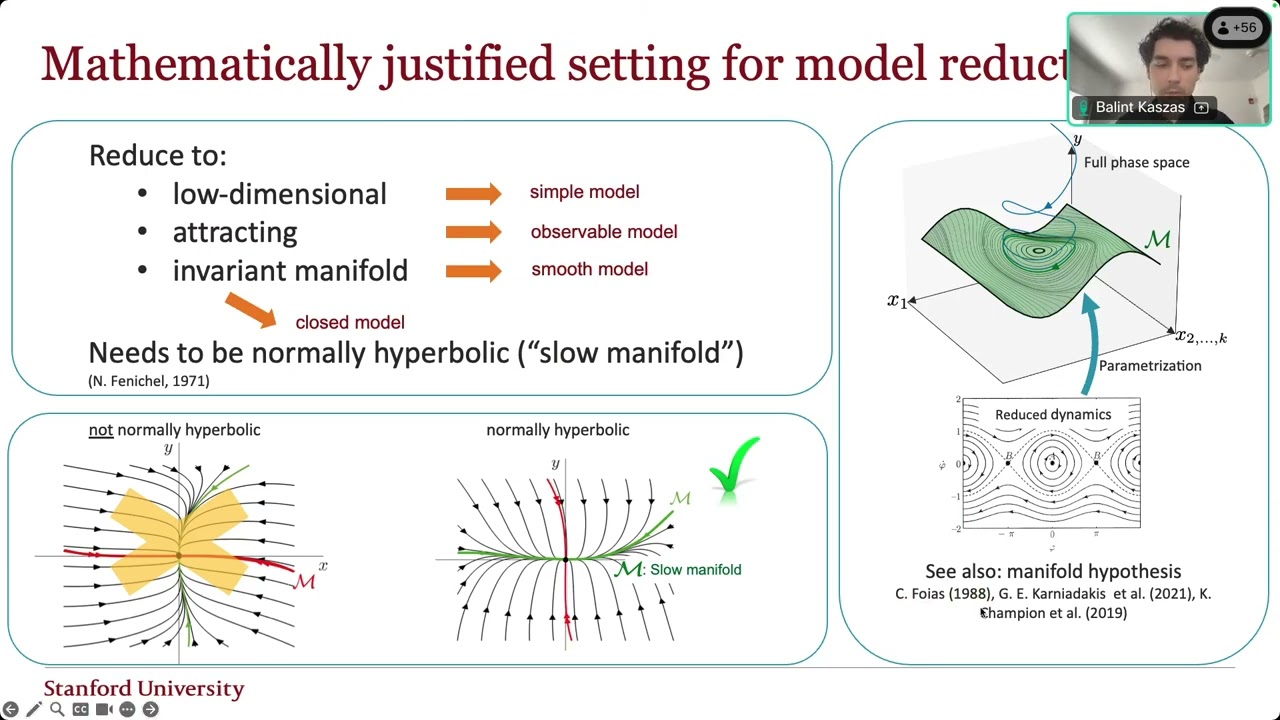
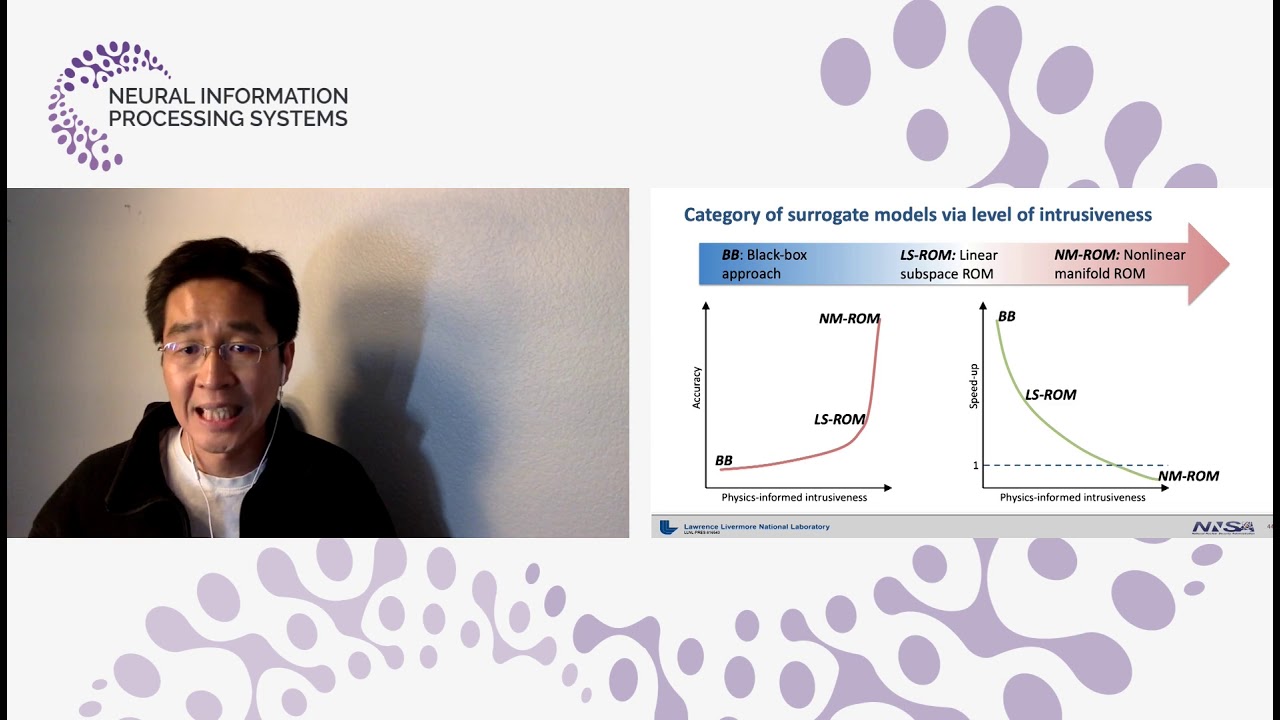
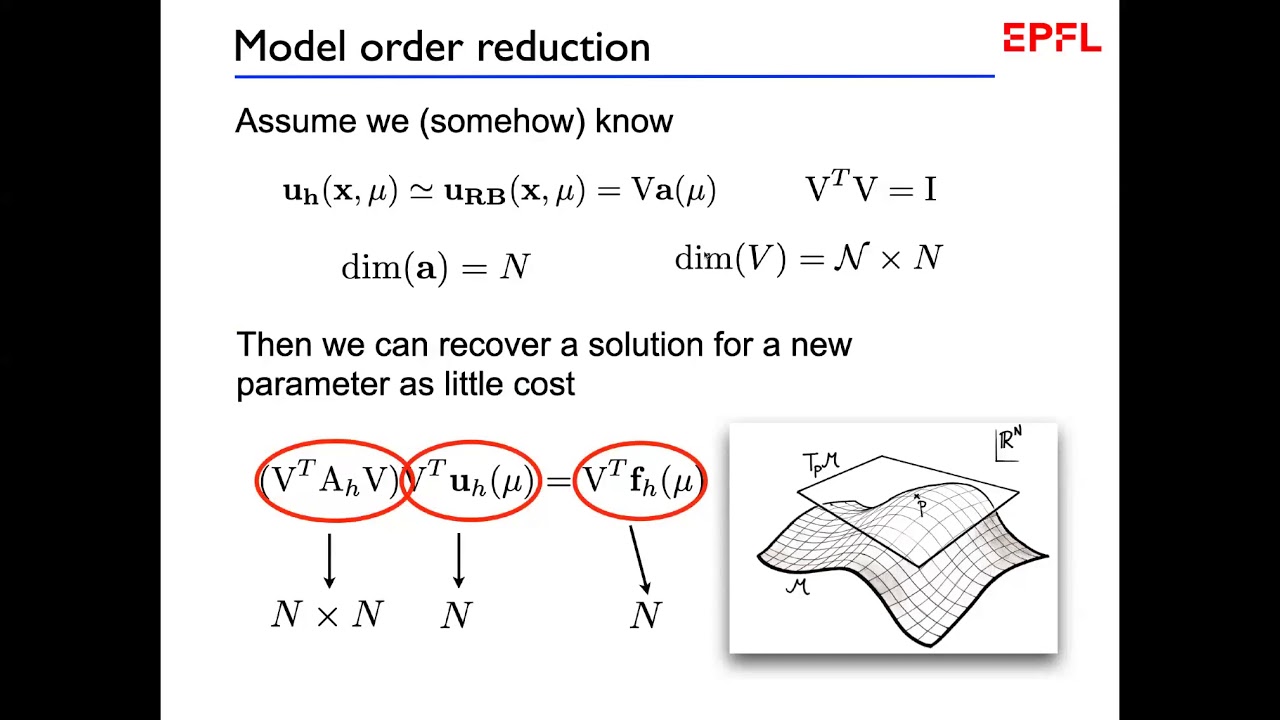
Traditional linear subspace reduced order models (LS-ROMs) are able to accelerate physical simulations, in which the intrinsic solution space falls into a subspace with a small dimension, i.e., the solution space has a small Kolmogorov n-width. However, for physical phenomena not of this type, such as advection-dominated flow phenomena, a low-dimensional linear subspace poorly approximates the solution. To address cases such as these, we have developed an efficient nonlinear manifold ROM (NM-ROM), which can better approximate high-fidelity model solutions with a smaller latent space dimension than the LS-ROMs. Our method takes advantage of the existing numerical methods that are used to solve the corresponding full order models (FOMs). The efficiency is achieved by developing a hyper-reduction technique in the context of the NM-ROM. Numerical results show that neural networks can learn a more efficient latent space representation on advection-dominated data from 2D Burgers’ equations with a high Reynolds number. A speed-up of up to11.7 for 2D Burgers’ equations is achieved with an appropriate treatment of the nonlinear terms through a hyper-reduction technique.
Short bio: Youngsoo is a computational scientist in CASC under the Computing directorate. His research focus lies on developing efficient reduced order models for various physical simulations to be used in multi-query problems, such as inverse problems, design optimization, and uncertainty quantification. His expertises include various scientific computing discplines as indicated in "Research interests" below. He has developed various powerful model order reduction techniques for nonlinear dynamical systems, such as nonlinear manifold and space–time reduced order models. He has also developed new component-wise reduced order model lattice-structre design optimization algorithms, which enable fast and accurate computational modeling tool. He is currently leading data-driven surrogate model development team for various physical simulations, with whom he developed the open source code, libROM. He is also involved with quantum computing research. He has earned his undergraduate degree for Civil and Environmental Engineering from Cornell University and his PhD degree for Computational and Mathematical Engineering from Stanford University. He was a postdoc in Sandia National Laboratories and Stanford University prior to joining LLNL in 2017.
Повторяем попытку...
Доступные форматы для скачивания:
Скачать видео
-
Информация по загрузке:



![Пожалуй, главное заблуждение об электричестве [Veritasium]](https://imager.clipsaver.ru/6Hv2GLtnf2c/max.jpg)