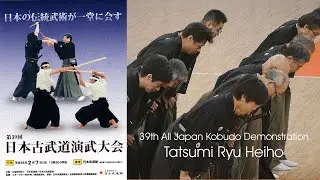
TATSUMI RYU | 立身流 | KENJUTSU | BOJUTSU
Автор: Yoshin Dojo
Загружено: 2023-08-04
Просмотров: 614
Описание:
TATSUMI RYU | 立身流 | KENJUTSU | BOJUTSU
#yoshindojo #tatsumiryu #kenjutsu #bojutsu
WIKI:
Tatsumi-ryū Hyōhō (立身流兵法, Tatsumi-ryū Hyōhō) is a traditional school (koryū) of Japanese martial arts founded in the early 16th century by Tatsumi Sankyo.
History
Tatsumi Sankyo was born in what is now Ehime Prefecture, Japan, on Shikoku island. He is thought to have been active as a warrior (bushi) in the Eishō Era (1504–1520). Tatsumi trained in the martial arts from an early age. As a result, he was never defeated, either on the battlefield or in single combat. As a young man, Tatsumi was dissatisfied with mere technical proficiency, or even victory in combat, and secluded himself in prayer to the mountain deity (kami) Tsumayama Daimyojin. Through intense ascetic training (修行, shugyō), Tatsumi gained enlightenment (satori) in the sword arts going beyond superficial levels of purely physical achievement. He then formulated the Tatsumi-ryū as a result of his experiences in light of his new understanding.
Curriculum
Tatsumi-ryū is a martial art (総合武術, sōgō bujutsu), encompassing many of the classical martial and strategic skills of the martial artist (武芸者, bugeisha). The central weapon of Tatsumi-ryū is the katana, and training to use the sword in combat constitutes the largest part of the curriculum. The use of other weapons, such as the spear (yari), glaive (naginata), long staff (rokushaku-bō), and short staff (hanbō), is undertaken with the aim of enabling the swordsman to defeat such weapons. Indeed, the studies of naginata, rokushaku-bō, and hanbō are classified as part of the swordsmanship (kenjutsu) curriculum and are not considered as separate areas of study. Therefore, in the practice of pre-determined exercises with partners (kata) these weapons always "lose" to the sword.
The school also contains a large curriculum for unarmed grappling arts (which Tatsumi-ryū refers to as yawara, rather than jujutsu). The yawara syllabus includes training for combat both in and out of armour, and covers a wide range of techniques and situations. Also included in the yawara syllabus are the resuscitation techniques (活, katsu) and the art of restraining a person with rope-tying techniques (hojōjutsu). The curriculum includes also a number of weapons for which there are no kata, but which are referred to in Tatsumi-ryū's scrolls (makimono). This includes the baton (jutte), throwing blade (shuriken), iron fan (tessen), and weighted chain (manriki-gusari). These scrolls also include a number of "case studies" of various situations, esoteric charms, tactics (手段戦闘法, shudan sentōhō), and scouting, reconnaissance and observation techniques (物見, monomi), as well as an array of other teachings about different aspects of warrior culture and philosophy.
名称
立身流 (たつみりゅう)
成立
永正年間 (室町時代 1504年-1520年)
流祖 / 流祖神
立身三京 / 妻山大明神
現宗家 第22代
加藤 紘
立身流系譜
立身三京-立身石見守-立身数馬佐-三上半之丞-松井琴古-桑島太左衛門-大石千助-山口七郎左衛門-竹河九兵衛-糟谷団九郎-逸見柳芳-逸見宗八-半澤喜兵衛-逸見新九郎-半澤権右衛門-逸見宗八-逸見忠蔵-半澤成恒-加藤久-加藤貞雄-加藤高-加藤紘
Please Like, Follow and Share our video!
Published books by Todd Schweinhart: https://www.amazon.com/s?k=todd+schwe...
Yoshin Dojo Website and Info : http://yoshindojo.com/
Follow us on Facebook: / yoshin.dojo
Yoshin Dojo on Instagram: / yoshindojo
Yoshin Dojo on YouTube:
/ yoshindojo
Повторяем попытку...

Доступные форматы для скачивания:
Скачать видео
-
Информация по загрузке:



![Tatsumi-ryū Heihō [4K 60fps] - 46th Japanese Kobudo Demonstration](https://image.4k-video.ru/id-video/IsJwgDSo4g4)


![SHINDEN FURO RYU - IKKEN HASSO & BIKEN ISSHUN [ 神伝不動流 一剣八相 秘拳一瞬 ]](https://image.4k-video.ru/id-video/inPZxQ2UNRQ)