Anselm Kiefer 安瑟倫·基弗爾 (1945) Neo-Expressionism German
Автор: Tuen Tony Kwok
Загружено: 2017-07-25
Просмотров: 852
Описание:
[email protected]
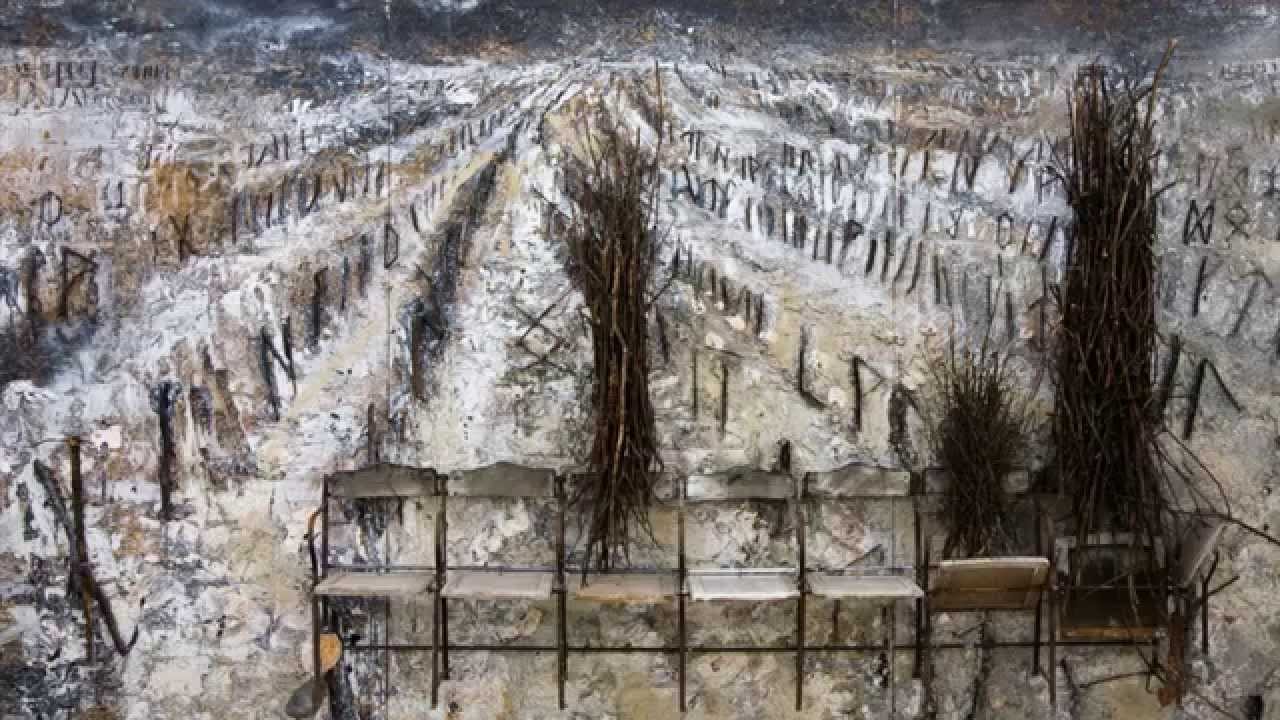
Anselm Kiefer German painter. Early in his career he was a Conceptual artist, but he turned to painting and has become one of the chief exponents of Neo-Expressionism, with an international reputation. He produces large, heavily worked canvases, often with objects or vegetable matter (such as plants or straw) attached to them (he has also mixed blood with his paint). Sometimes the surface is further ‘distressed’ by such means as scorching it with a blowtorch. Many of his pictures refer to German history or Nordic mythology and show an attempt to come to terms with his country's Nazi past. Another subject that has interested him is the Chinese Communist leader Mao Zedong (Let a Thousand Flowers Bloom, 2000, Tate, London).
安瑟倫·基弗爾,德國畫家。在職業生涯早期,他是一個概念藝術家,但他開始畫畫,已成為新表現主義的主要代表人物之一,享有國際聲譽。他生產大,沉重的工作畫布,經常與物體或植物性物質(如植物或稻草)連接到他們(自己也混血與他的油漆)。有時表面是通過諸如用噴燈頂著它進一步'苦惱'。他的許多照片是指德國歷史或北歐神話,並顯示嘗試來與他國的納粹歷史方面。已經引起他的興趣另一個問題是中國共產黨領袖毛澤東(讓百花齊放,2000年,泰特,倫敦)。
Anselm Kiefer (born 8 March 1945) is a German painter and sculptor. He studied with Joseph Beuys and Peter Dreher during the 1970s. His works incorporate materials such as straw, ash, clay, lead, and shellac. The poems of Paul Celan have played a role in developing Kiefer's themes of German history and the horror of the Holocaust, as have the spiritual concepts of Kabbalah.
In his entire body of work, Kiefer argues with the past and addresses taboo and controversial issues from recent history. Themes from Nazi rule are particularly reflected in his work; for instance, the painting "Margarethe" (oil and straw on canvas) was inspired by Paul Celan's well-known poem "Todesfuge" ("Death Fugue").
His works are characterised by an unflinching willingness to confront his culture's dark past, and unrealised potential, in works that are often done on a large, confrontational scale well suited to the subjects. It is also characteristic of his work to find signatures and/or names of people of historical importance, legendary figures or historical places. All of these are encoded sigils through which Kiefer seeks to process the past; this has resulted in his work being linked with the movements New Symbolism and Neo–Expressionism.
Kiefer has lived and worked in France since 1992. Since 2008, he has lived and worked primarily in Paris and in Alcácer do Sal, Portugal.
The son of a German art teacher, Kiefer was born in Donaueschingen two months before the end of World War II. In 1951, his family moved to Ottersdorf, and he attended public school in Rastatt, graduating high school in 1965. He entered University of Freiburg, and studied pre-Law and Romance languages. However, after 3 semesters he switched to Art, studying at Art academies in Freiburg, Karlsruhe, and Düsseldorf. In Karlsruhe, he studied under Peter Dreher, an important realist and figurative painter. He received an Art degree in 1969.
Kiefer moved to Dusseldorf in 1970. In 1971 he moved to Hornbach, in southwestern Germany, where he established a studio. He remained there until 1992; his output during this first creative time is known at The German Years. In 1992 he relocated to France.
Kiefer began his career as a photographer with performances in which he, in paramilitary costume, mimicked the Nazi salute on various locations in France, Switzerland and Italy calling for Germans to remember and to acknowledge the loss to their culture through the mad xenophobia of the Third Reich. In 1969, at Galerie am Kaiserplatz, Karlsruhe, he presented his first single exhibition "Besetzungen (Occupations)" with a series of photographs about controversial political actions.
Kiefer is best known for his paintings, which have grown increasingly large in scale with additions of lead, broken glass, and dried flowers or plants, resulting in encrusted surfaces and thick layers of impasto.
Повторяем попытку...
Доступные форматы для скачивания:
Скачать видео
-
Информация по загрузке: