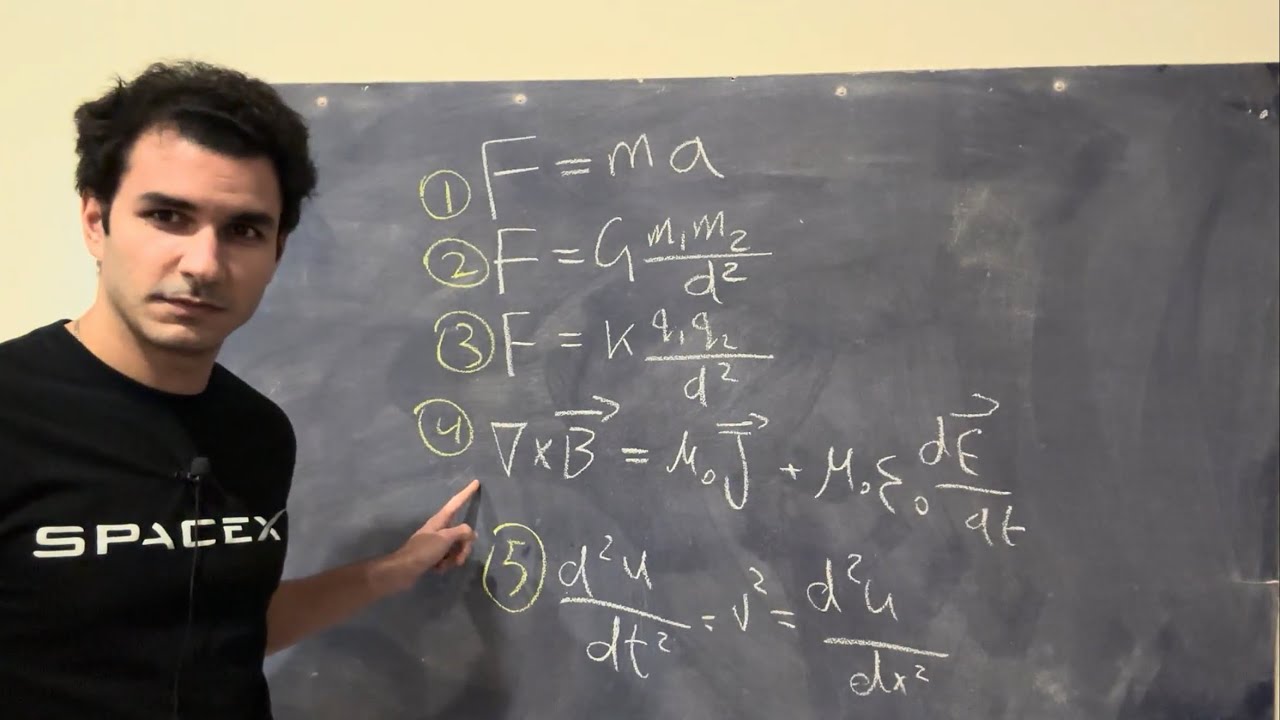
Derivation of wave velocity equation #5
Автор: The Science Cube
Загружено: 2019-04-26
Просмотров: 7727
Описание:
Derivation of wave velocity equation can be done using several methods. The simplest is using Newton's second law of motion.
Solved numerical problems and downloadable PDFs: ▶ https://thesciencecube.com/
Join our Telegram Channel: ▶ https://t.me/TheScienceCube_Community
Wave Speed on a stretched String -
We have established that the speed of a wave is related to the wave’s wavelength and frequency but if you think a little deeper, what you will find is that eventually it is set by the properties of the medium. So you’ll never find a thread between your hands vibrate the same way as a rubber band, if you’ve pulled both to the same magnitude of force and plucked them pretty much the same
We have also learnt that waves are a result of vibrations of the medium in which they are traveling. Thus, a wave traveling through a medium such as wood, water, iron, or a stretched string must cause the particles of “that medium” to oscillate as it moves across. “And if there is vibration”, there has to be kinetic energy “which” therefore requires mass. So mass has to play a role in determining how the wave would look like. Well, we also know from the earlier lesson that that this kinetic energy is not constant, it fluctuates between some minima and a maxima and the change in kinetic energy manifests itself as Potential energy in the string. Which therefore means elasticity of the string also is a predictor of the way the wave will behave. And indeed, mass and elasticity both determine how fast the wave will travel.
There are several ways of finding the magnitude of this dependency – it could be done through dimensional analysis, using Newtons’ 2nd law or using impulse momentum method.
I felt that Newton’s 2nd law is the most convenient way of deriving the velocity of the wave in a stretched string.
Derivation from Newton’s Second Law
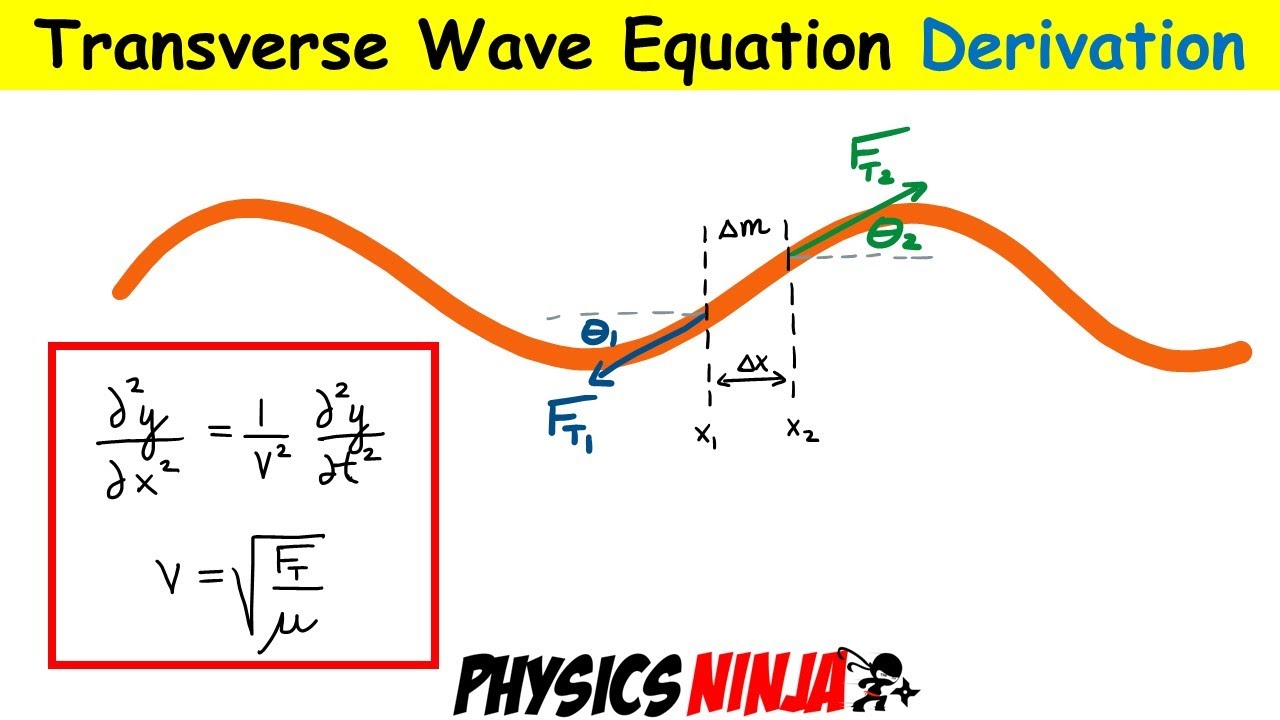
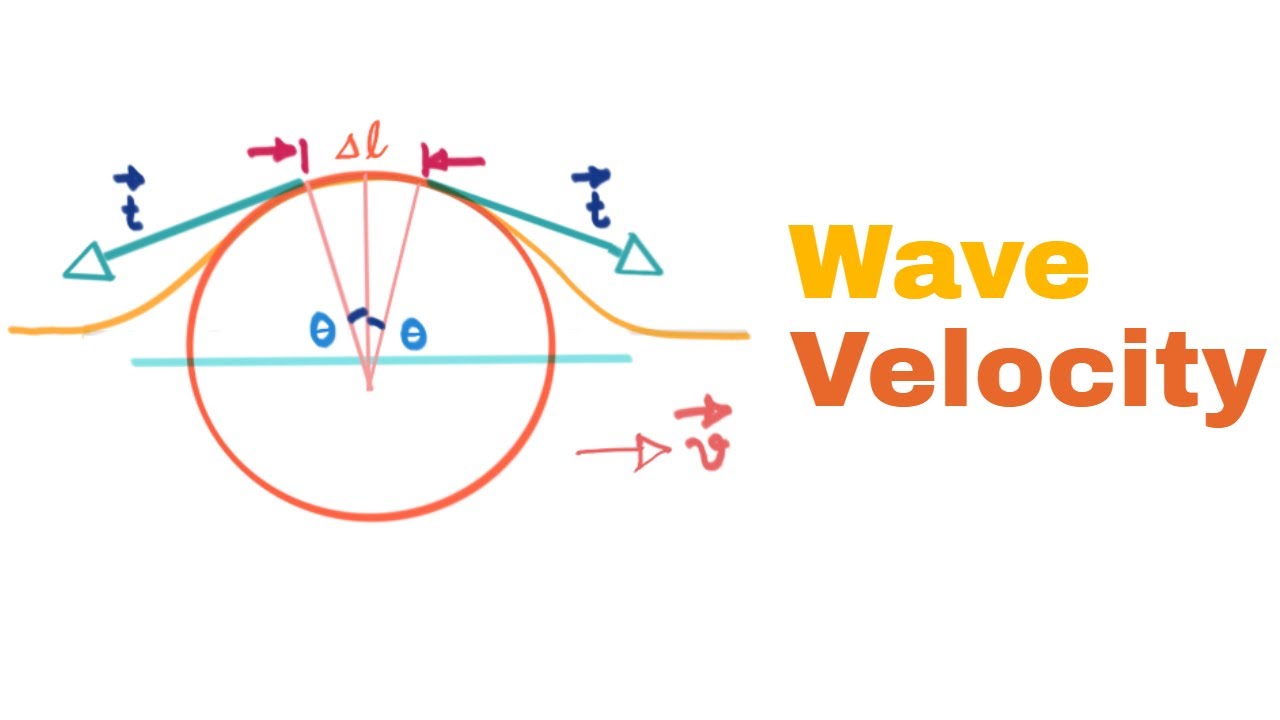
Consider a single symmetrical pulse moving with a velocity v along a string.
Lets zoom into a small string element of length delta l within the pulse that
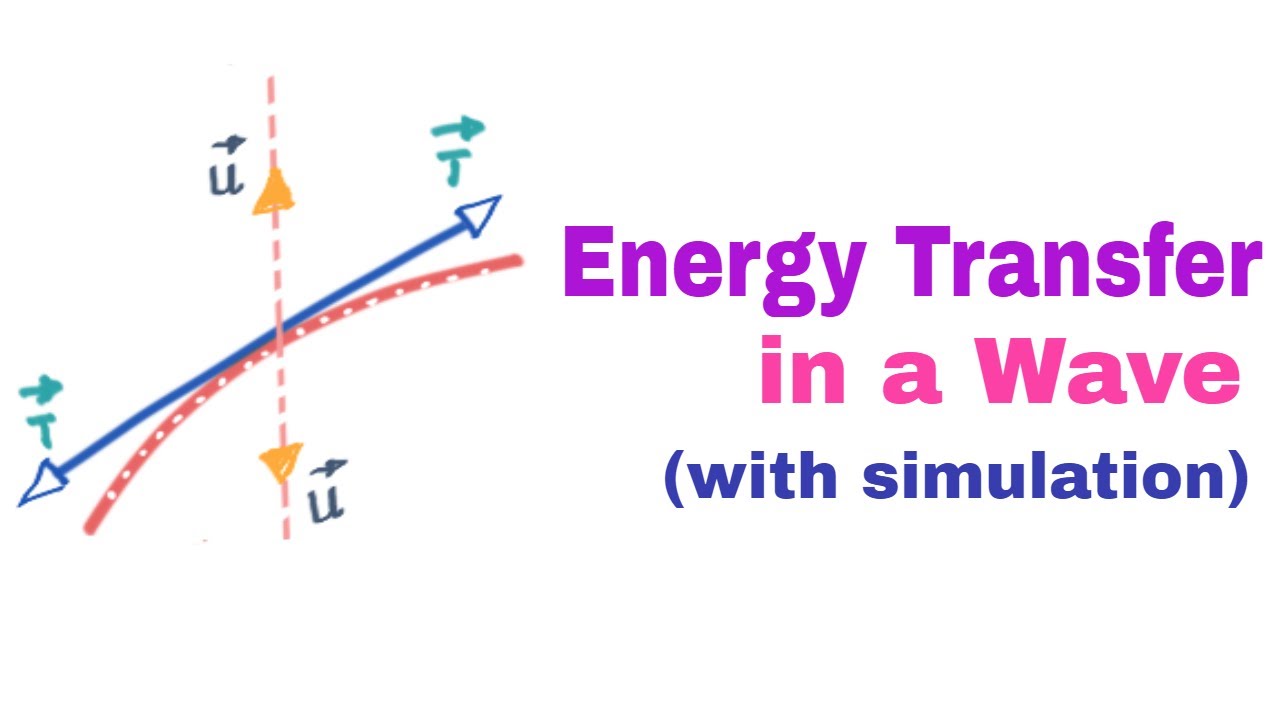
Is an arc of a circle of radius R and makes an angle 2 theta at the center of that circle. The force that pulls the string would have a magnitude equal to the tension t in the string and pulls tangentially on this element on each side.
What you’ll observe is that the horizontal components of these forces nullify each other, but the vertical components add up to form a restoring force directed towards the center,
So we can say that F = 2(t sine theta)
And if we assume that theta is very small,
t (sine theta) can be written as t2theta
Well, we also know that length of any arc of a circle = angle in radians subtended by the arc into the radius.
So we can say that 2theta = delta l/ R or
F = t delta(l)/R
If we assume that the linear density of the string is mu that is mass per unit length is mu, or delta (m) = mu X delta (l)
Well, we can also see that the string element delta l is moving in an arc of a circle and therefore it should experience a centripetal acceleration v(sq)/ R
Using Newton’s second law of motion F = ma
We can rewrite the above equation as
F = t delta(l)/R = mu X delta (l) v (sq)/ R
Or v = root of t/mu
A couple of very interesting observations you can make from this equation are-
1. The velocity of the string dependents on linear density and tension in the string and has no dependence on the frequency of the wave. You can clearly see that frequency does not appear in this equation
2. The velocity of any string made of same material under similar tension will have the same velocity
3. The frequency of the wave is actually fixed by the source creating the waves. Well, it could be you if you are shaking the string or any mechanical device used to create the wave
4. The wavelength lambda is therefore fixed as = v/f
Another interesting way of interpreting this equation is that velocity of a wave =
So here, tension t in the string provides the restoring force and brings the string back to the equilibrium position while the mass of the string or the linear mass density mu provides the inertia that resists the string from returning to equilibrium.
So you see, the interplay of the two variables results in an expression for velocity of a mechanical wave
ABOUT "THE SCIENCE CUBE"
Who can use:
Class 11 and 12 students (CBSE, ICSE, NCERT)
IIT-JEE Preparation (JEE Main and JEE advanced)
K-12
Advanced Placement (AP Physics, physics 1)
Повторяем попытку...
Доступные форматы для скачивания:
Скачать видео
-
Информация по загрузке: