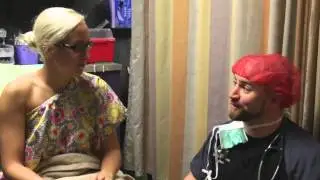
Patient Gets a Breast Implant Exchange, Part I, Honolulu, HI
Автор: S. Larry Schlesinger, MD FACS
Загружено: 2020-04-21
Просмотров: 1362
Описание:
Patient Gets a Breast Implant Exchange with Dr. S. Larry Schlesinger in Honolulu, Hawaii. Part one of three in a series. Visit us online at http://bit.ly/2lACFpNdrlarry or call 808-201-0540.
Our patient has a tough case. She came to us after three capsular contractures, one ruptured implant, and the use of textured implants from other surgeons.
Dr. Larry joins her in pre-op to review the upcoming procedure, what they are going to do today during surgery, and how they are going to do all they can to make this her final and successful surgery.
Follow us on
Facebook: / hawaiibreastimplants
Instagram: / drschlesinger
https://www.breastimplantcenterofhawa...
Transcript:
Hi, I'm Larry Schlesinger and I'm a board-certified plastic surgeon from Honolulu, Hawaii. And today we're going to be doing a breast re-do. This young lady has had three surgeries? [Woman] - Three, yes.
Three surgeries on her breast. She had tuberous breasts, which is an interesting category of breasts. Used to be 5% of the population. Now it's between 50 and 88% of the population and they're constricted at the bottom. You can usually tell them because the nipple tends to point downward. How many times have you had capsular contracture? [Woman] - I've had capsular contracture three times and I've had one rupture. One rupture and three capsular contractures so this is not gonna be an easy case but the goal is to get out the entire capsule and we're also going to release the constricted lower portion of the breast so the nipple can move up and be in a better location. So, it's gonna take longer than one would normally take for a surgery like this just because we're trying to do a minimum of two things simultaneously. One, get rid of the constricted lower portion and move the bottom of the breast downward to allow the nipple to be at a good location. We're gonna get--do our best to get rid of the capsular contracture which could have been caused by blood around the implant, which could have been caused by non-pathogenic bacteria getting into the implant pocket. So, there's any number of reasons why you got this but one possibility... [Woman] - I've never had drains.
Say again? [Woman] - I've never had drains installed after any procedure.
You've never had drains, okay. No drains and were you bruised after the procedures? [Woman] - Very.
Very bruised, so that would be again, one of the more likely causes. One thing the surgeon can do to avoid capsular contracture is to use a drain to decrease the chances of bleeding. The drains will be in for a minimum of three days right now because there's a great deal of chance of bleeding because of all the capsular contracture we're removing. Secondly, we're also gonna be making cuts in the inside anyhow to release the contracture so there's a couple reasons why the drains are gonna be in there for a while. So, the surgeon can decrease chance of capsular contracture by doing--putting a drain in and by using the Keller Funnel to put in the implant so it never touches the skin and we change gloves just before we start working on the Keller Funnel so no bacteria from touching your skin gets on the implant and then inside of you. So, there's a lot of things the surgeon can do... [Woman] - The surgeon had also told me last time that by using a textured implant, there was less risk of capsular contracture.
That's right. Textured implants have been shown to have less risk of a capsular contracture. Unfortunately, there's a much greater chance that other problems but true, I don't like--I never liked the feel of textured implants. They didn't...you know, you're trading off a nice, soft breast for some... a decrease in the chance of capsular contracture. I never thought the trade-off was worth it but every surgeon has his own opinions. So, what we're looking for now is get rid of the capsule, release the implant, move the inframammary fold down so that the nipple comes up where it's an inverse relationship as the fold goes down, the nipple comes up. We're gonna do all of that through an incision around your areola, periareolar incision. We'll use sizers and once we know the sizes are correct, what you're looking for based on what you told me you wanted and you've already given us permission, then we're going to use the Keller Funnel, put the implant in, put a drain in, put the stratus in, sew things up. We're gonna wrap you relatively tightly to also decrease the chance of bleeding. All of these things and I think we're gonna get exactly what you're looking for. At least we're gonna give it our best shot. You know?
Повторяем попытку...

Доступные форматы для скачивания:
Скачать видео
-
Информация по загрузке: