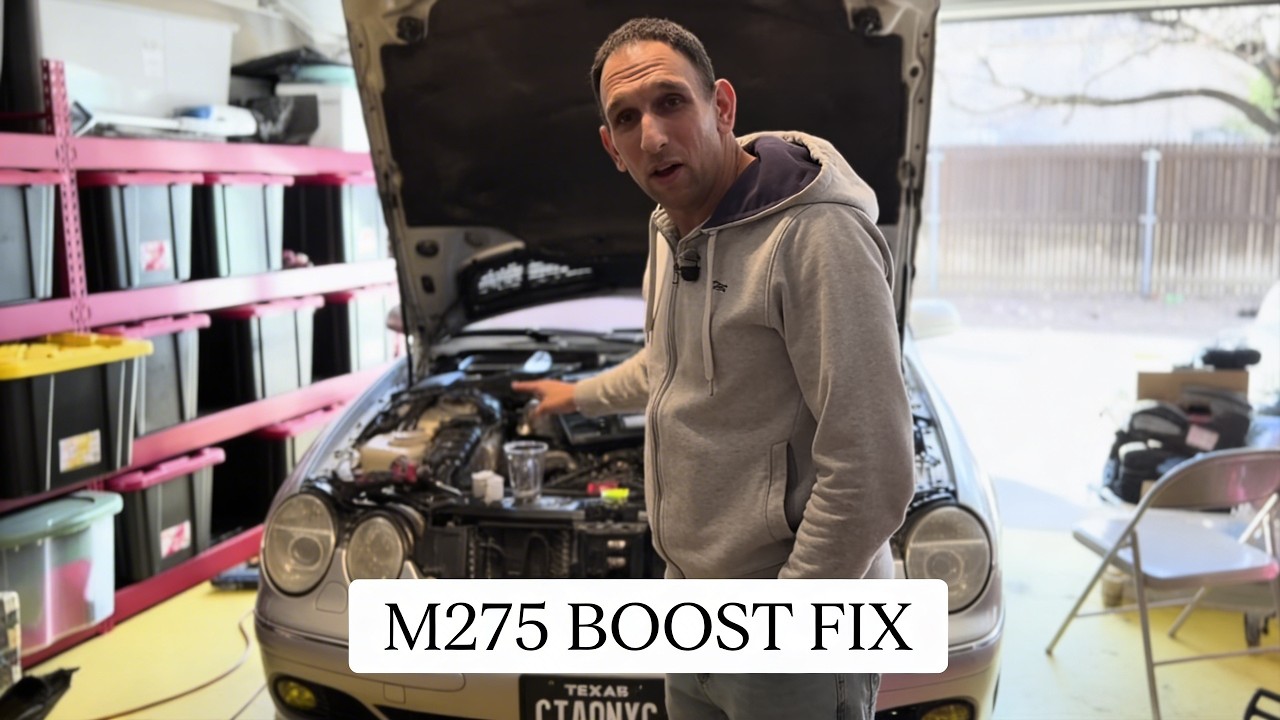
Mercedes CL600 / M275 biturbo / Twin Turbo Over boost Diagnosis – Full Deep Dive
Автор: Justin DeFillippo
Загружено: 2026-01-22
Просмотров: 25
Описание:
Mercedes CL600 / M275 Twin-Turbo Over boost Diagnosis – Full Deep Dive
Codes, Parts, Boost Control, Wastegates, Transducers, and Real-World Troubleshooting
This video documents a real-world diagnostic journey on a Mercedes-Benz CL600 (C215) equipped with the M275 twin-turbo V12, focusing on intermittent overboost, limp mode, and boost control faults that are commonly misunderstood and frequently misdiagnosed — even by professionals.
If you own, service, or are thinking about owning an M275-powered Mercedes (CL600, S600, SL600, AMG 65 variants), this video is meant to be a technical reference, not clickbait.
⸻
🔴 Symptoms Experienced
• Intermittent overboost
• Limp mode triggered during acceleration
• Vehicle would:
• Run perfectly at times
• Then suddenly fault after restart or heat soak
• Boost felt violent / uncontrolled at times
• Resetting the ignition temporarily restored normal operation
• No consistent mechanical noise or permanent failure
These symptoms are classic for boost control faults, not turbo failure.
⸻
⚠️ Fault Codes Encountered (via Xentry / SDS)
Common codes encountered or discussed during diagnosis included:
• P20E2 / Charge pressure control – boost pressure too high
• Charge pressure plausibility faults
• Stored vs current overboost faults
• No permanent actuator or turbo hardware fault codes
Important takeaway:
Overboost codes do NOT automatically mean bad turbos.
⸻
🧠 Turbo System 101 – M275 Specific (Important)
The M275 uses a pressure-controlled wastegate system, NOT vacuum like many older Mercedes engines.
Key components:
1️⃣ Wastegates (Exhaust Side)
• Control maximum boost
• Actuated by compressed charge air pressure
• Spring-loaded CLOSED
• Pressure OPENS the wastegate
• No pressure → wastegate stays closed → turbo overspeeds
2️⃣ Boost Pressure Transducer (Y31/5)
• 3-port solenoid valve
• Routes intercooler pressure to wastegate actuators
• Also vents pressure when ECU wants boost reduced
• Failure modes:
• Sticking internally
• Failing to vent
• Passing pressure constantly
• Intermittent behavior after heat soak
This component is a very common failure point.
3️⃣ Diverter / Bypass Valves (Compressor Side)
• Vacuum-operated
• Open during throttle lift
• Prevent compressor surge
• Do NOT control max boost
• Failed diverters cause flutter or underboost, NOT overboost
⸻
🔍 Diagnostic Process Covered in the Video
This video shows how to properly isolate the system instead of guessing:
✔ Sensor Verification
• Multiple boost / pressure sensors were inspected and replaced
• OEM sensors were ultimately required
• Incorrect aftermarket sensors can cause misleading data
✔ Wastegate Actuator Testing
• Hand pressure pump used
• Both actuators:
• Held pressure
• Were visually confirmed to move using a borescope
• This ruled out:
• Torn diaphragms
• Seized rods
• Stuck wastegate flaps
• Engine-out repairs
✔ Borescope Inspection
• Allowed direct confirmation of actuator rod movement
• Eliminated speculation
• Confirmed mechanical integrity
✔ Control System Focus
Once hardware was verified, the issue narrowed to:
• Boost pressure routing
• Transducer behavior
• ECU control logic
⸻
❌ Common Myths Debunked
• ❌ “Overboost = bad turbo”
• ❌ “Wastegates are vacuum-controlled” (not on M275)
• ❌ “You need to pull the engine”
• ❌ “Just tune it and send it”
This video explains why those assumptions are wrong.
⸻
🧩 Why the Car Felt Sluggish After Repair
After correcting uncontrolled boost:
• ECU may limit torque temporarily
• Wastegates may open earlier (as designed)
• Throttle response becomes smoother instead of violent
This is normal behavior after restoring proper boost control.
⸻
🔧 Parts & Components Discussed
• Boost pressure transducer (Y31/5)
• Wastegate actuators (tested, not replaced)
• Boost pressure sensors (OEM required)
• Diverter valves (explained, not blamed)
• Hand pressure pump
• Borescope (critical diagnostic tool)
⸻
🏁 Final Takeaway
This car did NOT need:
• Turbos
• Engine removal
• $10,000+ in parts
It needed:
• Correct understanding of how the M275 controls boost
• Proper isolation of mechanical vs control faults
• Patience and diagnostics over assumptions
If you’re dealing with:
• Intermittent limp mode
• Overboost codes
• Conflicting forum advice
This video is for you.
⸻
👍 If This Helped You
• Like the video
• Subscribe for real-world diagnostics (not parts cannon repairs)
• Drop a comment if you’re chasing a similar issue
These cars are complex — but they’re not magic.
You just have to understand how Mercedes actually engineered them. Plus using Xentry helps lol
Повторяем попытку...
Доступные форматы для скачивания:
Скачать видео
-
Информация по загрузке: