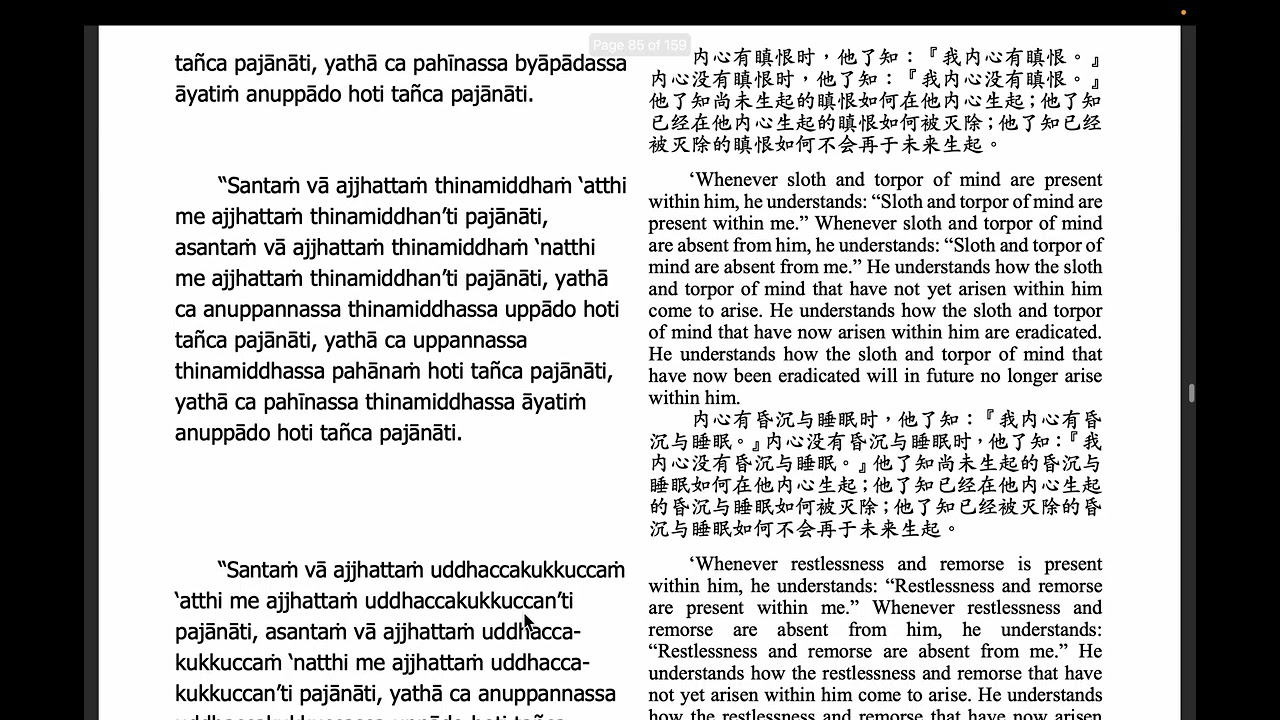
Daily Dhamma Reflection 每日佛法省思 84-86 The Five Hindrances 法隨觀念處:五蓋節 PLEASE SHARE THE DHAMMA
Автор: Buddhist Audiobooks with text. r. Angus Cargill
Загружено: 2025-05-26
Просмотров: 6
Описание:
Daily Dhamma Reflection 每日佛法省思 84 Dhammānupassanā Nīvaraṇapabbaṁ. Contemplation of Dhamma-Objects: The Five Hindrances 法隨觀念處:五蓋節 PLEASE SHARE THE DHAMMA
Pāli (/ˈpɑːli/, IAST: pāl̤i), also known as Pali-Magadhi, is a classical Middle Indo-Aryan language on the Indian subcontinent. It is widely studied because it is the language of the Buddhist Pāli Canon or Tipiṭaka as well as the sacred language of Theravāda Buddhism.Pali was designated as a classical language by the Government of India on 3 October 2024.
The Theravada commentaries refer to the Pali language as "Magadhan" or the "language of Magadha". This identification first appears in the commentaries, and may have been an attempt by Buddhists to associate themselves more closely with the Maurya Empire.
However, only some of the Buddha's teachings were delivered in the historical territory of Magadha kingdom. Scholars consider it likely that he taught in several closely related dialects of Middle Indo-Aryan, which had a high degree of mutual intelligibility.
Theravada tradition, as recorded in chronicles like the Mahavamsa, states that the Tipitaka was first committed to writing during the first century BCE. This move away from the previous tradition of oral preservation is described as being motivated by threats to the Sangha from famine, war, and the growing influence of the rival tradition of the Abhayagiri Vihara.[6]: 5 This account is generally accepted by scholars, though there are indications that Pali had already begun to be recorded in writing by this date.[6]: 5 By this point in its history, scholars consider it likely that Pali had already undergone some initial assimilation with Sanskrit, such as the conversion of the Middle-Indic bahmana to the more familiar Sanskrit brāhmana that contemporary brahmans used to identify themselves.
In Sri Lanka, Pali is thought to have entered into a period of decline ending around the 4th or 5th century (as Sanskrit rose in prominence, and simultaneously, as Buddhism's adherents became a smaller portion of the subcontinent), but ultimately survived. The work of Buddhaghosa was largely responsible for its reemergence as an important scholarly language in Buddhist thought. The Visuddhimagga, and the other commentaries that Buddhaghosa compiled, codified and condensed the Sinhala commentarial tradition that had been preserved and expanded in Sri Lanka since the 3rd century BCE.
With only a few possible exceptions, the entire corpus of Pali texts known today is believed to derive from the Anuradhapura Maha Viharaya in Sri Lanka. While literary evidence exists of Theravadins in mainland India surviving into the 13th century, no Pali texts specifically attributable to this tradition have been recovered. Some texts (such as the Milindapanha) may have been composed in India before being transmitted to Sri Lanka, but the surviving versions of the texts are those preserved by the Mahavihara in Ceylon and shared with monasteries in Theravada Southeast Asia
Повторяем попытку...
Доступные форматы для скачивания:
Скачать видео
-
Информация по загрузке: