The Protestant Reformation (1517–1648): Key Events That Changed Christianity Forever
Автор: Scriptura Lab
Загружено: 2025-06-05
Просмотров: 3817
Описание:
#Shorts #Protestant #Reformation #ChurchHistory
💡 Read the Companion Notes below for more detailed insights about the Protestant Reformation.
#BibleShorts #ChristianShorts #Faith #ProtestantReformation #MartinLuther #95Theses #JohnCalvin #CouncilOfTrent #HenryVIII #ThirtyYearsWar
📝 Companion Notes
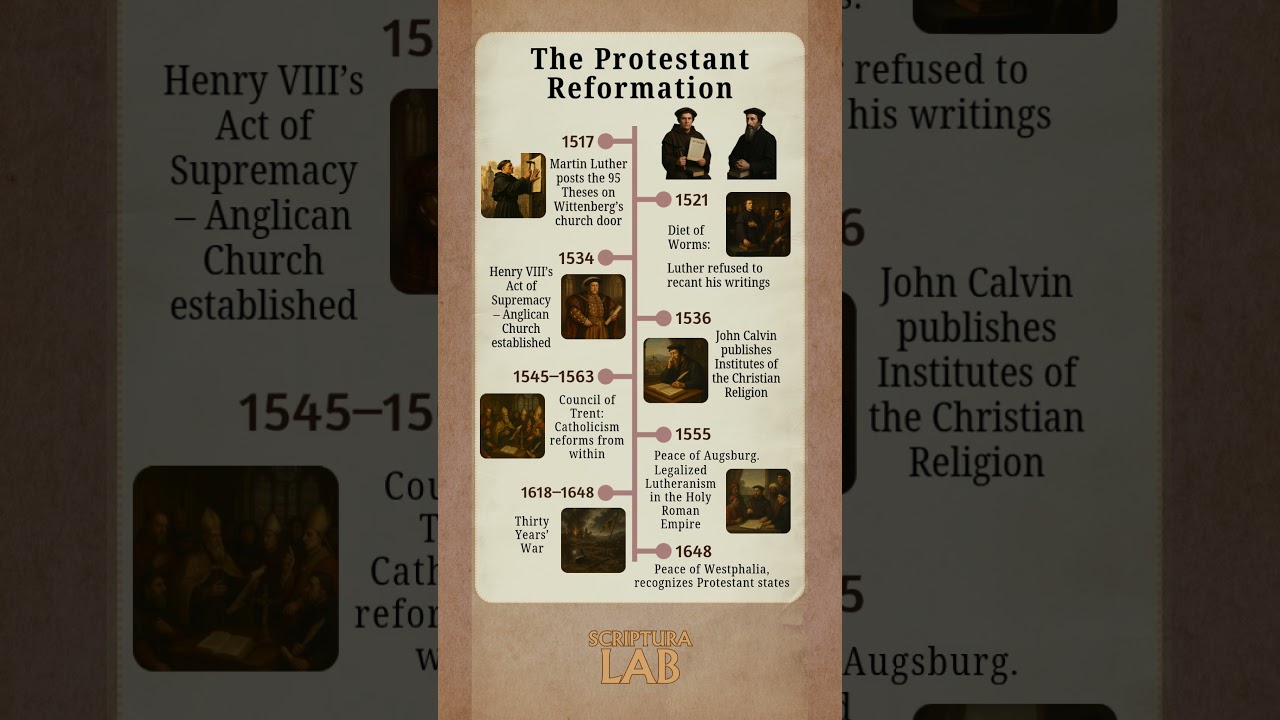
🟤 1517: Martin Luther posts the 95 Theses on Wittenberg’s church door
On October 31, 1517, Luther posted his Disputation on the Power and Efficacy of Indulgences (commonly known as the 95 Theses), challenging the sale of indulgences. This act is traditionally marked as the beginning of the Protestant Reformation.
⚪ 1521: Diet of Worms – “Here I stand, I can do no other.”
Luther was summoned before the Diet of Worms in April 1521 and refused to recant his writings. The famous quote “Here I stand...” is widely attributed to him, though it is not found in official transcripts and may have been added by later chroniclers. Still, it summarizes his stance faithfully.
🟣 1534: Henry VIII’s Act of Supremacy – Anglican Church established
In 1534, the English Parliament passed the Act of Supremacy, declaring Henry VIII the Supreme Head of the Church of England, thereby breaking from Rome. This initiated the English Reformation, not purely theological but rooted in political and dynastic concerns.
🟠 1536: John Calvin publishes Institutes of the Christian Religion
Calvin published the first edition of his Institutes in 1536 (in Latin). It laid out Protestant theology systematically and became a foundational text for Reformed (Calvinist) Christianity.
🟢 1545–1563: Council of Trent – Catholicism reforms from within
The Council of Trent was held over three sessions between 1545 and 1563. It was the centerpiece of the Catholic Counter-Reformation, clarifying doctrine (e.g., justification, sacraments) and addressing internal corruption.
🟡 1555: Peace of Augsburg – Legalized Lutheranism in the Holy Roman Empire
The Peace of Augsburg established the principle of “Cuius regio, eius religio” ("Whose realm, his religion"). Rulers within the Holy Roman Empire could choose between Catholicism and Lutheranism, but not other reform traditions like Calvinism or Anabaptism.
🔵 1618–1648: Thirty Years’ War
The Thirty Years’ War began as a religious conflict between Protestant and Catholic states in the fragmented Holy Roman Empire and evolved into a broader political struggle involving major European powers.
🔴 1648: Peace of Westphalia – Recognizes Protestant states
The Peace of Westphalia ended the Thirty Years’ War and officially recognized Calvinism alongside Lutheranism and Catholicism. It also helped establish modern principles of state sovereignty and religious toleration.
🕊️ 👇
Повторяем попытку...
Доступные форматы для скачивания:
Скачать видео
-
Информация по загрузке: