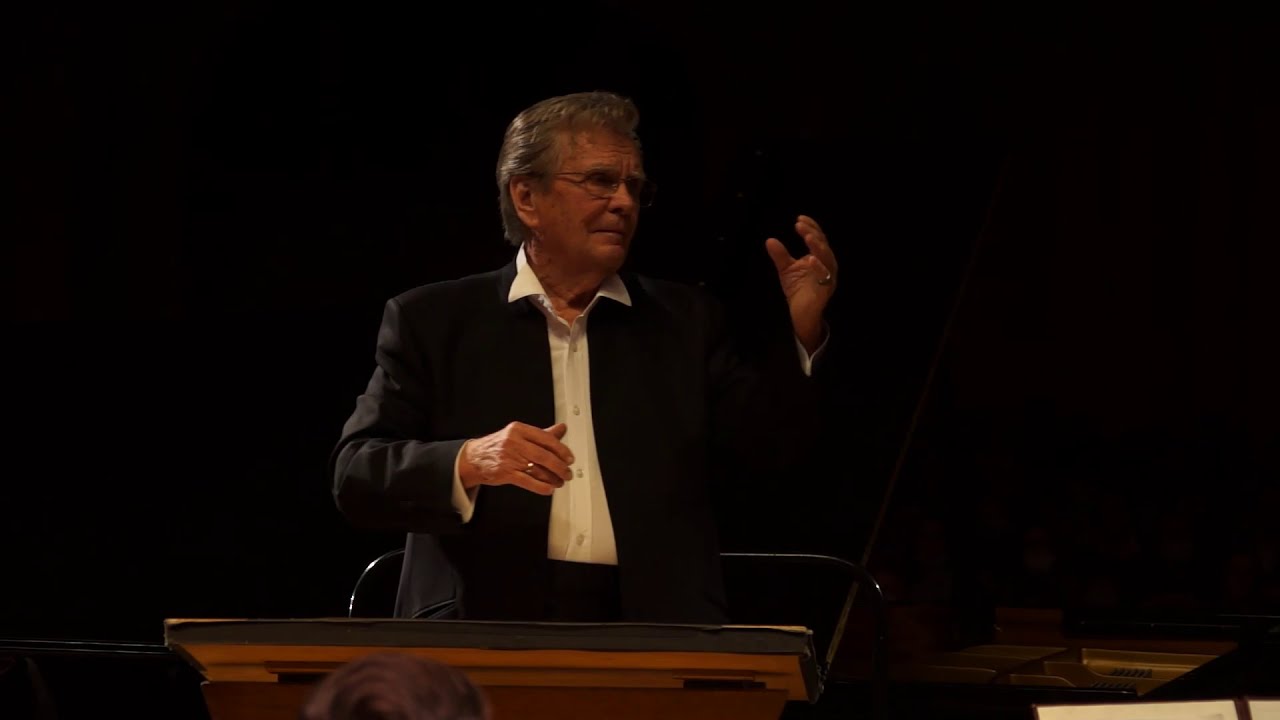
Henryk Melcer-Szczawiński - Piano Concerto No. 2 in C-Minor (Rutkowska, Wiłkomirski)
Автор: Polish Scores
Загружено: 2025-06-10
Просмотров: 447
Описание:
Henryk Melcer-Szczawiński - Koncert Fortepianowy II C-moll
Composed in 1898 or earlier.
Pianist: Teresa Rutkowska
Conductor: Józef Wiłkomirski
Orchestra: Warsaw National Philharmonic Orchestra
0:00 - I. Allegro Moderato
14:25 - Andante non troppo lento
26:47 - Allegro con fuoco
Biography
Henryk Melcer-Szczawiński (1869-1928) was born into a musical family at the northern outskirts of Warsaw. His talent was discovered early on, and both his father and his relative's grandmother taught him piano when he was little. His father, Karol Melcer, was a violinist, a conductor, and a composer, so Henryk had an abundance of early education. His gave his first public performance when he was only 8 years old.
Later, he studied mathematics at the University of Warsaw before enrolling at the Musical Institute of Warsaw. He studied piano technique with Rudolf Strobla and composition with Zygmunt Noskowski. Interestingly, he began his early career as an accompanist. Melcer-Szczawiński's victory at the Rubinstein Competition in 1895 changed his professional trajectory.
Melcer-Szczawiński was an incredibly talented composer, winning the Rubinstein Competition for his Piano Concerto, his Piano Trio, and three Character pieces. He would later be awarded at the Ignacy Jan Paderewski Competition for this Piano Concerto, and he would later win the Warsaw Philharmonic's composition competition for his opera Maria. These awards opened the door for Melcer-Szczawiński to teach at institutions from Helsinki to Lviv to Łódź and even Vienna. He also gave concerts throughout Europe.
In 1907, after some trouble with his workload and his family situation, he finally returned to Warsaw where he began working for the Warsaw Philharmonic. He shuffled around a few positions in Warsaw, but he was a dedicated advocate of Polish music. When the Philharmonic began to decline, he and Grzegorz Fitelberg began initiatives to change the repertoire to include Karłowicz's symphonic works and those of more unknown Polish composers. Through all of this he never stopped giving concerts or growing his own repertoire. He continued to give concerts as both a soloist and an accompanist.
Through the rest of his life, he would take hard stances on issues that arose in common musical life and in the life of Poland. While working as the director of Opera, he protested giving performances of German Composers while they occupied Warsaw in the 1st World War. He also drew hard lines on issues like defending the autonomy of students at the Warsaw Conservatory. He went so far as to resign as director of the conservatory over this issue. Later in life, he stopped giving concerts because of his health problems, dying in the Warsaw Conservatory in the middle of a lecture.
The 2nd Piano Concerto
Henryk Melcer-Szczawiński's 1st concerto won the Anton Rubinstein competition, and his talent and hard work as a composer would win him another competition. This time, he won the Paderewski competition in Leipzig. Once again, the most critical and refined eyes were on Melcer-Szczawiński and his work [1]. As Felicjan Szopski rightly remarked, however, "But because of the concerto's evident value, it did not need to fear the judgement of the strictest and the most serious. It was a work that showed mastery of form and compositional technique, as well as being a work of deep invention, arising from a spirit of genuine poetry." [1]
The concerto was composed only a few years after Melcer-Szczawiński's first piano concerto, so there is some overlap in techniques. Both feature alternating chords over a 9th or 10th interval, dissonances, rhythmic alternation by a 16th note, long lines, harmonic complexity, and so on. They share a distinct style, but they both stand on their own as examples of Melcer-Szczawiński's inventiveness as a composer and expressiveness as an artist.
Allegro Moderato - A very romantic, albeit very dissonant 1st mvt. The dramatic 1st theme meshes with the staccato elements accompanying the 2nd theme. The dramatic, the dissonant, and the staccato all contrast throughout and give a sense of vastness to the movement, but some light, lyrical moments still survive the whirlwind.
The most interesting element here is the patience the mvt has with itself. There are many passages of small elements slowly unfolding to be revealed in full glory later.
Andante non troppo lento - Where the 1st mvt departed from many of the norms at the time, the 2nd mvt (generally) returns to Grieg, Chopin, and Rachmaninoff. Of course, it still bears Melcer-Szczawiński's distinctive style.
Allegro con fuoco - The 3rd mvt. is an incredibly fun roller-coaster. The movement races ahead, but the mvt. stops every so often to recite a melody with grand chords to remind one that this is the finale and the darkness of the 1st mvt. is all over. The last few moments really reinforce this theme.
Повторяем попытку...

Доступные форматы для скачивания:
Скачать видео
-
Информация по загрузке: