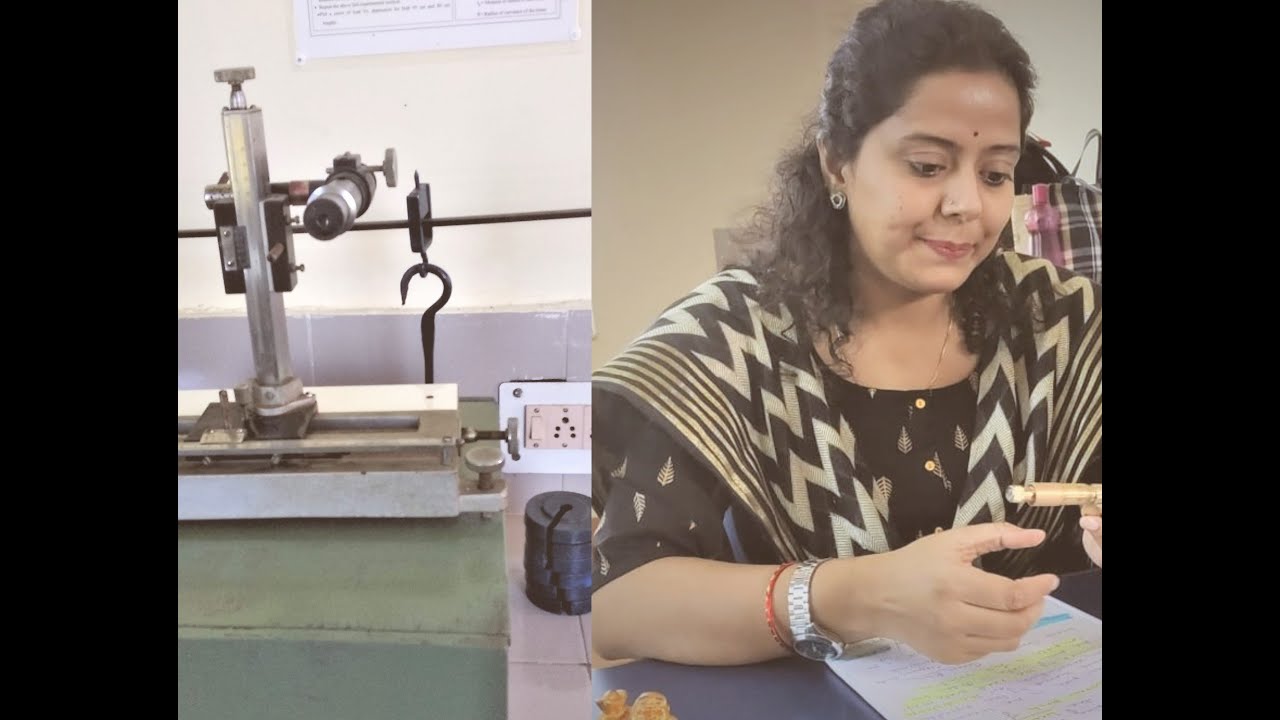
Determination the Young’s Modulus by the flexure of a beam (In Bangla), Physics Lab I, PHY 102
Автор: বিদ্যাভূমি - BiddaVumi
Загружено: 2025-02-21
Просмотров: 3537
Описание:
#youngsmodulus
For More:
https://sites.google.com/view/cselabb...
Course Title: Physics Lab I
Course Code: PHY 102
Experiment No.:04
Name of the Experiment:
Determination of the Young’s Modulus by the flexure of a beam
Objectives:
a) To determine Young’s modulus by the flexure of a beam
b) To determine the intrinsic property of the given material
Theory:
Provided the distortion of a body is not too great it has been found that the amount of distortion is directly proportional to the magnitude of the forces producing the distortion. This fact is known as “Hooke’s” law. If a wire of natural length l is stretched or compressed a distance x by a force F, experiment reveals that
F = kx----------------------------- (1)
Where, k is a constant whose value will depend on the material, the dimension of the wire and the units used for measurement. In practice it is very desirable that the value of the constant should depend only on the material of the specimen and not on its dimension. Experiment shows that such a constant exists-it is called Young’s modulus of elasticity for the material-symbol Y.
If a force F be applied normally to a cross-sectional area A of the material in the form of a wire, then F/A is called the tensile stress.
Young’s modulus Y is then defined as the ratio of the tensile stress to tensile strain.
Y = tensilestress/tensilestrain = (F/A)/(x/l)
= mg/〖πr〗^2 ×l/x dynes/ cm2
Where m is the mass of the load, g is the acceleration due to gravity and r is the radius of the wire. Let x be the increase in length produced in an original length l as a result of this force, then x/l, is called the tensile strain.
If a rectangular beam of breadth b and thickness d is supported near its two ends by two knife edges separated by a distance l and if a mass m acting at a point of the beam equidistant from the knife edges produces a depression x, then the Young’s modulus of the material is given by Y= (mgl^3)/(4bd^3 x)
As stress is a force per unit area, it must be expressed in dynes per sq. cm or other units of similar dimensions. A strain is a ratio and has no dimension. Young’s modulus is, therefore, expressed in the same units as those used for stress.
Apparatus:
Pin and microscope,
meter scale,
suitable weights,
screw gauge and
A long wooden stick.
Experimental Procedure:
Put two suitable weights (say 1 to 2 kg) on the hook and scale pane to make the wires straight (dead load).
By means of a screw gauge measure the diameter of the experimental wire W at several regions (say 5 regions) with two perpendicular readings at each region. Calculate the mean diameter and the area of cross-section of the wire in sq. cm.
Multiply the area of cross-section of the wire in sq. cm by the breaking stress of the particular material given in the Appendix. This is the breaking load for the wire. The wire must not be loaded with more than half this breaking load.
To find the least count of the micro-meter screw attached to the frame, determine the value of the smallest division of the vertical scale. Give the circular scale a complete rotation and observe the linear distance through which the edge of the disc moves. The distance covered is the pitch of the screw. Divide the pitch by the number of circular divisions. This gives the least count of the micrometer.
Rotate the micrometer screw so that air bubble in the spirit level goes to the other end of it. Then rotate the micrometer screw in the opposite direction, until the air bubble is at the Centre of the spirit level. From now on the micrometer should always be turned in the same direction. Take the readings of the linear scale R and circular scale S.
Place load (say half kg) on the scale pan. Owing to elongation the level will be disturbed. After waiting for about a minute adjust the micrometer screw till the bubble is brought back to the center. Note the reading of the micrometer. The difference of the two readings will give the elongation due to the load added.
In this way put equal loads by a few installments and take the corresponding Readings. These are readings with the loads increasing on the pan.
When half the breaking load is reached, take out the load one by one from the pan and obtain another set of readings for loads decreasing, taking care to rotate the micrometer screw in the same direction. At each installment of decreasing the load, wait for about a minute before taking the reading.
Measure the length of the experimental wire from the point of suspension to the point where it is clamped to the apparatus
Calculate the elongation for each load increasing and decreasing. Take the mean. Draw the load versus mean elongation graph with load along abscissa and elongation along ordinate.
Calculation:
For the mass of ………………..gm
Young’s modulus of the material, Y= (mgl^3)/(4bd^3 x) dyne/cm2
Results and Discussion:
Young’s modulus of the given material is .................dyne/cm2
Повторяем попытку...

Доступные форматы для скачивания:
Скачать видео
-
Информация по загрузке:




![Как измеряют самые слабые силы во Вселенной? [Veritasium]](https://imager.clipsaver.ru/6lK2JVwajTw/max.jpg)




![Эффект Джанибекова [Veritasium]](https://imager.clipsaver.ru/N9HlQ-XVnFk/max.jpg)
![Пожалуй, главное заблуждение об электричестве [Veritasium]](https://imager.clipsaver.ru/6Hv2GLtnf2c/max.jpg)