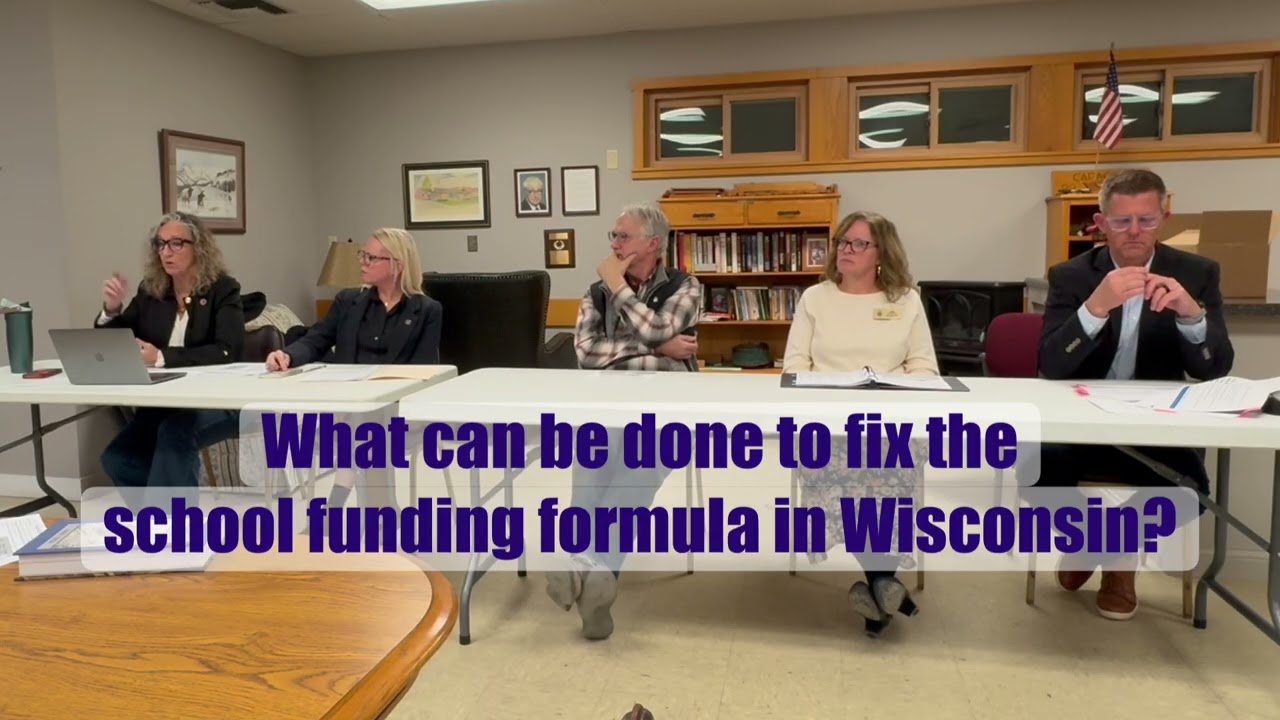
School Funding Panel Spring Green, WI @CommUNITYConversations2.0
Автор: CommUNITY Conversation’s
Загружено: 2026-02-28
Просмотров: 21
Описание:
Education Funding Panel & Discussion
Spring Green, Wisconsin
**School Funding**
Wisconsin public schools are funded primarily through general state aid and local property taxes. The combination of these two sources makes up a district's revenue limit.
• Through a partial veto in the 2023-25 State Budget, Governor Evers increased the revenue limit for all school districts by $325 per pupil.
• When general state aid stays flat, the entire revenue limit increase for the year has to be funded through local property taxes.
• When School Districts are forced to seek funding through property taxes, the number of operational referendum increases to cover / general operating revenue.
**2025-27 State Budget**
• Since 2009 Wisconsin public schools have not had their revenue limits adjusted to match inflation. Since then, school funding has not kept pace with inflation.
• The 2025-2027 Wisconsin State Budget allowed an increase in the revenue limit but provided no increase in general state aid to school districts.
• The last time there was no increase in State aid was the 2009-2011 budget cycle when Wisconsin faced a budget deficit.
• With rising costs and voucher schools siphoning off school funding, no increase in general aid is irresponsible.
**General School Aid: AB 495/SB 491**
• The 2025-27 State Budget provided no increase in general state aid to school districts.
• This bill increases state funding for school districts and protects districts from funding cuts through a "supplemental hold harmless aid" provision.
• This would ensure each district receives at least as much total state aid in the 2025-26 school year as it received in the 2024-25 school year.
• This bill aims to provide more responsive school funding that can adjust with inflation while maintaining a baseline of financial stability.
**Sum Sufficient Special Education: AB 859/SB 852**
• The 2025-27 State Budget established a "sum-certain" special education reimbursement of 42% in the first year.
• Annual funding, or "sum-certain" means the Legislature has provided a specific amount of funding that cannot be exceeded without Legislative approval.
• Already, districts are seeing reimbursement rates closer to 35%
• This bill would make the funding "sum-sufficient", meaning it allows agencies to spend whatever is necessary to fulfill the purpose.
**Voucher Schools**
In the 2023-2024 school year:
• In total, 92,000 students received private school vouchers costing Wisconsin taxpayers $573.6 million. When independent charter schools are included, it reaches $701 million.
• Funding for elementary and junior high private voucher schools increased from about $8,400 per student to $9,500 (13%) per student.
• Funding for private voucher high schools in the state went up from about $9,045 to $12,000 (33%) per student.
Source WPR & DPI
**Voucher schools strain school district funding**
• Wisconsin taxpayers are funding two separate school systems: one public and one private
• Voucher schools are private schools that use taxpayer dollars to subsidize the cost of private education
• When public school districts subsidize private schools, they are forced to go to operational referendum more often
• Operational referendums only cover general operating revenue
• Taxpayers still foot the bill for this program even when there are no voucher schools in their district.
**Voucher schools have weaker student protections**
• Religious entities (which comprise ~95% of voucher schools) are exempted from federal Title IX protections against discrimination.
• Private voucher schools are "only required to offer services to assist students with special needs that it can provide with minor adjustments".
**Voucher Disclosure: AB 504/SB 483**
Taxpayers should be informed right on their property tax bill how much they are being shorted by the state. SB 483 would require that the cost of vouchers appear as a separate line item from public schools on property tax bills. The voucher system is, in large part, what leads to the massive wave of referenda impacting our local school districts. Districts need to raise revenue because state funds are taken by voucher schools.
(All of the information in this description was provided by Karen DeSanto’s Office.)
Повторяем попытку...
Доступные форматы для скачивания:
Скачать видео
-
Информация по загрузке: