The V-1 Flying Bomb | Training Video In English | Vergeltungswaffe 1 "Vengeance Weapon 1" | Upscaled
Автор: DroneScapes
Загружено: 2022-12-07
Просмотров: 31772
Описание:
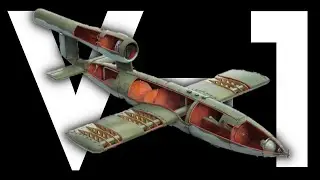
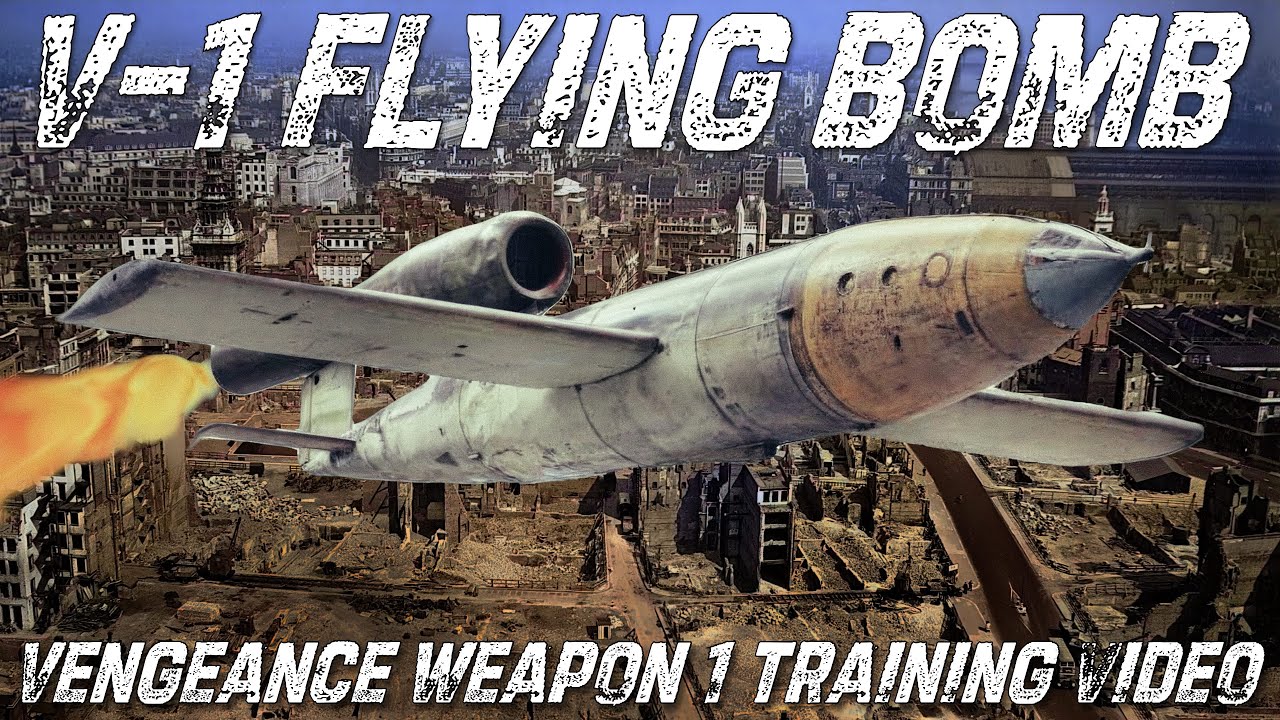
The V-1 Flying Bomb's original training video translated into English. The V-1 or Vergeltungswaffe 1 AKA Vengeance Weapon 1 was an early cruise missile. This German training film labeled as "TOP SECRET" from the E.d.L (Erprobungsstelle der Luftwaffe = Test Center of the Air Force) Karlshagen describes in detail the technique and handling of this completely new weapon system. Its official Reich Aviation Ministry (RLM) designation was Fi 103. It was also known to the Allies as the buzz bomb or doodlebug and in Germany as Kirschkern (cherry stone) or Maikäfer (maybug).
The V-1 was the first of the Vergeltungswaffen (V-weapons) deployed for the terror bombing of London. It was developed at Peenemünde Army Research Center in 1939 by the Luftwaffe at the beginning of the Second World War, and during initial development was known by the codename "Cherry Stone". Because of its limited range, the thousands of V-1 missiles launched into England were fired from launch facilities along the French (Pas-de-Calais) and Dutch coasts.
The Wehrmacht first launched the V-1s against London on 13 June 1944,one week after (and prompted by) the successful Allied landings in France. At peak, more than one hundred V-1s a day were fired at southeast England, 9,521 in total, decreasing in number as sites were overrun until October 1944, when the last V-1 site in range of Britain was overrun by Allied forces. After this, the Germans directed V-1s at the port of Antwerp and at other targets in Belgium, launching a further 2,448 V-1s. The attacks stopped only a month before the war in Europe ended, when the last launch site in the Low Countries was overrun on 29 March 1945.
As part of operations against the V-1, the British operated an arrangement of air defences, including anti-aircraft guns, barrage balloons, and fighter aircraft, to intercept the bombs before they reached their targets, while the launch sites and underground storage depots became targets for Allied attacks including strategic bombing.
In 1944, a number of tests of this weapon were conducted in Tornio, Finland. According to multiple soldiers, a small "plane"-like bomb with wings fell off a German plane. Another V-1 was launched which flew over the Finnish soldiers' lines. The second bomb suddenly stopped its engine and fell steeply down, exploding and leaving a crater around 20 to 30 metres wide. The V-1 flying bomb was referred by Finnish soldiers as a "Flying Torpedo" due to its resemblance to one from afar.
In 1935, Paul Schmidt and Professor Georg Hans Madelung submitted a design to the Luftwaffe for a flying bomb. It was an innovative design that used a pulse-jet engine, while previous work dating back to 1915 by Sperry Gyroscope relied on propellers. While employed by the Argus Motoren company, Fritz Gosslau developed a remote-controlled target drone, the FZG 43 (Flakzielgerat-43). In October 1939, Argus proposed Fernfeuer, a remote-controlled aircraft carrying a payload of one ton, that could return to base after releasing its bomb. Argus worked in co-operation with C. Lorenz AG and Arado Flugzeugwerke to develop the project. However, once again, the Luftwaffe declined to award a development contract. In 1940, Schmidt and Argus began cooperating, integrating Schmidt's shutter system with Argus' atomized fuel injection. Tests began in January 1941, and the first flight made on 30 April 1941 with a Gotha Go 145. On 27 February 1942, Gosslau and Robert Lusser sketched out the design of an aircraft with the pulse-jet above the tail, the basis for the future V-1.
Lusser produced a preliminary design in April 1942, P35 Efurt, which used gyroscopes. When submitted to the Luftwaffe on 5 June 1942, the specifications included a range of 299 km (186 miles), a speed of 700 km/h (435 mph), and capable of delivering a 500-kilogram (1⁄2-long-ton) warhead. Project Fieseler Fi 103 was approved on 19 June, and assigned code name Kirschkern and cover name Flakzielgerat 76 (FZG-76). Flight tests were conducted at the Luftwaffe's Erprobungsstelle coastal test centre at Karlshagen, Peenemünde-West.
Milch awarded Argus the contract for the engine, Fieseler the airframe, and Askania the guidance system. By 30 August, Fieseler had completed the first fuselage, and the first flight of the Fi 103 V7 took place on 10 December 1942, when it was airdropped by a Fw 200. Then on Christmas Eve, the V-1 flew 900 m (1,000 yd), for about a minute, after a ground launch. On 26 May 1943, Germany decided to put both the V-1 and the V-2 into production. In July 1943, the V-1 flew 245 kilometres and impacted within a kilometre of its target.
The V-1 was named by Das Reich journalist Hans Schwarz Van Berkl in June 1944 with Hitler's approval.
#v1 #flyingbomb #ww2
Повторяем попытку...
Доступные форматы для скачивания:
Скачать видео
-
Информация по загрузке:
![Gloster Meteor - The First Jet That Chased And Downed A Nazi V-1 Flying Bomb [WWII DOCUMENTARY]](https://image.4k-video.ru/id-video/I_GJWH0xdeM)