How AI Catches Crypto Criminals: GNNs & Blockchain Forensics Explained
Автор: Antosh Dyade
Загружено: 2026-02-06
Просмотров: 2
Описание:
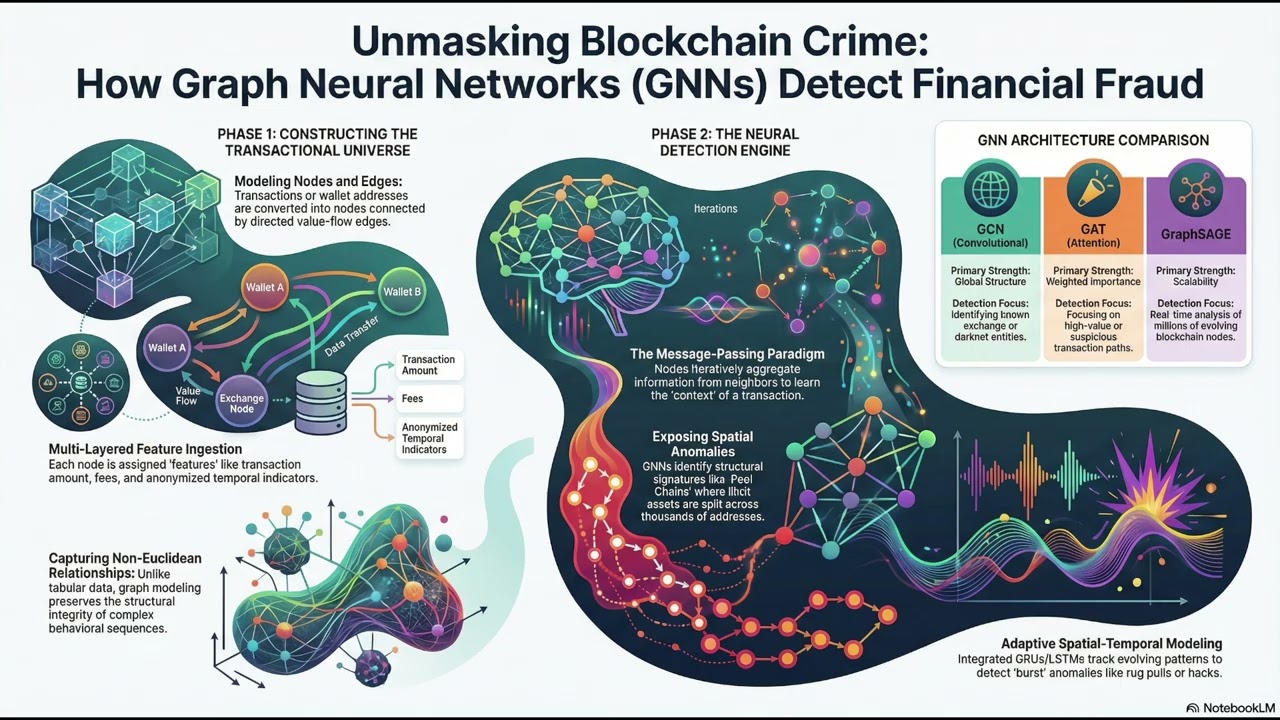
Discover how Graph Neural Networks (GNNs) are revolutionizing the detection of financial crimes on the blockchain. This audio overview dives deep into the latest research on how AI models analyze transaction graphs to uncover money laundering, phishing scams, and Ponzi schemes hidden within the complexity of decentralized ledgers.
In this overview, we cover:
1. The "God’s Eye" View of the Blockchain Unlike traditional machine learning, GNNs model blockchain data as complex graphs where nodes represent accounts and edges represent the flow of assets. We explore how models like MDST-GNN (Multi-Distance Spatial-Temporal GNN) capture both local and global dependencies to identify illicit patterns that span multiple "hops" in the network.
2. GNNs vs. Transformers: The Battle for Detection Which architecture is better at catching criminals? We break down a comparative study between Graph Attention Networks (GAT) and Graph-enhanced Transformers (GTAD-T).
• GNNs (GAT): Excel at spotting structural laundering patterns like "smurfing" or mixing services, achieving higher precision.
• Transformers: Leverage self-attention to detect long-range temporal behaviors, achieving higher recall for sophisticated, time-dispersed crimes.
3. Detecting Specific Crimes
• Phishing Scams: How PEAE-GNN uses "ego-graphs" and interaction intensity features to flag phishing accounts on Ethereum. We also look at DA-HGNN, which combines data augmentation with hybrid GNNs to handle the imbalance between licit and illicit samples.
• Ponzi Schemes: An analysis of X-SPIDE, an explainable pipeline that not only detects smart contract fraud but uses Shapley values to explain why a contract is a Ponzi scheme.
• Privacy Coins (Monero): How researchers use ART (Address-Ring-Transaction) graphs to investigate illicit activity even in privacy-preserving networks like Monero.
4. Advanced Techniques & Future Trends
• Temporal Dynamics: Understanding how models like ATGAT use triple attention mechanisms (structural, temporal, and global) to track evolving fraud patterns.
• Code Vulnerabilities: How SCGformer converts smart contract opcodes into Control Flow Graphs (CFG) to detect vulnerabilities without needing the original source code.
• Hybrid Sampling: How techniques like SGAT-BC use ensemble learning (Bagging and CatBoost) to solve the "class imbalance" problem, where fraud represents less than 2% of total transactions.
Timestamps: 0:00 - Introduction: Why Graph Neural Networks? 2:15 - Structural vs. Temporal Detection (GAT vs. Transformers) 5:30 - Spotting Phishing and Ponzi Schemes (X-SPIDE & DA-HGNN) 8:45 - Cracking Privacy Coins: Monero & ART Graphs 11:20 - The Future of Forensic AI
#Blockchain #AI #GNN #CryptoCrime #MoneyLaundering #Ethereum #Bitcoin #MachineLearning #CyberSecurity #FinTech #Forensics
Повторяем попытку...
Доступные форматы для скачивания:
Скачать видео
-
Информация по загрузке: