Sword Kata Freestyle: ASU Kumitachi #1
Автор: Tampa Aikido
Загружено: 2020-05-27
Просмотров: 3498
Описание:
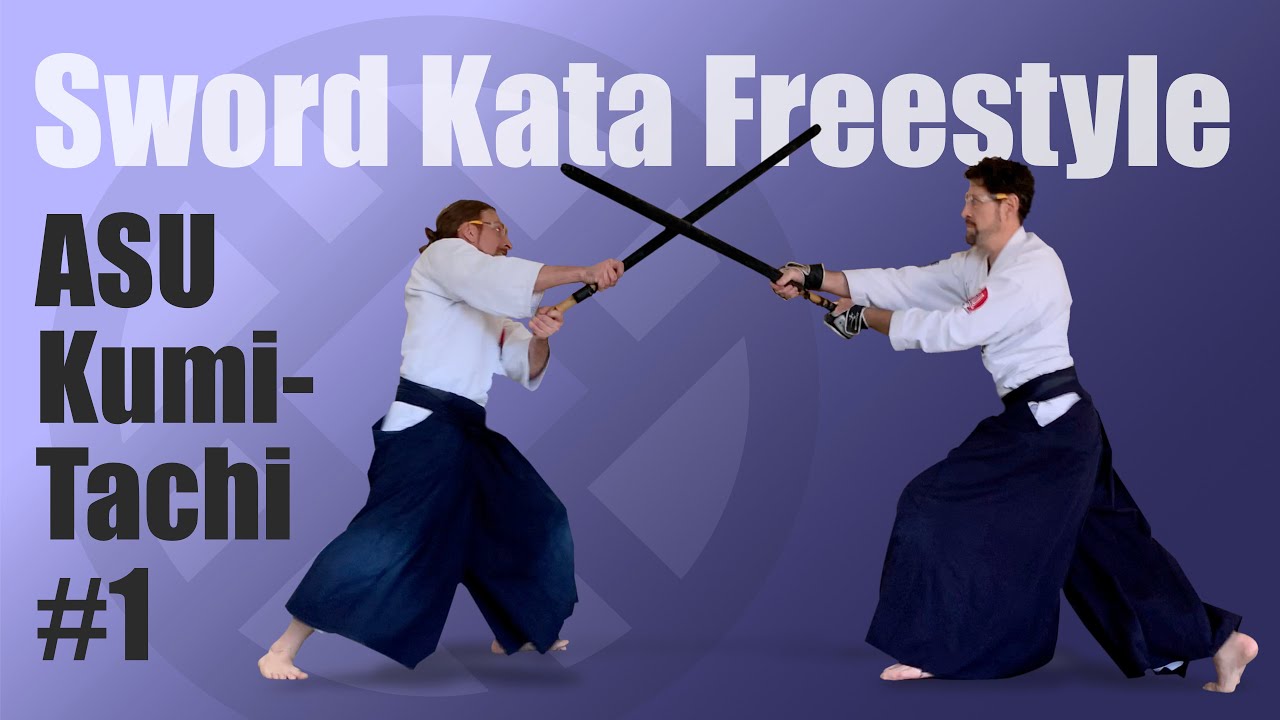
"Kata" is the opposite of "freestyle", right? Unfortunately, if kata is learned as rote choreography, it often lacks meaning and depth; the practitioner can learn to make the moves more confident and sharp, but will never build an understanding of "why" each step in the kata is the way it is. This video shares some of our training in how to explore kata by adding improvisation, adding intent to kill with every movement, while still maintaining the overall kata sequence as an objective for both participants. Ideally, the kata will end exactly as designed (no variation); however, if there is the slightest variation in movement, or if either participant changes intent, clarity, or responsiveness, a different outcome ensues. In this manner, we hope to be true to how Saotome Shihan taught his original kumitachi kata: with variations; with the idea that the variations are not additional kata to be learned by rote, but were intended to reveal different outcomes resulting from different intent, angles, or speeds.
These are the "rules" we developed for this freestyle practice:
1. Start by performing the kata in its standard (canon) form, at standard speed. Occasionally reset the form and speed to be reminded of the full manifestation of the kata's sequence and form.
2. Start speeding up, and adding intensity and imagination (that this is serious martial practice).
3. Add the goal that both participants try to win (end the kata) with EVERY CUT, while also trying to follow their part of the kata to the end. To win, they must be sharper, faster, cleaner, more accurate with each movement than their opponent. Understand that even following their part in the kata, the kata can end at any time if one of the participants makes a better cut.
4. If opponent seems to be anticipating (predicting) the next move, either participant is allowed to take advantage of that by doing something different. However, neither should try to be sneaky, or try to trick, outguess, or apply tactics to control the outcome. The goal of "switching things up" is just to keep both participants alert and un-programmed.
5. If a sequence wanders too far from the kata, both participants try to seek an ending with simple, clean basic strikes and blocks.
6. Always avoid muscling or overpowering an opponent through the weapon. Focus on crisp, fast, responsive movements. When in doubt, slow down and improve footwork and line control rather than overemphasizing technique (weapon interaction). In no case should either participant try to win by muscling through an opponent's defense.
I wish to emphasize: this is not kendo or kenjutsu. This is our training to explore our aiki-ken kata as taught by Mitsugi Saotome Shihan, in the spirit that we think he meant – to not let ourselves become trapped in the form, while still using the form as a guideline for our practice.
Saotome Sensei often will raise a bokken (wooden sword) and ask, "what is this? This is a live blade! Use your imagination!" Our intent is to treat our shinai as deadly, edged weapons. But at the same time, it is not "make believe"; they are not really swords, and we are not really training for live sword-on-sword combat. We try to remember that visualization of our training weapons as lethal is only a gateway for understanding how to use them better as wooden or bamboo weapons, or for how they can teach us about open hand training. So, while they are not swords, they aren't baseball bats either.
A few notes that may interest observers:
The shinai we were using in this clip were relatively light, and good for speed.
We broke one of the shinai somewhere along the line. The bamboo slats inside the covering were snapped.
I started wearing gloves because the suede on Barry's shinai started slicing up my knuckles. Either I consistently left my wrists exposed, or Barry really just liked hitting my knuckles.
There were no injuries (aside from the knuckles) other than some light bruising.
You might not be able to see it, but Barry was really stretching out the initial distance (ma-ai), making me really have to cross the distance when I was attacking. It definitely affected the manifestation of the kata.
Participants: Sensei Guy Hagen and Sensei Barry Engh. Video by Guy Hagen.
===========================================
The ASU Aikido Chuseikan of Tampa Bay dojo is affiliated with the Aikido Schools of Ueshiba and Aikido World Headquarters, and provides quality adult and family martial arts instruction in Tampa, Florida.
http://tampaaikido.com
http://tampaaikido.com/facebook
Creative Commons Non-Commercial Attribution license - please use and share, but give a link and credit if you do!
Повторяем попытку...
Доступные форматы для скачивания:
Скачать видео
-
Информация по загрузке: