Unscripted E3: Introduction to the Latent Curve Model
Автор: CenterStat
Загружено: 2023-02-23
Просмотров: 2217
Описание:
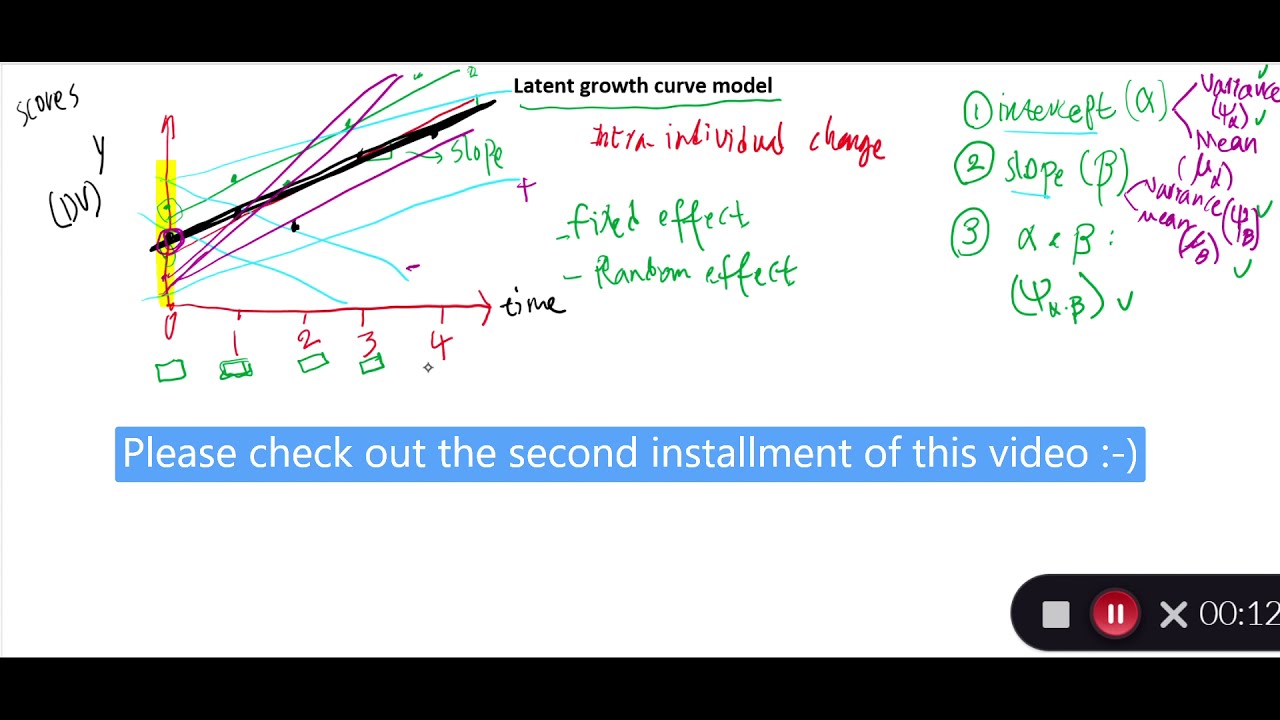
Dan and Patrick bicker their way through an introduction to the latent curve model (LCM), a common type of structural equation model used to analyze change over time. They begin by discussing two time-point longitudinal models, and then extend this to three or more time points. They describe the theoretical concept of an individual growth trajectory and explore how latent factors can be defined to estimate growth trajectories using repeated measures data. They then discuss incorporating time-invariant and time-varying predictors and conclude with a brief survey of more advanced models and applications. This is interspersed with Patrick throwing creamers at Dan, and Dan threatening Patrick with a white board marker. Please visit centerstat.org for additional freely-available instructional materials and other training opportunities, including a comprehensive online workshop dedicated to longitudinal SEM and LCM.
Please visit centerstat.org for additional freely-available instructional materials and other training opportunities. You can also sign up for notifications about future Unscripted episodes at centerstat.org/centerstat-unscripted/
Bollen, K. A., & Curran, P. J. (2006). Latent curve models: A structural equation perspective. John Wiley & Sons.
Curran, P. J., Bauer, D. J., & Willoughby, M. T. (2004). Testing main effects and interactions in latent curve analysis. Psychological Methods, 9, 220-237.
Curran, P.J., Bauer, D.J, & Willoughby, M.T. (2006). Testing and probing interactions in hierarchical linear growth models. In C.S. Bergeman & S.M. Boker (Eds.), The Notre Dame Series on Quantitative Methodology, Volume 1: Methodological Issues in Aging Research (pp.99-129). Mahwah, NJ: Lawrence Erlbaum Associates.
Curran, P. J., Obeidat, K., & Losardo, D. (2010). Twelve frequently asked questions about growth curve modeling. Journal of Cognition and Development, 11, 121-136.
Curran, P. J., & Willoughby, M. T. (2003). Implications of latent trajectory models for the study of developmental psychopathology. Development and Psychopathology, 15, 581-612.
McArdle, J. J. (2009). Latent variable modeling of differences and changes with longitudinal data. Annual Review of Psychology, 60, 577-605.
Preacher, K. J., Curran, P. J., & Bauer, D. J. (2006). Computational tools for probing interactions in multiple linear regression, multilevel modeling, and latent curve analysis. Journal of Educational and Behavioral Statistics, 31, 437-448.
Повторяем попытку...

Доступные форматы для скачивания:
Скачать видео
-
Информация по загрузке: