Kinematics and One Dimensional Motion - Physics Basics
Автор: Mostly Physics
Загружено: 2023-08-12
Просмотров: 4874
Описание:
In this video we cover one dimensional kinematics, or motion in a straight line, for intro physics. Kinematics is an area of mechanics that describes motion and answer questions such as, where is an object, how fast is an object moving, is the object speeding up or slowing down, etc.
0:00 - Introduction to Kinematics
0:27 - Displacement
2:26 - Distance
2:40 - Displacement vs Distance
6:52 - Average Velocity
8:21 - Average Speed
8:48 - Velocity vs Speed
9:18 - Position and Velocity Graphs
11:25 - Instantaneous Velocity
12:58 - Acceleration
14:50 - Units of Acceleration
16:03 - Velocity from Acceleration
17:15 - Position from Velocity
Position is where an object is located. In order to describe the position, it is important that we have a coordinate system. In one dimension, this coordinate system is typically an x-axis or y-axis depending on whether motion is horizontal or vertical. The position by itself does not have much meaning, but a coordinate system gives us something to measure the positive relative to, typically the origin of the coordinate system. In two dimensions, objects would have position with an x- and y-component that tells us how far left or right and how far up or down the object is from the origin.
It's important to remember that we get to choose our coordinate system and where we put it. If we notice that an object is moving along a straight line but that line is at an angle, such as when a square block slides down a ramp, we can rotate or coordinate system so that our axis aligns with the direction of motion. This is something we will do in the future. The important thing to remember, is that all of our equations, coordinate systems, and tools for solving problems and understanding physics are just that, tools!
Displacement is different from position, it is the change in position. This is an important distinction. There is only a displacement when the position changes, which means we need a starting or initial position and an ending or final position. Mathematically, how do we find displacement? We always find the displacement as the final position minus the initial position. Displacement is also a vector quantity that points from the initial position to the final position.
Distance and displacement are different! Distance is the overall length traveled and is a scalar. So if you move 10 meters to the right and then 10 meters to the left, the distance, or overall length traveled, is 20 meters. However, you ended at the same position as you started, therefore the displacement is zero. Now if we only looked at the first have the motion, where we moved 10 meters to the right. In this case the distance and the displacement have the same magnitude, 10 meters. So sometimes they can be the same and sometimes they can be the different. Distance, as a scalar, does not have a direction.
Speed vs velocity:
Velocity is defined as the change in position over the change in time, or displacement over the change in time. It is also a vector quantity since displacement is a vector. Speed is different from velocity because it is a scalar and is just defined as the distance over elapsed time. These definition are technically average velocity and average speed. Speed and velocity both have units of m/s.
Acceleration is the change in velocity over the change in time, which means it is also a vector quantity. An object can accelerate by speeding up, slowing down, or changing direction. The last one is primarily relevant for motion in two dimensions which we'll look at in the future.
We can graph position, velocity, and acceleration over time as a useful tool for analyzing motion. There are also relationships between these graphs. If we look at the definitions of average velocity and acceleration, they are the change in one quantity over the change in time. If we write average velocity for example as the final position minus initial position divided by the final time minus the initial time, this looks like the equation for slope. So the slope of a position vs. time graph gives the average velocity. If we imagine bringing these two points together, we can imagine a line that touches our graph at a single point representing the slope of velocity at that instant. This is the instantaneous velocity. We can do the same thing for acceleration and the velocity vs. time graph.
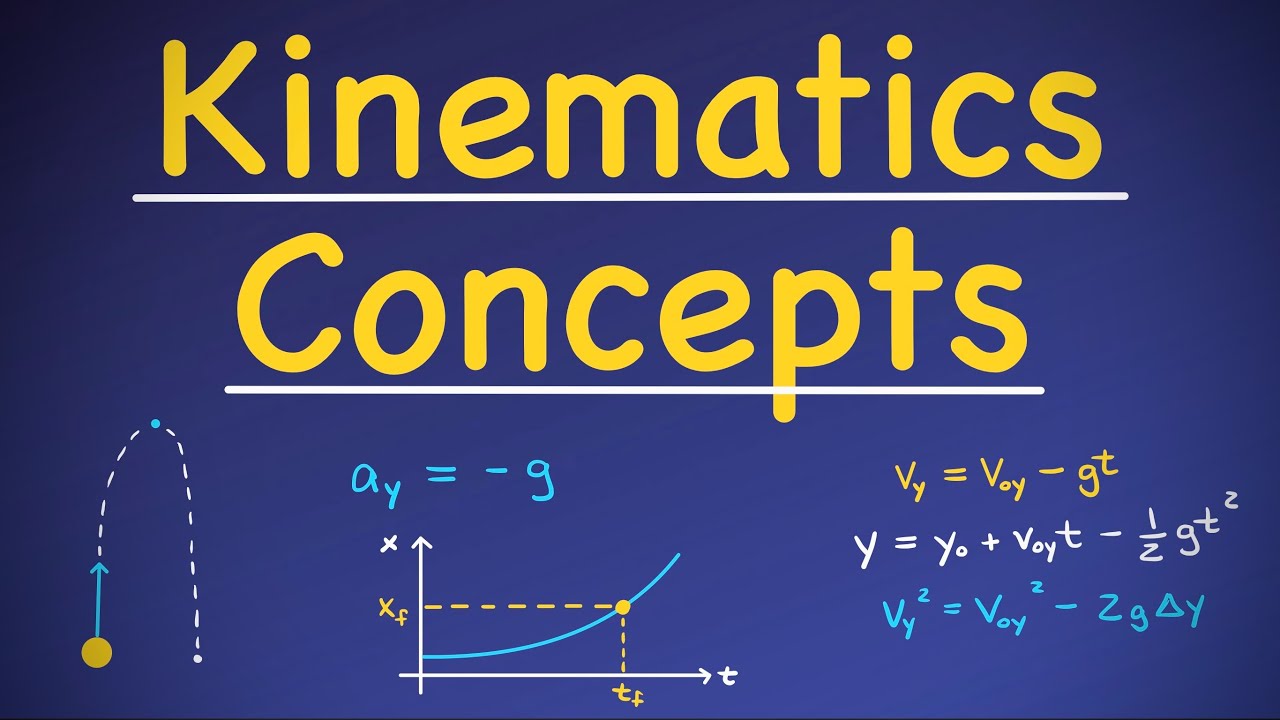
We will focus on motion where acceleration is constant. A real example of this is when objects are only moving under the influence of gravity, such as a rock that is falling, dropped or thrown straight up. This motion is called free-fall. For constant acceleration motion, we can derive kinematic equations that describe this motion. We will use these in 1D and 2D kinematics.
Повторяем попытку...
Доступные форматы для скачивания:
Скачать видео
-
Информация по загрузке:
![How to Use Conversion Factors [Unit Conversions]](https://image.4k-video.ru/id-video/cgWAMubT2lw)

![MATHS (Class -9) [Surface Areas and Volumes]](https://image.4k-video.ru/id-video/PNZMAAevQ6Y)



![[НОВОЕ] Обзор кинематики курса AP Physics 1, Модуль 1](https://image.4k-video.ru/id-video/jDHXw69AlYA)


![Resistors & Basic Circuits [Series and Parallel]](https://image.4k-video.ru/id-video/RGizNzK230E)