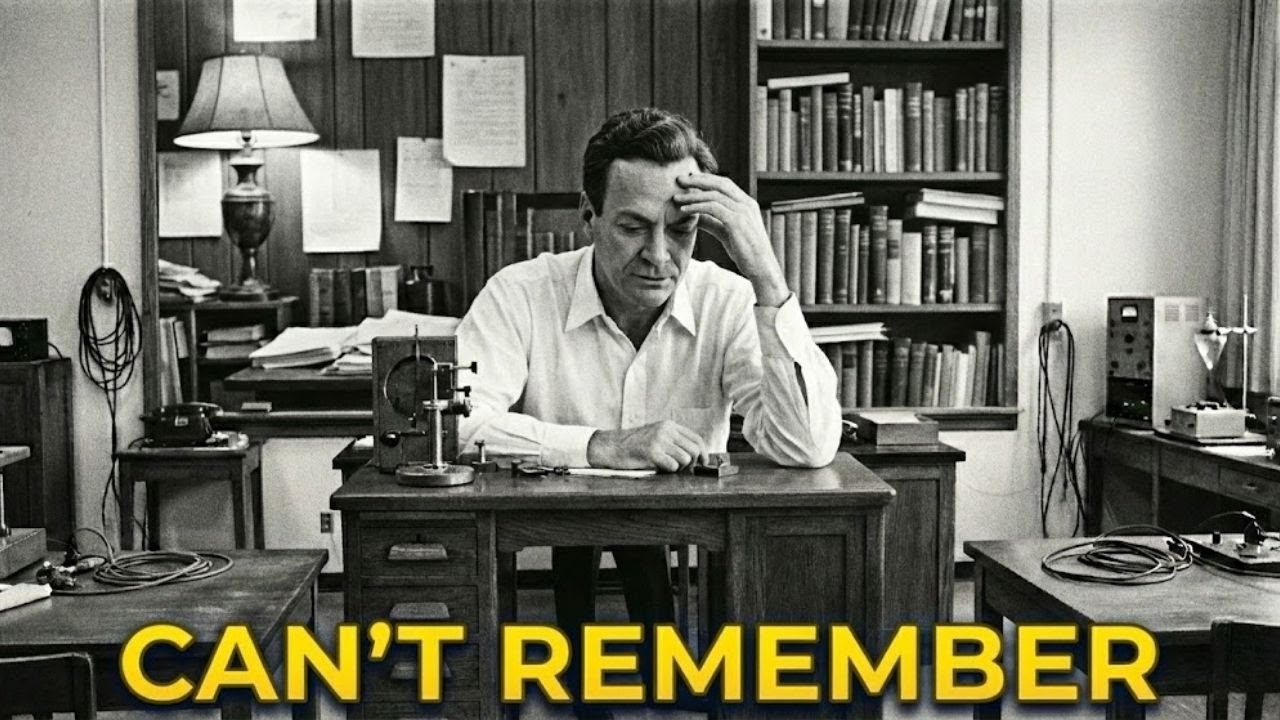
Why You Can't Remember Tomorrow - Feynman on Time
Автор: The Feynman Lab
Загружено: 2026-01-21
Просмотров: 73
Описание:
This video is inspired by Richard Feynman's understanding of time, entropy, and the second law of thermodynamics, presented from his perspective.
Why can you remember yesterday but not tomorrow? It seems like an obvious question. Of course we remember the past, not the future. That's just how time works.
But why? What makes past and future different?
The fundamental laws of physics don't distinguish between past and future. Newton's laws. Maxwell's equations. Schrödinger equation. All time-symmetric. They work equally well forward and backward.
So where does time's arrow come from? Why does time flow in one direction?
The answer is entropy. The second law of thermodynamics. Entropy increases. And this single fact explains everything about time's direction.
In this video:
→ Why fundamental physics is time-symmetric
→ Why everyday experience is time-asymmetric
→ What entropy actually is (microstates vs macrostates)
→ Why the second law is statistical, not fundamental
→ How entropy increase creates the arrow of time
→ Why we remember the past but not the future
→ Why causes precede effects
→ Why eggs break but never un-break
→ The cosmological mystery: why was entropy low at the Big Bang?
→ Why time's arrow is emergent, not fundamental
Memory is a physical record. Creating a memory requires encoding information in a low-entropy state. Your brain. Neurons firing in specific patterns. That's ordered. Low entropy locally.
But you can only create records of the past because the past was lower entropy. The universe started in a very special low-entropy state at the Big Bang. Structure. Correlations. Information.
The future is higher entropy. More random. Less correlated. There's nothing to record yet. No structure to encode.
So memory points backward because entropy points forward.
The same goes for causality. Causes precede effects because correlations flow from the low-entropy past. The Big Bang provides the initial conditions. The boundary condition that makes cause-and-effect work.
All the time asymmetries we experience - memory, causality, eggs breaking, coffee mixing - all trace back to one fact: entropy was low at the beginning and has been increasing ever since.
But why was it low? That's the real mystery. That's cosmology. The Big Bang. Initial conditions. We don't fully know.
Maybe inflation smoothed things out. Maybe anthropic selection. Maybe something we haven't discovered. But whatever the reason, that low-entropy start is what gives us time's arrow.
Time doesn't flow because of a fundamental law. Time flows because entropy increases. And entropy increases because the universe started in a very special, very unlikely, very low-entropy state.
The content is inspired by Feynman's work and understanding, presented for educational purposes.
⚠️ DISCLAIMER:
This channel has no official affiliation with Richard Feynman or his estate. The content is inspired by his understanding of thermodynamics, statistical mechanics, and the arrow of time, created solely for educational purposes. This is not Richard Feynman's voice. No impersonation is intended. Our goal is to respectfully share insights from physics in an inspiring way.
→ All content is carefully researched original educational material based on extensive study of thermodynamics, statistical mechanics, cosmology, and the arrow of time. Created independently for science education.
→ Our mission is to educate a NEW GENERATION about the profound questions in physics. This is our way of keeping scientific understanding alive.
🔔 Subscribe for deep physics insights from Feynman's perspective
👍 Like if "entropy creates time's arrow" blew your mind
💬 Comment: Did you know physics laws are time-symmetric?
Повторяем попытку...
Доступные форматы для скачивания:
Скачать видео
-
Информация по загрузке: