Symphony No.12 "La Rurale" - Darius Milhaud
Автор: Sergio Cánovas
Загружено: 2024-06-23
Просмотров: 1305
Описание:
Basel Radio Symphony Orchestra conducted by Alun Francis.
I - Pastoral: 0:00
II - Vif et gai: 3:48
III - Paisible: 7:05
IV - Lumineux: 10:58
Milhaud's Symphony No.12 was composed in 1961, commissioned for the inauguration of a new concert hall at the University of California at Davis. It was premiered there by the San Francisco Symphony Orchestra under the baton of Enrique Jordá. At the aforementioned University, Jérome Rosen had been in charge of creating a music department. Its success was so great that they were soon forced to build a concert hall capable of holding 2,500 seats.
The university and campus has long been known for the excellence of its agricultural training and research, and has significantly contributed to agricultural innovations. Milhaud, coming from the sunny and agriculturally rich Provence region in France, had an attraction to the subject of growing crops. Over forty years earlier he had even set the words of a Farm Machinery catalogue to music. The association produced one of the most jovial and bright symphonies he wrote, despite being his last numbered one. The composer's publisher would discourage him from writing more symphonies.
The first movement is monothematic in form. It begins with a bucolic and serene main theme on woods and strings, only disturbed by brief dramatic peaks that employ polytonality. It is then reexposed in its entirety, leading us to a calm coda.
The second movement is structured in ternary form. It opens with a bright and animated main theme in form of a march, reminding us of Milhaud's mediterranean neoclassicism. It is contrasted by a more reflective and melodic second theme on woods, but quickly becomes blurred. The main theme returns, made spikier and more angular through polytonality. The music then goes into a diminuendo, dissolving in the silence.
The third movement is also monothematic. It begins with a lyrical main theme introduced between clarinet and horns and taken by strings. A countermelody is soon added in another tonality, as the material unfolds linearly. The orchestration and dynamics are smooth and light, unlike the more dramatic and expressive slow movements from previous symphonies. A final recapitulation of the theme leads us to a calm coda.
The fourth movement is written in sonata form. It opens with a measured, rhythmic main theme contrasted by a more lyrical second one, pastoral in nature. The ensuing development combines and transforms the rhythmic and bucolic elements of the music, making use of rhythm changes and polytonality in a more subtle way. An unusual coda, with the themes in counterpoint in different keys, ends the movement with decision.
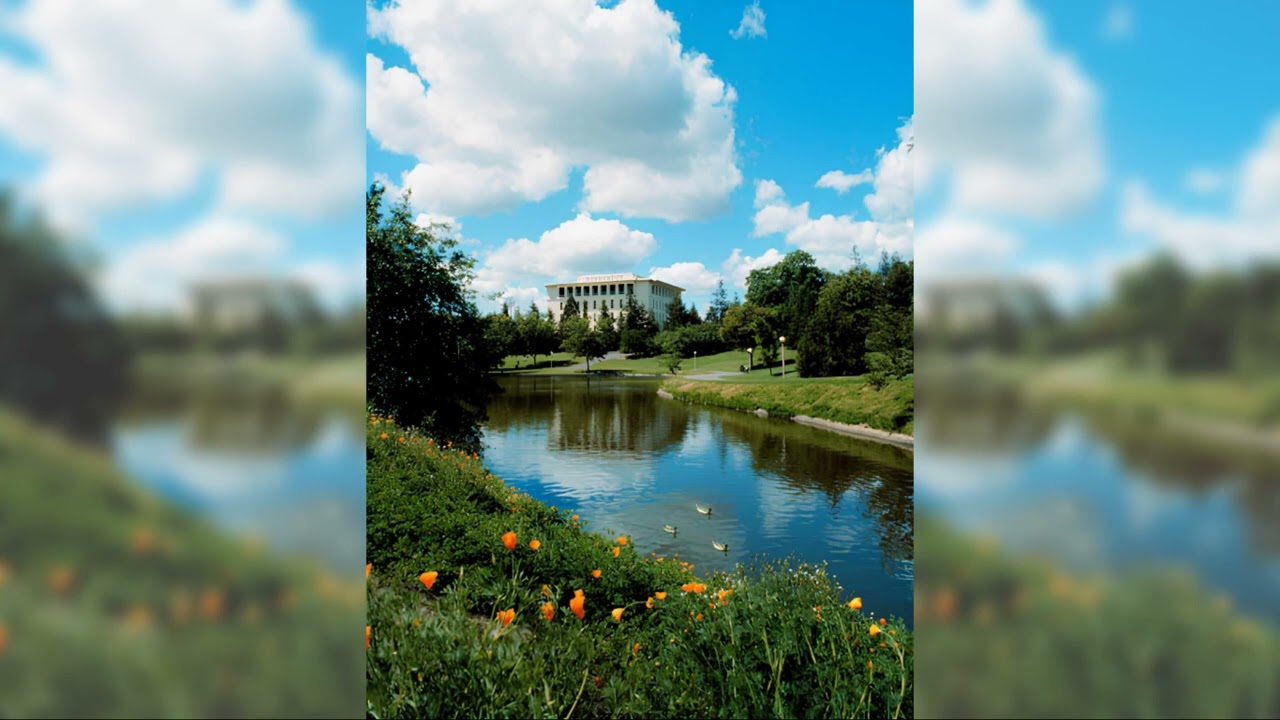
Picture: Photograph of a view of Mrak Hall, the administrative building of UC Davis, from the Arboretum.
Musical analysis mostly written by myself. Sources: https://tinyurl.com/28dy7vq2 and https://tinyurl.com/2auk5wz5
Unfortunately, the score is not freely available.
Повторяем попытку...
Доступные форматы для скачивания:
Скачать видео
-
Информация по загрузке: