IgM Antibodies – First Line of Defense | Immunology Made Easy
Автор: Fakirsir
Загружено: 2026-01-18
Просмотров: 61
Описание:
Introduction
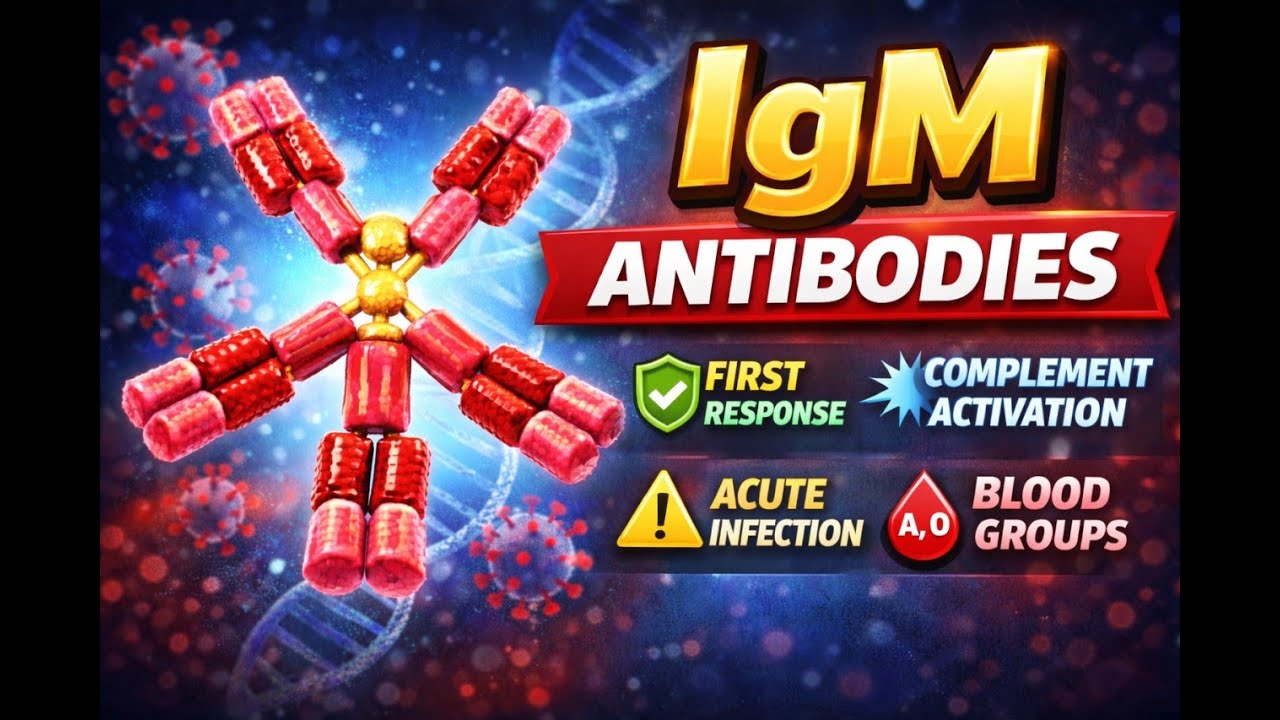
Immunoglobulin M (IgM) is one of the five major classes of antibodies (IgG, IgA, IgM, IgE, and IgD) produced by the immune system. IgM plays a crucial role in the early (primary) immune response and is the first antibody to appear in the blood following exposure to an antigen.
Structure of IgM
IgM is the largest antibody in the human body.
It is mainly present as a pentamer in blood and extracellular fluid.
Each pentamer consists of:
5 basic immunoglobulin units
10 antigen-binding sites
A J (joining) chain that stabilizes the structure
In immature B cells, IgM exists as a monomer on the cell surface and acts as a B-cell receptor (BCR).
Key structural feature:
Due to its pentameric form, IgM has very high avidity (strong overall binding to antigens).
Production and Distribution
Produced by plasma cells derived from activated B lymphocytes.
Mainly found in:
Blood (intravascular space)
Lymph
Because of its large size, IgM does not cross the placenta.
Functions of IgM Antibodies
1. Primary Immune Response
IgM is the first antibody produced after initial exposure to an antigen.
Appears within 3–7 days of infection.
Provides early defense before IgG production begins.
2. Complement Activation
IgM is the most efficient activator of the classical complement pathway.
A single IgM molecule can activate complement, unlike IgG which requires multiple molecules.
Leads to:
Cell lysis
Opsonization
Inflammation
3. Agglutination of Antigens
IgM effectively causes clumping (agglutination) of:
Bacteria
Red blood cells
This helps in rapid clearance by phagocytes.
4. Neutralization of Pathogens
IgM binds to viruses and toxins, preventing them from attaching to host cells.
5. Role in Blood Group Antibodies
ABO blood group antibodies (anti-A and anti-B) are mainly IgM.
Responsible for acute hemolytic transfusion reactions.
IgM in B-Cell Development
Surface IgM is the first immunoglobulin expressed on immature B cells.
Acts as an antigen receptor essential for:
B-cell maturation
Immune tolerance
Clinical Significance of IgM
1. Marker of Acute Infection
Presence of IgM antibodies indicates recent or active infection.
Used in diagnosis of:
Dengue (IgM ELISA)
Hepatitis A
Typhoid
Rubella
COVID-19 (early phase)
2. IgM in Newborns
IgM does not cross the placenta.
Detection of IgM in a newborn suggests intrauterine infection (e.g., TORCH infections).
3. Hyper-IgM Syndrome
A primary immunodeficiency disorder.
Characterized by:
High IgM levels
Low IgG, IgA, IgE
Caused by failure of class-switch recombination.
4. Waldenström’s Macroglobulinemia
A B-cell malignancy.
Excessive production of monoclonal IgM.
Leads to hyperviscosity syndrome.
Comparison of IgM and IgG
Feature IgM IgG
Size Largest Smaller
Structure Pentamer Monomer
First response Yes No
Placental transfer No Yes
Complement activation Very strong Moderate
Duration Short-lived Long-lasting
Half-Life
IgM has a short half-life of approximately 5 days, which explains its transient presence during infections.
Summary
IgM is the first and fastest antibody produced in immune responses.
It provides early protection, activates complement efficiently, and plays a major role in blood group immunity and infection diagnosis.
Though short-lived, IgM is vital for immediate immune defense.
Повторяем попытку...
Доступные форматы для скачивания:
Скачать видео
-
Информация по загрузке: