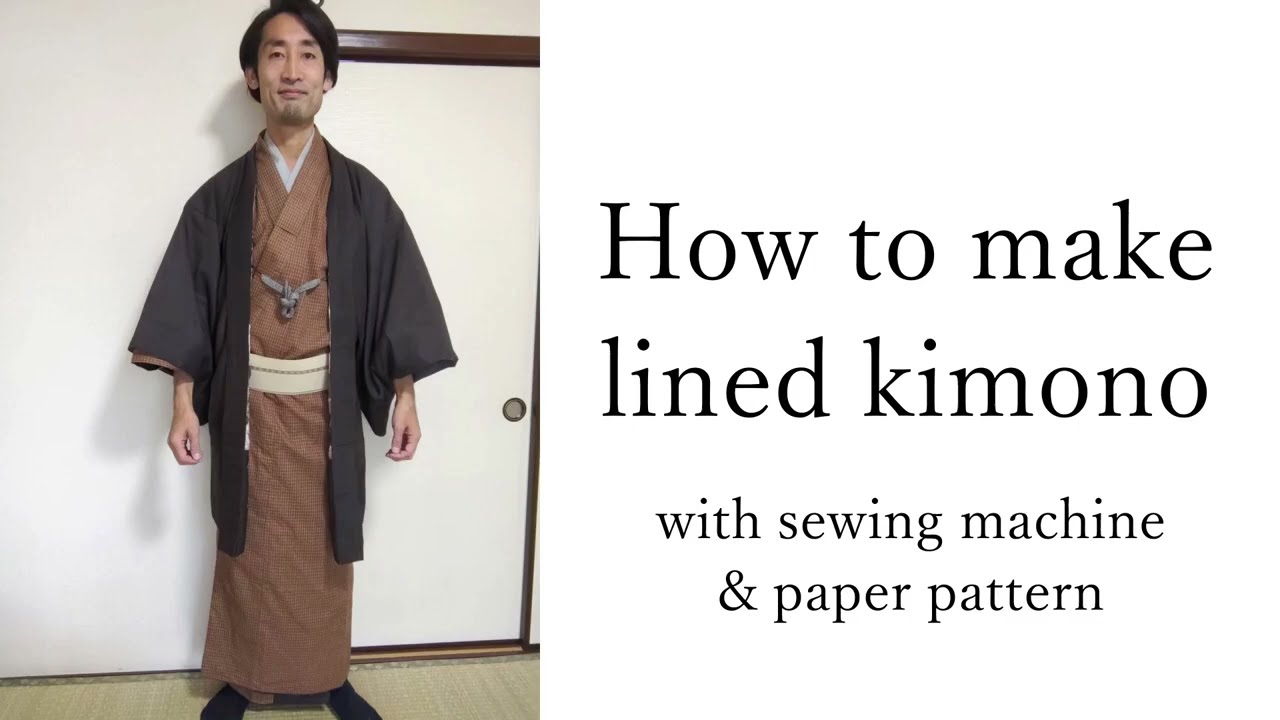
How to make lined kimono with pattern & sewing machine
Автор: ワカモノキモノ 和の学び Wakamono Kimono Lab
Загружено: 2026-01-28
Просмотров: 129
Описание:
item page
Under preparation
Purchase pattern and download
Under preparation
Email support on inquiry or trouble
[email protected]
Let's share your work
/ 209844911823511
Steps
===================================
Order Instructions
1 Pre-shrink the fabric (water soak).
Fill a tub with water and fold the bolt in an accordion (zigzag) so it can be submerged evenly.
Take it out of the water and hang to dry.
While still slightly damp, press from the wrong side, then roll and store.
2 Print the pattern pieces for:
Migoro (Body), Sleeve, Okumi, Collar, Kake Eri, Collar Interfacing
Cut out the patterns along the seam allowance lines.
Trim one side of each pattern join, then tape the joins together with cellophane tape.
If the bolt width is not enough:
Use the patch patterns for Migoro (Body)
Use the patch patterns for Sleeve
If the bolt length is not enough, use the mitsu-wari collar option and do not use the regular Collar.
3 ■ Cut the outer fabric
Fold the Migoro (Body) pattern in half. Fold the front/back hem outer seam allowance; use the folded pattern edge as a ruler/template.
If the fabric is bolt width
With the pattern length as the reference, fold the bolt right sides together into 4 layers in an accordion fold.
Cut off the two folded hems.
If the fabric is dressmaking width
With the pattern length as the reference, fold the fabric right sides together in half at the shoulder line.
Then fold again at the center back.
Cut along the seam allowance lines for sleeve attachment, Miyatsu-Guchi, side, and hem.
In the same way, use the Sleeve pattern as a template; with the pattern length as the reference, fold the fabric right sides together into 4 layers in an accordion fold.
Cut off the two folded sleeve bottoms.
Pre-fold the outer seam allowance at the Okumi hem on the pattern.
On the wrong side of the remaining fabric, place and check the layout for:
2 Okumi pieces, Collar, 2 Kake Eri pieces
Then cut them out.
■ Cut the lining
Unfold the Migoro (Body) pattern and the hem outer seam allowance that were folded.
Unfold the Okumi hem outer seam allowance, and fold the under-collar lining seam allowance at the collar bottom.
Cut Migoro (Body), Sleeve, and Okumi in the same way.
■ Cut the collar interfacing
Prepare a separate fabric for the collar interfacing.
4 (If the bolt length is not enough)
Use the mitsu-wari collar option.
Use a different fabric for the parts that will be hidden by the Kake Eri, and use the outer fabric for the parts that will be exposed.
Place the patterns on the outer fabric and the different fabric and cut them out.
Make two pieces in the outer fabric.
5 (If the bolt width is not enough for Migoro / Body)
Place the patch pattern for Migoro (Body) on the wrong side of the fabric and cut out two pieces at a time.
Do this for both Left/Right, and for both Outer Fabric and Lining.
6 (If the bolt width is not enough for Sleeve)
Place the patch pattern for Sleeve on the wrong side of the fabric and cut out two pieces at a time.
For the Outer Fabric, fold the pattern along the outer seam allowance line. For the Lining, use the pattern as-is.
Fold on the fold line (“wa”), stack two layers, and cut.
Do this for both Left/Right, and for both Outer Fabric and Lining.
7 Stack the left and right Migoro (Body) pieces right sides together, then place the pattern on top.
Align the center-back side of the pattern with the fabric edge and clip in place.
Leaving 3 mm of seam allowance around the collar/shoulder area, cut notches through the pattern and fabric.
Do this for both Outer Fabric and Lining; re-tape the cut pattern as needed each time.
8 ■ If the fabric is bolt width
Partially lift the pattern from the center back of the Migoro (Body). Keeping the layers right sides together, measure 1 cm from the fabric edge using the presser foot and straight-stitch the center back.
■ If the fabric is dressmaking width
Fold the Migoro (Body) at the center-back seam allowance, partially lift the pattern from the center back, measure 1 cm from the fold using the presser foot, and sew a Knob Stich (straight stitch by machine).
Do this for both Left/Right, and for both Outer Fabric and Lining.
9 (If the bolt width is not enough for Migoro / Body)
On the right side of the Migoro (Body), mark the shoulder line on the sleeve-attachment side with a chalk pen.
Align the fold line of the patch piece for Migoro (Body) to the shoulder line, right sides together, and clip in place.
Sew while measuring a 1 cm seam allowance with the presser foot.
Press the seam allowance toward the patch side from the wrong side.
Do this for both Left/Right, and for both Outer Fabric and Lining.
=============================
I can't post the rest of the article due to character limits, but all the steps are included as an instruction manual with the pattern after you purchase it.
Повторяем попытку...
Доступные форматы для скачивания:
Скачать видео
-
Информация по загрузке: