Westmont Chamber Singers: El Guayaboso by Guido Lopez Gavilán
Автор: Daniel Gee
Загружено: 2023-07-14
Просмотров: 697
Описание:
El Guayaboso
Music by Guido López-Gavilán (b. 1944)
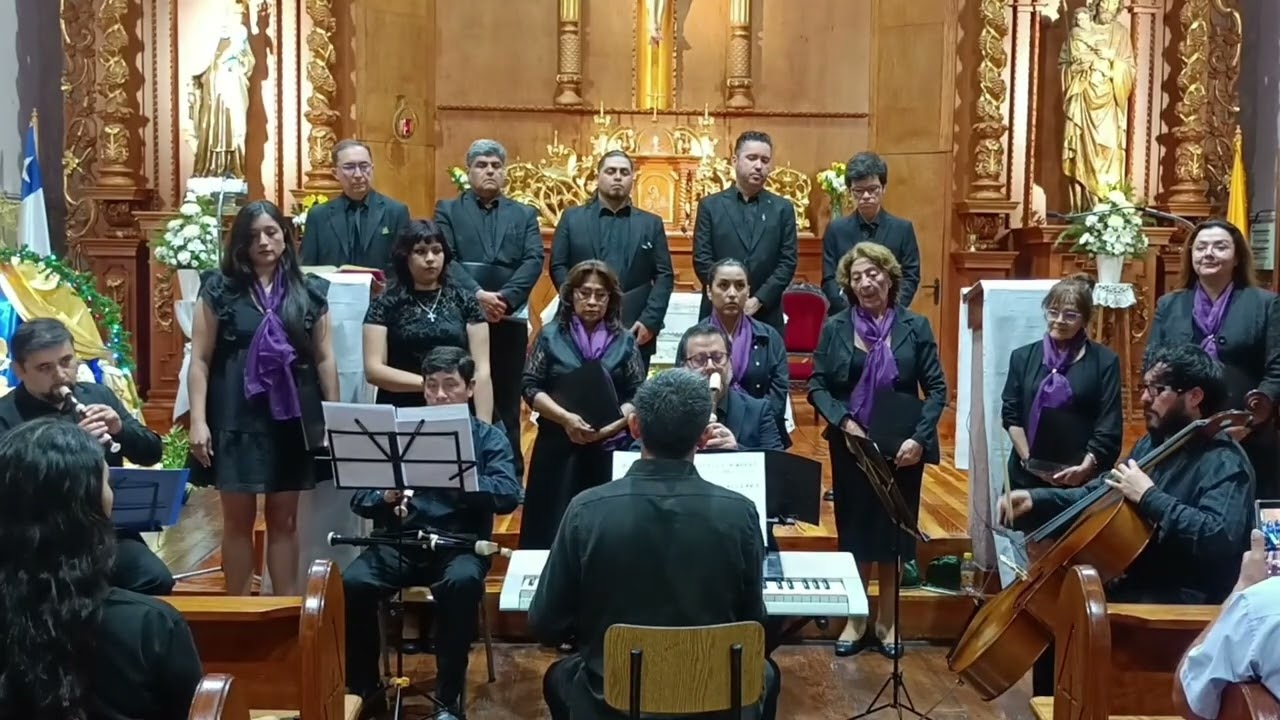
The Westmont Chamber Singers
Directed by Dr. Daniel Gee
Special thanks to the Santa Barbara Historical Museum
www.sbhistorical.org
Produced by Montecito Studios
John Butler - Director
Alex Dill - Camera Operator
William Blondell - Camera Operator
Mpho Mthethwa - Assistant Camera
---
Notes from the composer:
During the second half of the nineteenth century, when Cubans felt a growing sense of national pride and were fighting the Spanish army with machetes in hand-to-hand combat, several musical traditions were born that became symbols of what it means to be Cuban; one of those was the rumba.
The rumba has three variants: the columbia (fast), the yambú (slow), and the guaguancó (moderato). Guaguancó is the most widely recognized and most popular of the three. It almost always is very jovial in spirit and recounts a humorous or festive happening. A soloist always sings the verse, joined by a grouping of voices for the refrain. Only one couple dances, using traditional steps. The traditional rumba is accompanied only by percussion: claves, palitos (usually a hollowed trunk beaten with sticks), and three congas. The drummer who plays the quinto conga (the smallest of the three) executes combinations of rhythms that are amazing and always changing.
El Guayaboso is a choral guaguancó. I composed the first version in the 1960s for a youth chorus directed by Carmen Collado when I still was a student in the Conservatorio Amadeo Roldán. The melody was harmonized in three parts and accompanied by percussion; it was sung in this arrnangement for many years. It was in the decade of the 1980s that I conceived of a version for mixed chorus in which the voices were to sing the percussion parts. I knew it would be somewhat difficult, but perhaps I could find courageous souls to sing it! José Antonio Méndez proved to be the first of the valiant ones, premiering the piece as it appears in this edition in 1988 with the Coro de Matanzas.
Where did I get the title El Guayaboso? It is quite simple. In Cuba, a lie is a guayaba (which means a guava fruit) and it is plain to see that the text is nothing but pure guayabas! And where was I able to get so many guavas? It is a nice story. When I was young my maternal grandmother, like almost all grandmothers, told me lots of stories and read me lots of poems, many of which she remembered from her own childhood. I remembered these disparate rhymes, which probably emerged in a country fiesta in Matanzas province in the last years of the nineteenth century, and they appeared many years later in the text of El Guayaboso.
---
Guido López-Gavilán (b. 1944) earned the degree in choral conducting from the Amadeo Roldán Conservatory in 1966 and the degree in orchestral conducting from the Tchaikovsky Conservatory in 1973. His artistic accomplishments are well known both in Cuba and internationally. His compositions have won awards in the most distinguished competitions held in Cuba, including the National Composition contest, competitions sponsored by the Union of Writers and Artists, and the "26th of July," Golden Age, and Adolfo Guzman competitions. As a symphonic conductor he has received high praise for his interpretations of his own works and classical masterpieces like the Beethoven Ninth and the Shostakovich Fifth Symphony. The chamber orchestra Música Eterna, which he founded in 1995, performs regularly in Cuba and has toured several countries. Presently he is head of the Program of Orchestral Conducting of the Advanced Art Institute of Havana.
Повторяем попытку...

Доступные форматы для скачивания:
Скачать видео
-
Информация по загрузке: