Chp07 01E Auto AI Strategy
Автор: Roger Chen
Загружено: 2026-02-25
Просмотров: 4
Описание:
Global Automotive Technology Development Trends
7. Artificial Intelligence (AI) Empowerment
7.1 AI
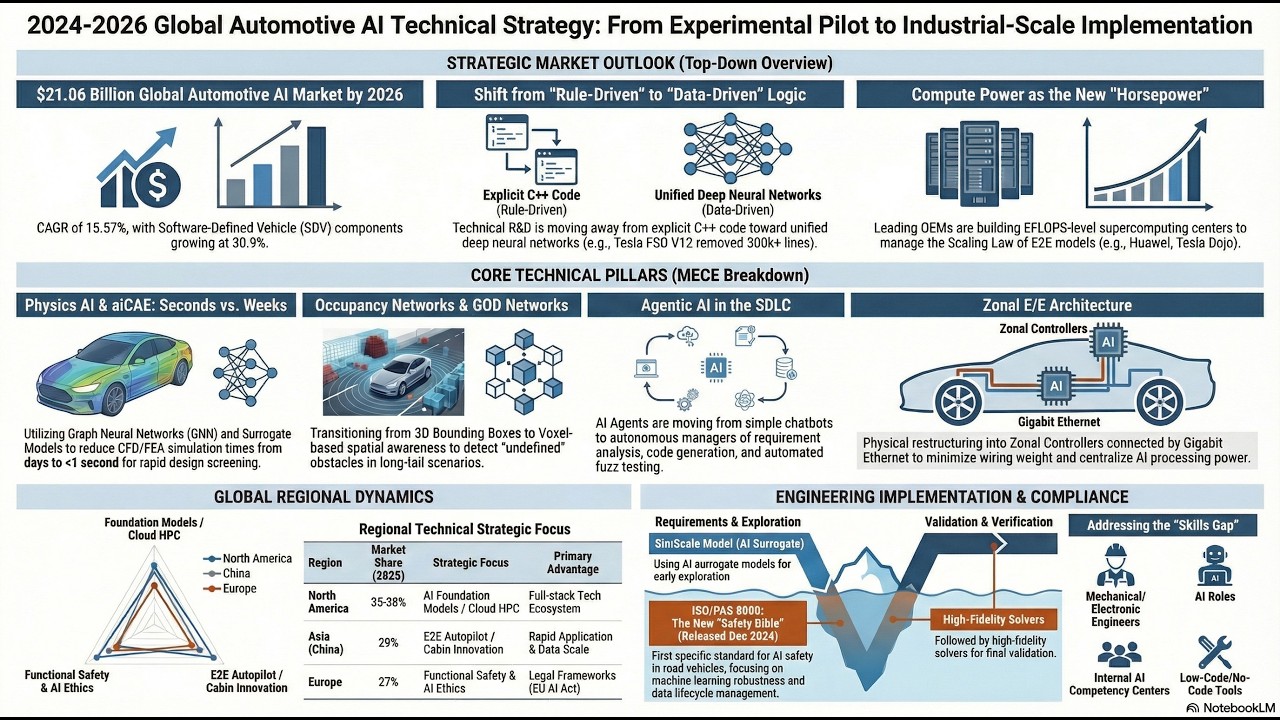
Large Language Models (LLMs) and Generative AI (GenAI) are reshaping every tiny link in the automotive value chain, driving the related market to expand at an astonishing CAGR of 23.3%, projected to reach $3.9 billion by 2034 .
In factory manufacturing, generative AI has demonstrated immediate operational value. For example, BMW's "Factory Genius" AI maintenance assistant absorbs and analyzes vast amounts of technical manuals, machine history logs, and tacit engineering knowledge, enabling on-site technicians to quickly retrieve solutions through natural language dialogue (e.g., "How was this fault code fixed last time?"). This significantly reduces equipment troubleshooting time, becoming a key tool for maintaining maximum production line uptime. In software engineering, generative AI is deeply integrated into IDEs, assisting in the automatic generation, debugging , and automatic creation of test cases, greatly alleviating the bottleneck of software talent shortage.
Even more revolutionary is the disruption that AI is bringing to the underlying logic of autonomous driving in vehicles. The industry is abandoning traditional control algorithms that rely on tens of thousands of lines of manually written rules (If-Else logic) and is shifting towards deploying end-to-end Vision Language Action (VLA) models. Taking NVIDIA's Alpamayo 1 open-source VLA model as an example, this architecture enables the vehicle's brain not only to "see" objects but also to "understand" complex and ambiguous traffic contexts, directly generating corresponding driving action commands (such as steering angle and braking force) . This allows autonomous driving systems to safely handle extreme and obscure cases that have never appeared in the training data in a way that is closer to human intuition and common sense, driving the industry to formally leap from "software-defined" to a new dimension of "AI-defined" .
--------------------------------------------------------------------------
Global Automotive Technology Development Trends
Table of contents:
1. Policies, Regulations and Carbon Neutrality Transition Pathways
1.1 AECC
2. Euro 7 and Extreme Emissions Regulation: The Era of Non-Exhaust Pollution and Onboard Monitoring
2.1 Euro 7 – Emission
2.2 EMC
2.3 NVH
2.4 Manufacture-Recycle
3. Diversification of power system technologies and energy transition
3.1 Battery
3.2 BMS
3.3 Motor-MCU
3.4 Inverter
3.5 OBC-Charger
3.6 H2ICE-Fuel Cell
3.7 Thermal Management
4. Evolution of Electronic and Electrical Architecture & Hardware
4.1 EE
4.2 CPU-Sensors
4.3 X-in-1
4.4 Communication-CAN-EtherNet
5. The Evolution of Software-Defined Vehicles (SDV) and the Transfer of Engineering Paradigms
5.1 SDV
5.2 AutoSar
5.3 ASPICE
5.4 Software-Linux
5.5 Agile Development (Agile CI/CD)
5.6 Design-CAE
5.7 Validation
5.8 Testing
5.9 Digital Twin-Zero Prototype
6. The Hierarchical Differentiation and Commercialization Model of Autonomous Driving
6.1 ADAS
7. Artificial Intelligence (AI) Empowerment
7.1 AI
8. The Perception Revolution in Smart Cockpits
8.1 CockPit
8.2 IVI
8.3 HMI
9. Strategic barriers to safety, security, and compliance
9.1 NCAP
9.2 Functional Safety
9.3 Expected Functional Safety (SOTIF)
9.4 Fail Operational
9.5 ISO-PAS 8800
9.6 CyberSecurity
9.7 NIS 2 (Network and Information Systems Security Directive)
10. Foresight Key Materials
10.1 Material
Повторяем попытку...
Доступные форматы для скачивания:
Скачать видео
-
Информация по загрузке: