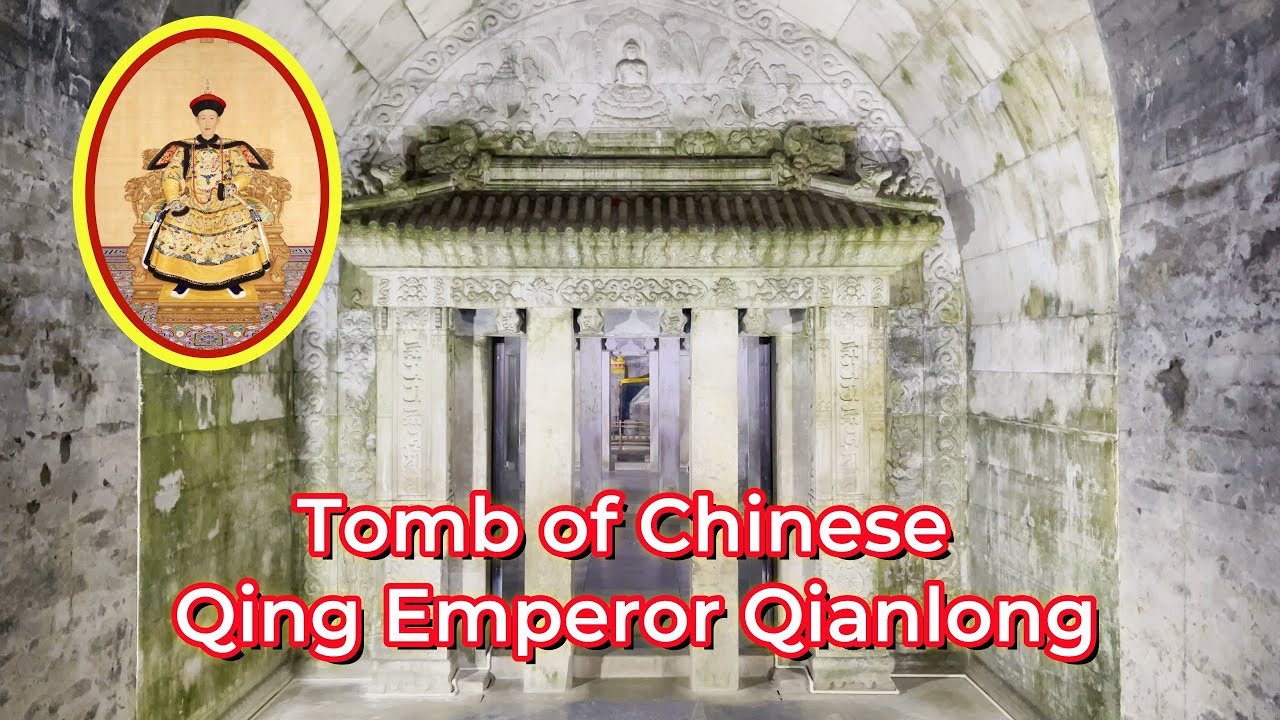
Qianlong ARMOUR REVEALED!!! Qing Dynasty China
Автор: World of Martial Arts Television
Загружено: 2020-03-21
Просмотров: 5376
Описание:
Qianlong ARMOUR REVEALED!!! Qing Dynasty China
Scott Rodell is at the British Museum and discovers a superb Qianlong Princely Armour & Ceremonial helmet. The helmet is conical in shape. A Tibetan influence is visible in the graphs applied to the rim of the helmet. Armour - velvet, silk and brocade reinforced with gilded copper alloy studs and lamellae. The sloping vent at the back allows the wearer to mount a horse. Made of silver, copper alloy, velvet, silk and brocade.
The conical shape of the helmet was introduced to China during the Mongol rule in the 13th century. The graphs applied to the rim of the helmet are Chinese renditions of Lantsha, A Kashmiri script borrowed for Buddhist invocations in Tibet and often applied to Tibetan arms.
Originally it would have had a 'mirror' breastplate and another in the centre of the back.
The Qing dynasty, officially the Great Qing ([tɕʰíŋ]), was the last imperial dynasty of China. It was established in 1636, and ruled China proper from 1644 to 1911. It was preceded by the Ming dynasty and succeeded by the Republic of China. The Qing multi-cultural empire lasted for almost three centuries and formed the territorial base for modern China. It was the fifth largest empire in world history. The dynasty was founded by the Manchu Aisin Gioro clan in Manchuria. In the late sixteenth century, Nurhaci, originally a Ming vassal, began organizing "Banners", military-social units that included Manchu, Han, and Mongol elements. Nurhaci united Manchu clans and officially proclaimed the Later Jin dynasty in 1616. His son Hong Taiji began driving Ming forces out of the Liaodong Peninsula and declared a new dynasty, the Qing, in 1636.
As Ming control disintegrated, peasant rebels led by Li Zicheng conquered the capital, Beijing, in 1644. Ming general Wu Sangui refused to serve them, but opened the Shanhai Pass to the Banner Armies led by the regent Prince Dorgon, who defeated the rebels and seized the capital. Dorgon served as Prince Regent under the Shunzhi Emperor and implemented policies of rule. Resistance from the Ming loyalists in the south and the Revolt of the Three Feudatories led by Wu Sangui delayed complete conquest until 1683 under the Kangxi Emperor (1661–1722). The Ten Great Campaigns of the Qianlong Emperor from the 1750s to the 1790s extended Qing control into Inner Asia. During the peak of the Qing dynasty, the empire ruled over the entirety of today's Mainland China, Hainan, Taiwan, Mongolia, Outer Manchuria and Outer Northwest China. The early Qing rulers maintained their Manchu customs, and while their title was Emperor, they used "Bogd khaan" when dealing with the Mongols and they were patrons of Tibetan Buddhism. They governed using Confucian styles and institutions of bureaucratic government and retained the imperial examinations to recruit Han Chinese to work under or in parallel with Manchus. They also adapted the ideals of the Chinese tributary system in asserting superiority over peripheral countries such as Korea and Vietnam, while annexing neighboring territories such as Tibet and Mongolia.
The dynasty reached its high point in the late 18th century, then gradually declined in the face of challenges from abroad and internal revolts, population growth, disruption of the economy, corruption, and the reluctance of ruling elites to change their mindsets.
The Wuchang Uprising on 11 October 1911, led to the Xinhai Revolution. General Yuan Shikai negotiated the abdication of Puyi, the last emperor, on 12 February 1912.
Rodell is best know internationally for his work reviving Chinese historical swordsmanship. Considered the leading authority on Chinese swordsmanship, he has dedicated 35yrs studying Yang Family Taijiquan (T’ai Chi Ch’uan). Rodell spent many years traveling to find and study with the best teachers in this lineage to fulfill a person goal – renovating Yang Family Taijiquan. Rodell has been privileged to receive instruction in push hands and free fighting from William C. C. Chen, sword and push Hands from T.T. Liang and the Yang Family Michuan Taijiquan, form, applications, push hands, fan, sword and spear, from Wang Yen-nien.
Great River Taoist Center
https://www.grtc.org
Online Chinese Swordsmanship course; https://threeislandsmedia.com/jianfa
British Museum
www.britishmuseum.org
Yes, we are aware of the foreground flicker produced by an LED light fitting.
Thanks for reading & watching, we hope you enjoyed it, please LIKE, SHARE and don't forget to SUBSCRIBE to World of Martial Arts Television for more great content!!
You can also FIND, FOLLOW and SUBSCRIBE to a huge World of Martial Arts Television here;
Main site - https://www.worldofmartialarts.tv
Magazine - https://www.worldofmartialarts.tv/mag...
Daily news - http://news.woma.tv
Facebook - / www.woma.tv
Twitter - / willwitter
Instagram - / worldofmartialartstelevision
Повторяем попытку...

Доступные форматы для скачивания:
Скачать видео
-
Информация по загрузке:


![The Manchu Conquest of China/明清战争: Every Five Days [MAJOR ERRORS]](https://imager.clipsaver.ru/CSFYUqH30l4/max.jpg)