Ford F150 Aerodynamics - How to add more than 10% range!
Автор: AirShaper
Загружено: 2021-10-05
Просмотров: 23532
Описание:
For more information about:
F150 coastdown testing: • Drag Measurement - Coastdown Testing
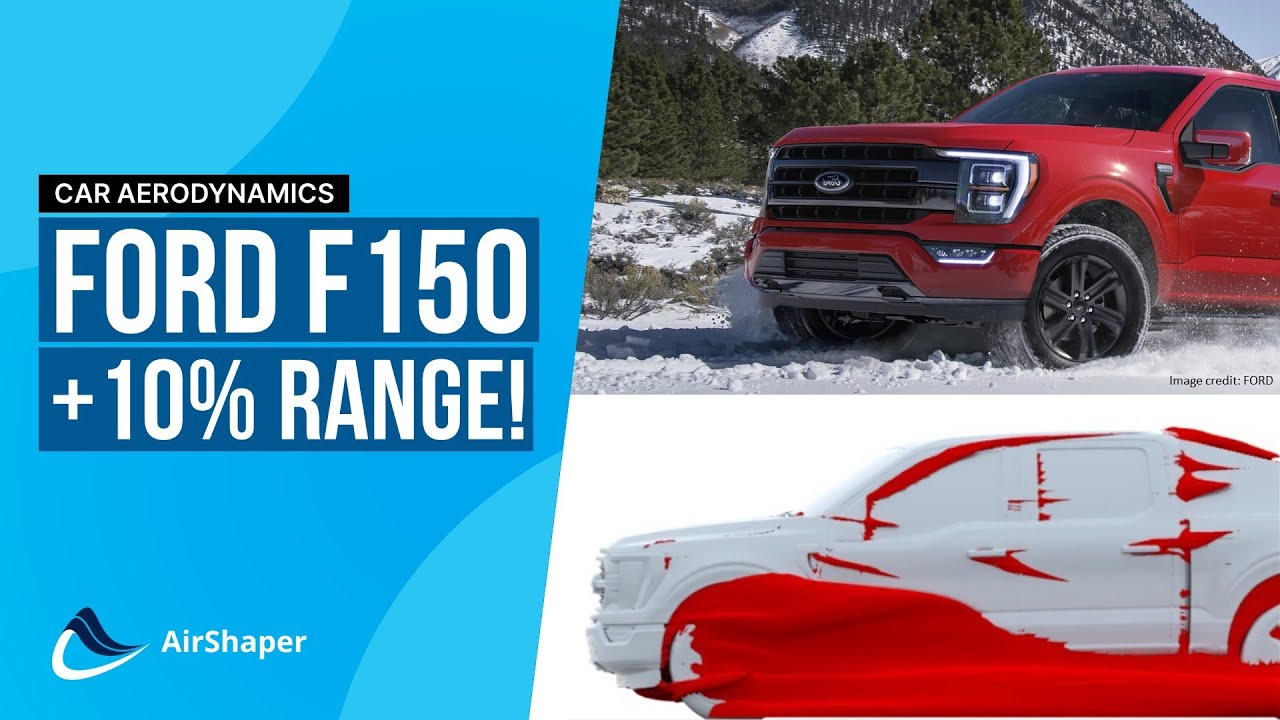
In this video, we’re going to improve the aerodynamics of America’s favorite pickup truck, the Ford F150. As a starting point, we used a highly detailed 3D scan of the latest version of the 2021 Ford F150, here in its hybrid version, provided by our partner A2MAC1. We uploaded this 3D scan directly to AirShaper, set the speed to 30 meters per second, added rotating wheels and launched a Regular Simulation.
A few hours later, we could immediately spot a number of problem areas in terms of aerodynamics:
Right after the cabin, the flow separates and turns into a turbulent wake. Some of the flow tumbles down into the cargo bed and then hits the tail gate on the way out, again creating a wake.
The huge mirrors are without a doubt very practical and safe, but they also generate a lot of drag.
The underbody features many exposed components. That’s very practical for easy access and quick repairs, but it strongly obstructs the flow underneath the car, which creates resistance.
The wheels look nice, but with their sharp edges and large openings, they create what is called ventilation drag – it’s the energy lost on mixing the air, which translates into extra drag. Also, they create dirty air which affects the aerodynamics of the car further downstream.
The ride height of the car is quite high – great for off-roading, but usually not so good for the aerodynamics of a car, as more air is now travelling through the channel between the underfloor and the ground. And with the underfloor being so exposed, this can also create extra drag.
The verdict: a drag coefficient of 0.463. Not very impressive compared to for example the 0.21 of the Lucid Air.
So, the guys at A2MAC1 went to work, drew inspiration from the Tesla Cybertruck and came up with a number of improvements – let’s check them out and see how much they each reduce drag!
First, the rear cover: by closing the cargo bed, the flow across and around the cabin now stays largely attached to the rear cover. The air is prevented from hitting the tailgate and now nicely slides downward to help reduce the wake behind the car. This solution alone lowers the aerodynamic drag by a staggering 14.82%! Optimizing this global shape of the car helps to improve what is called the pressure recovery: at the front of the car, the air hits the nose and creates a high pressure, pushing the car backwards. Once it has crossed the mid-point of the car, the flow starts to contract again. If you support the airflow in the right way, this helps to create a forward push, compensating for some of the drag at the front. The base shape of the Tesla Cybertruck offers a lot of potential in this regard, although the sharp edges might need to be tuned a little.
Secondly, the F150 was given a smooth underfloor. This is something we also saw when we analyzed the Porsche Taycan and which applies to many electric vehicles: because of the electric drivetrain, it’s possible to create an almost entirely flat underfloor. This facilitates a much smoother and less turbulent airflow which strongly lowers the drag. In this case, a very crude underfloor design already lowered drag by 3.4%!
Then, the aerodynamic wheel covers of the Tesla model 3 were pulled from A2MAC1’s database and, after some stretching and scaling, applied to the Ford’s wheels. Without any optimization, these cut drag by 2.23%.
Another tweak meant taking off the side view mirrors altogether. Yes, in reality you’d have to put camera’s instead, if regulations allow it at all. But just to show the potential, we ran a simulation and noted a 5.5% drop in aerodynamic drag!
Last but not least, the truck was lowered by 2 inches – this is a trick some other cars already apply to lower drag at cruising speeds. In this case, it lowered drag by another 2%.
When adding all of these modifications at the same time, we observed a total reduction in drag of 25.05% - that is a massive difference! If we assume that aerodynamics are responsible for roughly half of the energy or fuel consumption of a car, then this means a 12.5 reduction in fuel consumption, or roughly 12.5% more range!
-----------------------------------------------------------------------------------------------------------
The AirShaper videos cover the basics of aerodynamics (aerodynamic drag, drag & lift coefficients, boundary layer theory, flow separation, reynolds number...), simulation aspects (computational fluid dynamics, CFD meshing, ...) and aerodynamic testing (wind tunnel testing, flow visualization, ...).
We then use those basics to explain the aerodynamics of (race) cars (aerodynamic efficiency of electric vehicles, aerodynamic drag, downforce, aero maps, formula one aerodynamics, ...), drones and airplanes (propellers, airfoils, electric aviation, eVTOLS, ...), motorcycles (wind buffeting, motogp aerodynamics, ...) and more!
For more information, visit www.airshaper.com
Повторяем попытку...
Доступные форматы для скачивания:
Скачать видео
-
Информация по загрузке:


![How To Fix This Pickup Truck's Aerodynamics [Dodge Dakota 2002]](https://imager.clipsaver.ru/pJd0B-8rBxA/max.jpg)