A Ray of light travelling in the direction 1/2( i + √3j ) is incident on a plane mirror. After ref
Автор: Physics Behind Everything
Загружено: 2025-04-09
Просмотров: 1303
Описание:
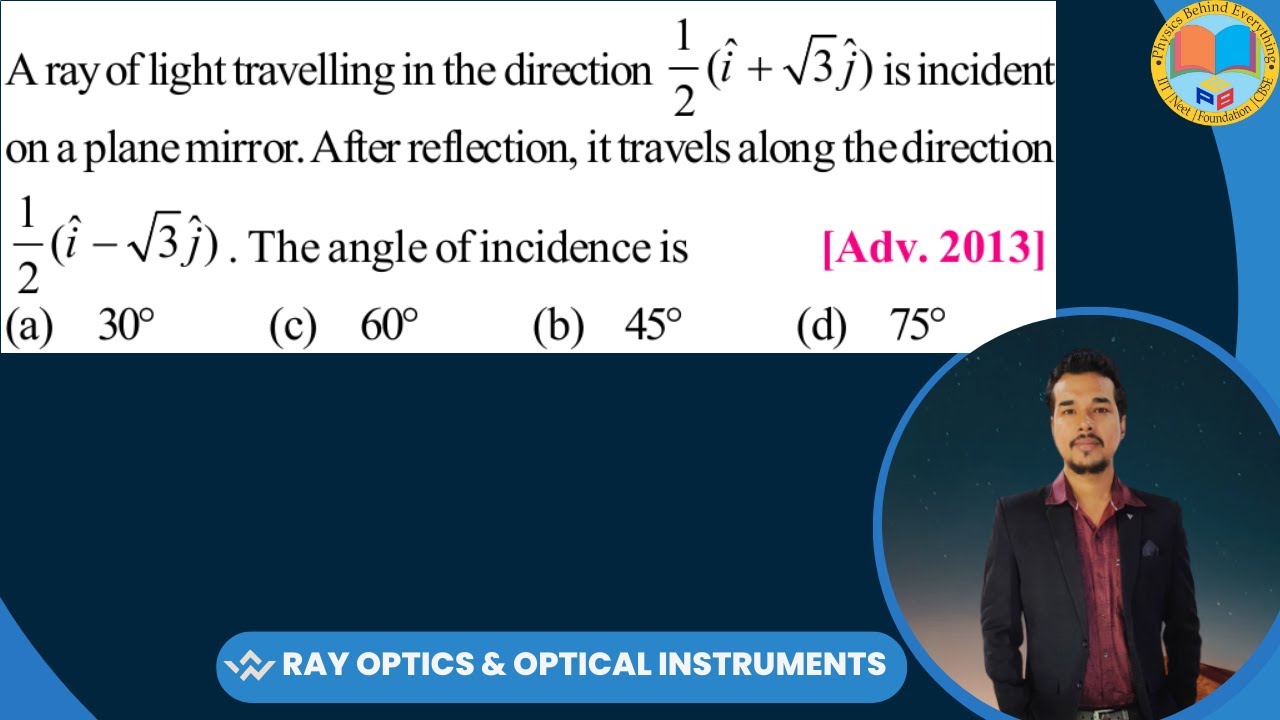
A Ray of light travelling in the direction 1/2( i + √3j ) is incident on a plane mirror. After reflection, It travels along the direction 1/2( i - √3j ) the angle of incidence is
(a) 30° (b) 60° (c) 45° (d) 75°
Video Title: JEE Advanced PYQ: The Conceptual Reflection of Light - Direction Vectors Unveiled! 💡 Pure Optics Theory!
Description:
Aspiring JEE Advanced conquerors! 🚀 Embark on a journey into the heart of light reflection, dissecting a challenging problem from a previous year's exam with a laser focus on conceptual understanding. We will meticulously unravel the theoretical implications of how a light ray's direction transforms upon striking a plane mirror, leaving all numerical calculations and formulaic manipulations behind. Our quest is to grasp the pure, elegant physics governing this phenomenon through insightful conceptual reasoning. ⚛️
Consider a light ray hurtling through space, its trajectory precisely defined by a direction vector. This vector, with its components along different spatial axes, paints a clear picture of the ray's movement. Upon encountering a perfectly smooth, flat plane – our mirror – this ray undergoes a change in direction, emerging with a new, distinct direction vector. The relationship between these initial and final direction vectors holds the key to unlocking the angle of incidence, a fundamental concept in optics. 📖
The bedrock of reflection lies in two core theoretical principles:
The intrinsic equality of the angle of incidence and the angle of reflection. Conceptually, the angle of incidence is the geometric measure between the incoming light ray and the normal – an abstract line erected perpendicularly from the mirror's surface at the precise point of the ray's impact. Similarly, the angle of reflection is the geometric measure between the outgoing light ray and that very same normal. The profound equality of these angles embodies the inherent symmetry of the reflection process, a balanced "bounce" dictated by the fundamental nature of light's interaction with matter.
The inherent coplanarity of the incident ray, the reflected ray, and the normal at the point of incidence. This principle conceptually dictates that the entire act of reflection unfolds within a single, flat, two-dimensional plane. This simplifies our conceptual visualization of the light's path relative to the mirror's orientation and its crucial perpendicular, the normal.
The crucial observation that one component of the direction vector (representing motion along a specific spatial dimension) remains invariant while another component (representing motion along a perpendicular spatial dimension) undergoes a precise reversal in sign upon reflection provides a powerful conceptual clue about the mirror's spatial alignment. Imagine a mirror surface oriented such that it is parallel to the spatial axis associated with the unchanged vector component. The normal to this mirror, by definition, must then be oriented along the spatial axis associated with the reversed vector component.
The given incident direction vector, with its positive contributions along two orthogonal axes, describes a ray moving in a particular quadrant of our conceptual space. The reflected direction vector, retaining one of these positive contributions while the other flips its sign to negative, signifies a "bounce" across the axis associated with the sign reversal. This symmetrical transformation is a direct conceptual consequence of the law of reflection.
Remember, the true mastery of physics lies in the profound understanding of its underlying concepts! We are dedicated to illuminating these intricate ideas for your JEE Advanced preparation! 🔥
Stay tuned for more conceptual explorations of challenging physics problems designed to sharpen your theoretical intuition! ✅
👉 Physics Behind Everything (Instagram: https://www.instagram.com/physics_beh...)
Tags: #JEEAdvancedPhysics #Optics #Reflection #ConceptualPhysics #PhysicsTheory #JEE2025 #IITJEE #AdvancedConcepts #PhysicsExplained #PhysicsBehindEverything #JEEStudy #RayOptics #AngleOfIncidence #AngleOfReflection #ConceptualUnderstanding #DirectionVectors
Join this channel to get access to perks:
/ @physicsbehindeverything
Повторяем попытку...
Доступные форматы для скачивания:
Скачать видео
-
Информация по загрузке: