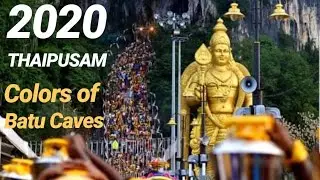
THAIPUSAM 1970 | VINTAGE BATU CAVES MALAYSIA | VISIT BATU CAVES MALAYSIA
Автор: THARAVI 001
Загружено: 2020-02-08
Просмотров: 24360
Описание:
Batu Caves (Tamil: பத்து மலை) is a limestone hill that has a series of caves and cave temples in Gombak, Selangor, Malaysia. It takes its name from the Sungai Batu (Stone River), which flows past the hill. It is the tenth limestone hill from Ampang. Batu Caves is also the name of a nearby village.
The cave is one of the most popular Hindu shrines outside India, and is dedicated to Lord Murugan. It is the focal point of the Hindu festival of Thaipusam in Malaysia.
Batu Caves in short also referred as 10th Caves or Hill for Lord Muruga as there are six important holy shrines in India and four more in Malaysia. The three others in Malaysia are Kallumalai Temple in Ipoh, Tanneermalai Temple in Penang and Sannasimalai Temple in Malacca.
History
Interior of Batu Caves
The limestone forming Batu Caves is said to be around 400 million years old. Some of the cave entrances were used as shelters by the indigenous Temuan people (a tribe of Orang Asli).
As early as 1860, Chinese settlers began excavating guano for fertilising their vegetable patches. However, they became famous only after the limestone hills were recorded by colonial authorities including Daly and Syers as well as American Naturalist, William Hornaday in 1878.
Batu Caves was promoted as a place of worship by K. Thamboosamy Pillai, an Indian trader. He was inspired by the vel-shaped entrance of the main cave and was inspired to dedicate a temple to Lord Murugan within the caves. In 1890, Pillai, who also founded the Sri Mahamariamman Temple, Kuala Lumpur, installed the murti (consecrated statue) of Sri Murugan Swami in what is today known as the Temple Cave. Since 1892, the Thaipusam festival in the Tamil month of Thai (which falls in late January/early February) has been celebrated there.
Wooden steps up to the Temple Cave were built in 1920 and have since been replaced by 272 concrete steps. Of the various cave temples that comprise the site, the largest and best known is the Temple Cave, so named because it houses several Hindu shrines beneath its high vaulted ceiling.
In August 2018 the 272 steps were painted in an extraordinary colour scheme, with each set of steps painted in a different range of colours. However, accusations were almost immediately made by the National Heritage Department for a breach of law requiring authorisation for renovations within 200 metres of a heritage site. The temple's management disputed their failure to receive authorisation.
Source : Wikipedia
Copyrights : This video is reusable , creative common rights , enjoy ya
Повторяем попытку...

Доступные форматы для скачивания:
Скачать видео
-
Информация по загрузке: