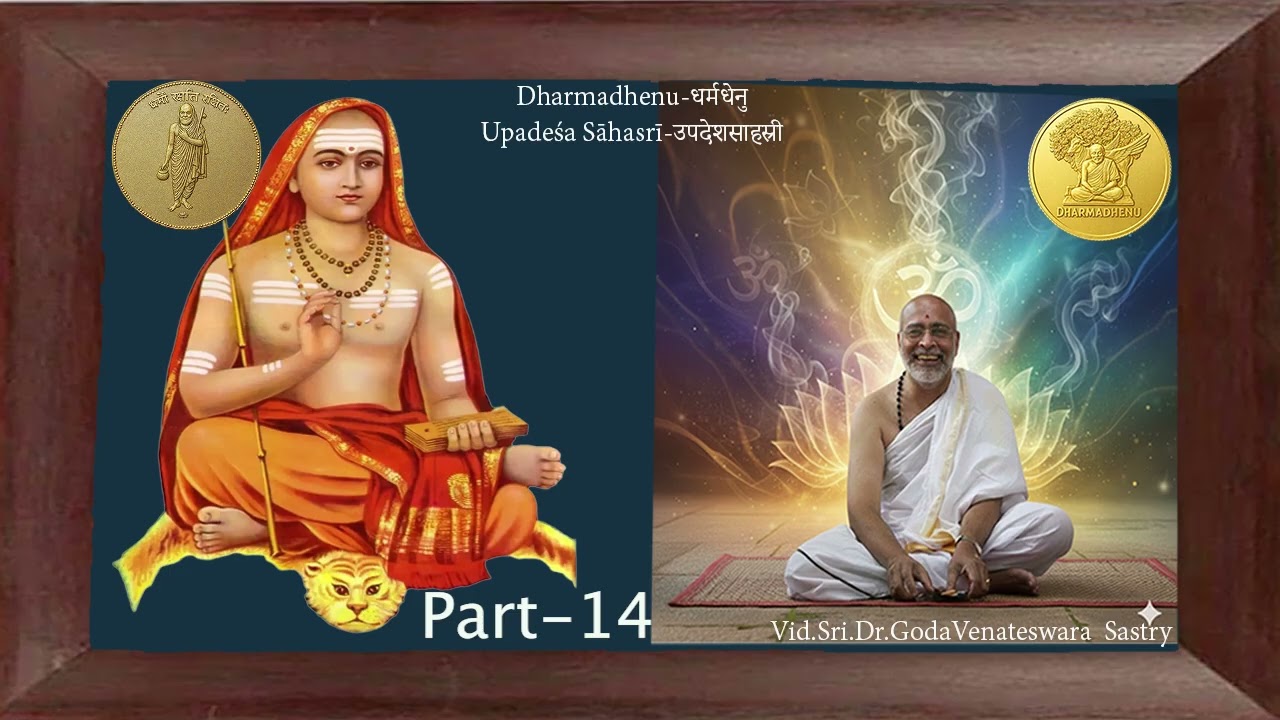
उपदेशसाहस्री-Upadesha Sahasri Of Shankaracharya -by Vid.Sri.Dr.Goda Venkateswara Sastri
Автор: धर्मधेनु - तितिक्षा- Dharmadhenu Titiksha
Загружено: 2026-01-20
Просмотров: 12
Описание:
Part-14
The Upadesha Sahasri (Sanskrit: उपदेशसाहस्री, meaning 'A Thousand Teachings') is a seminal 8th-century CE Sanskrit text of the Advaita Vedanta school of Hinduism, authored by Adi Shankara (or Śaṅkarācārya). It is considered one of his most important non-commentarial works.
The text serves as a practical guide for spiritual aspirants seeking Self-realization through knowledge (Jñāna) and is divided into two parts:
1. Metrical Part (Padyabandha)
Contains nineteen chapters (prakarana).
It discusses and repeatedly explains basic problems of Advaita or non-dualism.
The focus is on the identity of the individual Self (Ātman) with the ultimate reality (Brahman), often summarized by the great saying (Mahāvākya) "Tat Tvam Asi" (That thou art).
It refutes the view that action (karma) combined with knowledge (jñāna-karma-samuchaya) is the means to liberation, asserting that Self-knowledge alone leads to liberation (mokṣa).
A major chapter is the 18th, the Tat Tvam Asi Prakarana, which analyses this key Vedantic statement.
2. Prose Part (Gadya)
Consists of three chapters.
It often takes the form of a dialogue between a teacher and a disciple, detailing the method of instruction for Self-knowledge.
It emphasizes the importance of a Guru (teacher) in imparting the correct understanding of non-duality.
Key Teachings and Themes
Primacy of Self-Knowledge (Jñāna): Liberation is attained solely by the direct realization of the Self as Brahman, not by ritualistic actions or practices, which are born of ignorance.
Discrimination (Viveka): The core teaching is the power to discern between the eternal (Ātman) and the transient (body, mind, world).
Negation (Neti Neti): A methodical approach to eliminate identification with the non-Self (body, mind, senses) to realize the true nature of the Self, which is Pure Consciousness.
Role of the Guru: The guidance of a realized teacher is crucial for clarifying doubts and correctly transmitting the knowledge of non-duality derived from the Upanishads.
Would you like a summary of one of the specific chapters, or more detail on the concepts of Viveka or Neti Neti?
Повторяем попытку...
Доступные форматы для скачивания:
Скачать видео
-
Информация по загрузке: