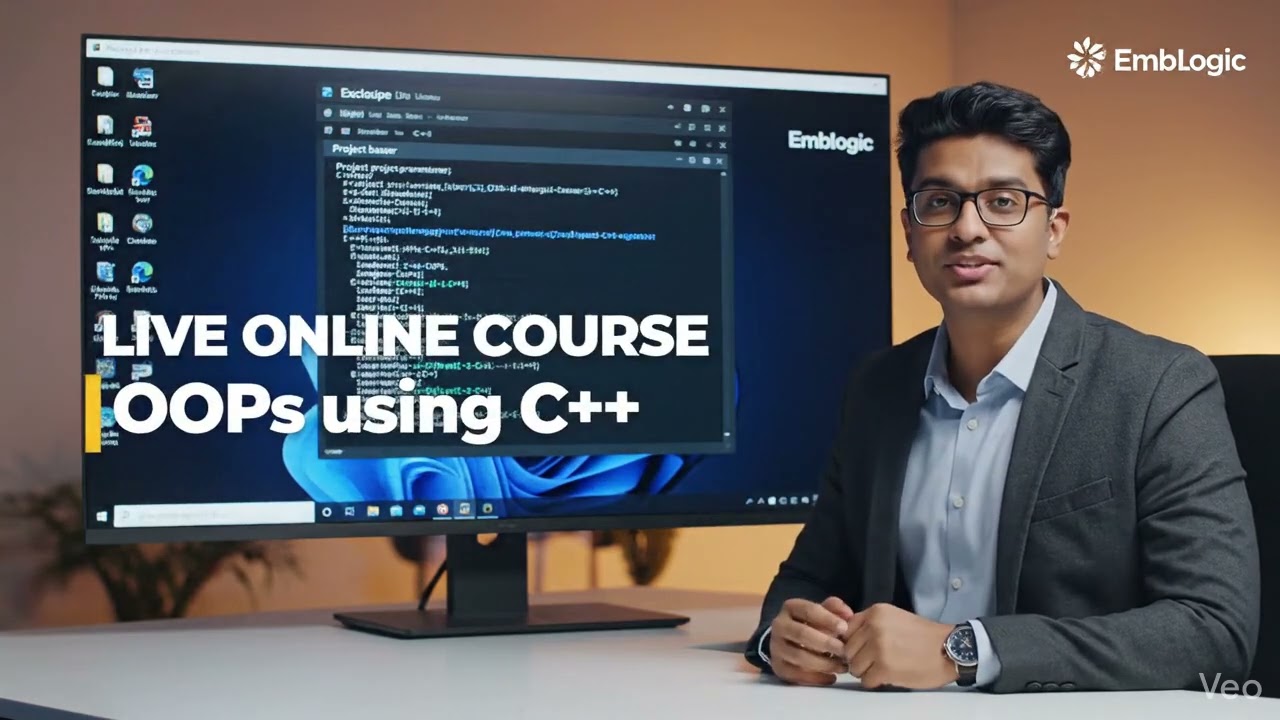
OOPs using C++ with Eclipse on Linux and Project.
Автор: EmbLogic Videos
Загружено: 2026-02-08
Просмотров: 5
Описание:
Program Overview
This comprehensive course is designed to introduce participants to the world of C++ programming, covering everything from basic syntax and semantics to advanced features like object-oriented programming, templates, and the Standard Template Library (STL). The course will culminate in a project that incorporates C++ programming, Linux, and shell scripting with Bash, providing a holistic understanding of how C++ can be used in real-world applications.
Target Audience
Programmers and developers transitioning from other programming languages to C++.
Computer science students seeking to deepen their understanding of object-oriented programming.
Professionals in fields requiring software development skills in C++.
Duration
25 sessions, each lasting 1 hour, delivered over 10 weeks.
Learning Objective
Participants will:
Gain a solid foundation in C++ syntax and semantics.
Understand and apply object-oriented programming principles in C++.
Master the use of the Standard Template Library (STL) for efficient coding.
Develop practical programming skills through hands-on labs and a comprehensive project.
Learn to debug and test C++ programs in a Linux environment using Bash scripting.
Course Curriculum
Introduction to C++
Overview of C++: Its history, unique features, and how to set up a development environment.
Understanding the basic syntax and structure of C++ programs.
Deep Dive into Object-Oriented Programming
Introduction to classes, objects, encapsulation, constructors, and destructors.
Detailed exploration of constructors and destructors, including copy constructors and destructor usage.
Advanced Object-Oriented Concepts
In-depth study of inheritance, including multiple and multilevel inheritance.
Polymorphism in C++: Understanding virtual functions and their role in enabling polymorphism.
Operator Overloading and Friend Functions
Techniques for overloading operators to extend the functionality of C++ classes.
Utilizing friend functions and classes to access private and protected members from outside the class.
Templates and Exception Handling
Leveraging function and class templates for generic programming.
Advanced exception handling strategies for robust error management.
The Standard Template Library (STL)
Comprehensive coverage of STL components: containers, iterators, algorithms.
Practical applications of vectors, maps, sets, and understanding iterators.
Managing Strings and Dynamic Objects
The String Class in C++: Methods, operators, and handling strings efficiently.
Dynamic object creation using new and delete operators for memory management.
Namespaces and Their Significance
Understanding namespaces for organizing code and avoiding name conflicts.
Practical examples of using namespaces in large projects.
Vectors and Arrays
Detailed exploration of vectors: Dynamic arrays that can resize themselves.
Comparing vectors to traditional C++ arrays and understanding their advantages.
File Input/Output
Using file streams for reading from and writing to files.
Advanced file operations and error handling techniques.
Debugging and Testing C++ Programs
Effective debugging techniques and tools for C++.
Introduction to unit testing in C++ and writing test cases.
Project Workshops
Initiating the project with an emphasis on object-oriented programming.
Application of advanced C++ features and STL in project development.
Project Development and Completion - Continued development of the C++ project with regular reviews.
Incorporation of dynamic object creation, file I/O, and efficient data handling using STL.
Final project presentations with a focus on learning from code reviews and peer feedback.
Course Delivery
Online: Live interactive sessions with real-time coding and Q&A.
In-person: Classroom sessions focused on hands-on practice and collaborative learning.
Hybrid: Combination of online lectures with in-person or virtual labs for practical application.
Training Methodology
Lectures: Detailed presentations on theoretical concepts and coding techniques.
Hands-On Labs: Practical programming exercises and labs to apply learned concepts.
Reading Assignments: Selection of books, documentation, and articles to supplement learning.
Videos: Access to video tutorials for visual learning of complex topics.
Deliverables
Upon completion, participants will:
Have a strong understanding of C++ programming principles and best practices.
Be proficient in object-oriented programming, templates, and STL.
Possess practical skills in developing, debugging, and testing C++ applications in a Linux environment.
Have completed a comprehensive project that demonstrates their C++ programming capabilities, incorporating Linux and shell scripting.
Повторяем попытку...
Доступные форматы для скачивания:
Скачать видео
-
Информация по загрузке: