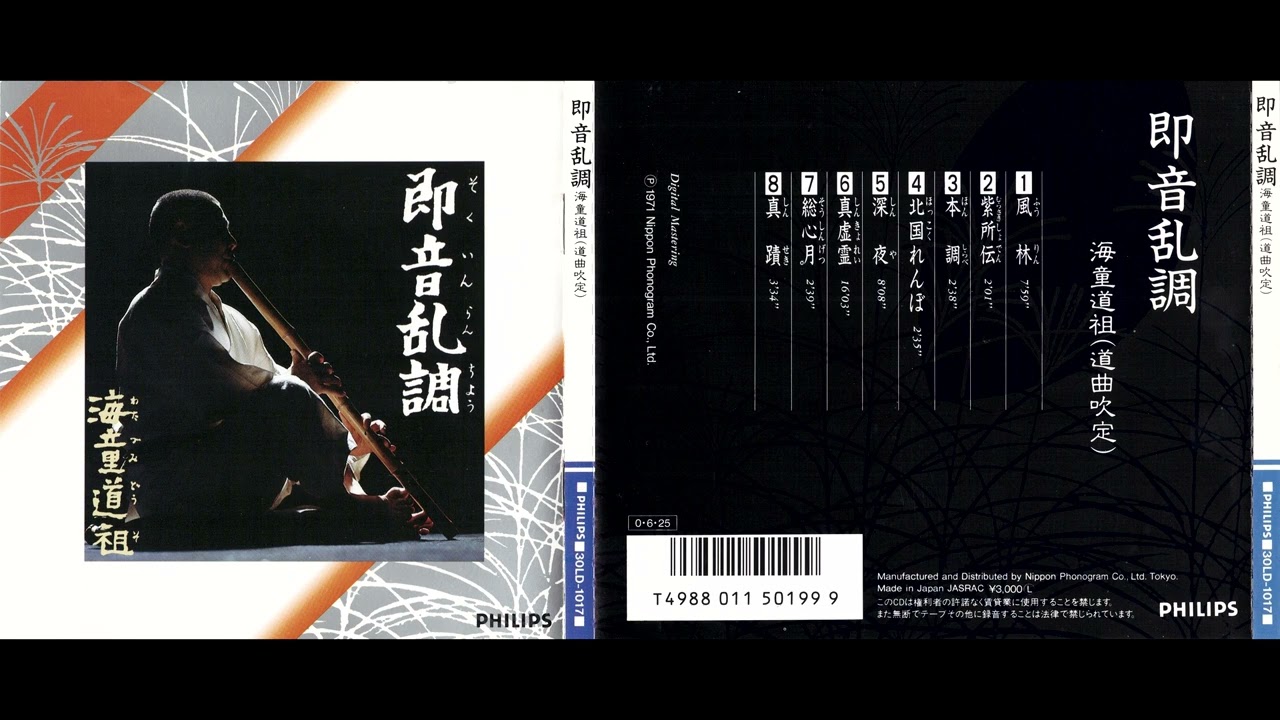
海童道祖 Watazumi Dōsō Rōshi・“Spontaneous Sound Dissonance” (1971) * New transfer & translation
Автор: ᏰᎬȵ ᎶᏋᎡᎦȶᎬᎥȠ
Загружено: 2025-06-01
Просмотров: 552
Описание:
Watazumi Dōso・Sokuon Ranchō | (Dōkyoku Suijō) – Composed/Selected Dōkyoku (Way pieces)
[00:00] 1. Fūrin (Wind in the Forest)
[08:08] 2. Murasaki Shoden (Purple Transmission)
[10:15] 3. Hon Shirabe (Fundamental Tuning Piece)
[12:58] 4. Hokkoku Renbo (Northern Alliance)
[15:39] 5. Shinya (Late Night)
[23:53] 6. Shin Kyorei (True Empty Spirit)
[40:03] 7. Sō Shingetsu (All-Encompassing Heart Moon)
[42:49] 8. Shinseki (True Praise)
[46:31] CD booklet
Booklet translation:
“This disc captures a new and unprecedented world of sound—beyond all techniques and pleasures inherited from the traditional shakuhachi and musical forms.” These are sounds not intended for enjoyment or mere appreciation. Rather, they are the product of rigorous practice—an ascetic path of sound, cultivated by the founder of Watazumi-dō, Watazumi Dōso Roshi. Watazumi-dō is a path to recover the primal rhythm of the universe and of nature within one’s own being. It is a Way that reveals nature’s laws through self-training, natural motion, and meditative quietude. To walk this Way is to study deeply, to observe oneself, and to learn from nature directly. The bamboo flute becomes the medium for this rigorous training. “Blowing” (fuki) is not music—it is discipline. Through the breath, the entire body becomes involved in a process of self-refinement. Eventually, when one picks up the bamboo, be it long or short, thick or thin, one can express the ineffable. The sound produced is not technique, but a manifestation of vital force (ki) and spirit. Thus, the pieces recorded here transcend mere composition. They are born of this path, and embody a new terrain of expression—described by some as “great magic of the breath.”
1. Fūrin
This piece, from the Tōhoku region, evokes the subtle presence of wind flowing through forested mountains and valleys. It transmits a micro-movement of quiet energy—a hidden, flowing rhythm of nature. The piece embodies a gentle tremble, a resonance that calls attention to the very breath of wind, and encourages deep listening. It is a representation of stillness in motion.
2. Murasaki Shoden
This dōkyoku traces back to Zen monk Ikkyū and the spiritual lineages associated with the Murasakidokoro (literary and spiritual refinement). A subtle and delicate piece, it demonstrates the effect of quiet motion and embodies a restrained yet elegant tone. It serves as a study in poised stillness.
3. Hon Shirabe
This is the essential foundational piece for anyone walking the Way of Watazumi. It emphasizes breath control, with long, slow tones and repeated rising passages that polish one’s internal capacity. Practicing this piece cultivates calmness and power. It is said that no further progress is possible without mastering it.
4. Hokkoku Renbo
This piece originates in the Northern provinces, evoking a poetic phrase linked to the sound of bells and wandering monks. It expresses a strong breath power, yet has a cool clarity. Renbo implies harmony among elements. It is a piece of spiritual depth, continuing the legacy of northern musical transmission.
5. Shinya
This is a piece reflecting the emotional atmosphere of night. It is not simply about time of day, but a state of the soul. To listen to it is to encounter one’s own interiority. It opens the heart to the quiet flow of mystery, like seeing a jewel glimmer faintly in the dark. This piece resonates with profound calm, marking emotional stillness and an introspective state.
6. Shin Kyorei
This is one of the oldest and most significant dōkyoku. It means “true spirit of emptiness.” Emptiness here is not nothingness—but a formless, boundless awareness. The piece transmits a high level of both spiritual insight and technical control. It demonstrates transformation through sound—the presence of formlessness as an active, living force.
7. Sō Shingetsu
From ancient times, the moon has been regarded as a mirror of the human spirit and natural cycles.
This piece reflects the moment when stillness and movement occur simultaneously—when clarity arises as if from emptiness. The moon in this piece represents the whole heart (sōshin)—open, quiet, and luminous.
8. Shinseki
One of the shortest pieces in the tradition, it consists of just a few sharp bursts of sound. Its meaning lies in its purity—a spontaneous expression of praise or realization. The sound is unfiltered, instinctive, and deep. Despite its brevity, it carries great weight, often compared to an exclamation of spiritual breakthrough.
Sokuon Ranchō (“Spontaneous Sound Dissonance”)
“In daily life, we humans are constantly influenced by external voices, colors, and noise. Depending on how we receive them, our hearts can become disturbed. But when one aligns internally with sound, allowing voice and breath to flow naturally, a profound order emerges from chaos. This is Sokuon—spontaneous sound. Ranchō—disorder or dissonance—becomes part of the training. This is the Way of cultivating through sound.” - Watazumi Dōso Roshi
Повторяем попытку...
Доступные форматы для скачивания:
Скачать видео
-
Информация по загрузке: