➤ Weight Transfer During Braking
Автор: Innovation Discoveries
Загружено: 2026-02-15
Просмотров: 6
Описание:
➤ Weight Transfer During Braking – Deep Technical Explanation
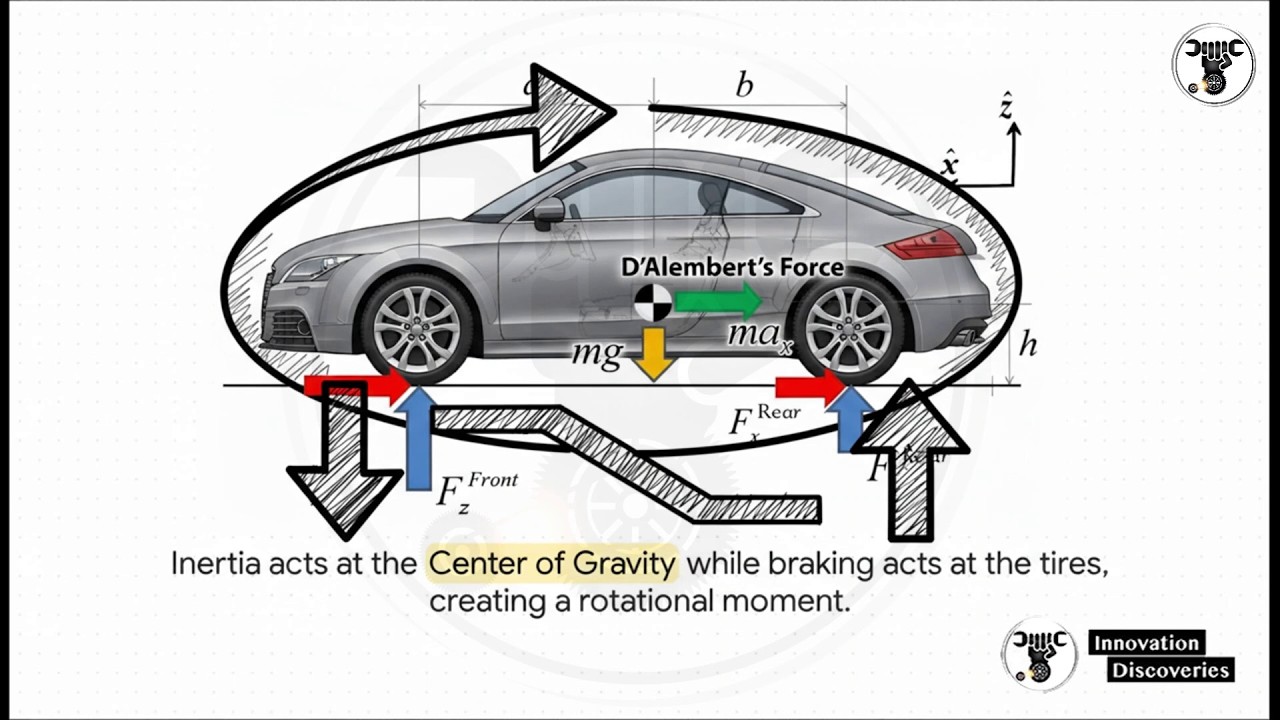
When a vehicle decelerates, its mass does not physically move forward. Instead, the distribution of vertical load between the front and rear axles changes due to inertia. This phenomenon is known as longitudinal weight transfer. It has a direct impact on braking performance, stability, suspension behavior, and available tire grip.
➤ Basic Principle – Why Weight Transfers Forward
According to Newton’s First Law, a moving object resists changes in motion.
During braking:
• The wheels apply a decelerating force to the road
• The chassis slows down
• But the center of gravity (CG) continues moving forward due to inertia
⤷ This results in:
• Increased load on the front axle
• Reduced load on the rear axle
• Front suspension compression (nose dive)
• Rear suspension extension (rear lift)
➤ Physics Behind Weight Transfer
The magnitude of weight transfer depends on four key vehicle parameters:
• Vehicle mass (m)
• Deceleration rate (a)
• CG height above the ground (h)
• Wheelbase length (L)
Weight Transfer Formula:
ΔW = (m × a × h) / L
Where:
• ΔW = Load transferred from rear to front
• m = Mass
• a = Deceleration
• h = CG height
• L = Wheelbase
⤷ Higher CG → more transfer
⤷ Shorter wheelbase → more transfer
⤷ Higher braking force → more transfer
This is why SUVs with tall CGs show more nose dive than low sports cars.
➤ Tire Grip and Friction Relationship
A tire’s maximum braking force is limited by friction:
Max Braking Force = μ × Normal Force
(μ = tire-road coefficient of friction)
Under braking:
• Front tires gain normal force → more grip
• Rear tires lose normal force → less grip
This explains:
• Why front brakes are physically larger
• Why front brake bias is 60–70%
• Why excessive rear brake force causes rear wheel lockup and oversteer
⤷ Proper brake bias is essential for stable braking.
➤ Suspension Dynamics During Braking
Braking causes noticeable suspension movement:
• Front suspension compresses (dive)
• Rear suspension extends (lift)
This affects:
• Camber
• Caster
• Toe
• Tire contact patch shape
• Steering precision
Modern vehicles reduce excessive dive using:
• Anti-dive geometry
• Stiffer front springs
• Progressive-rate dampers
• Adaptive suspension systems
⤷ All to maintain consistent tire contact and improve stability.
➤ Brake Bias & Electronic Control Systems
Because weight transfer constantly changes, brake systems must adapt.
Modern control strategies include:
• Hydraulic proportioning valves
• EBD – Electronic Brakeforce Distribution
• ABS – Anti-lock Braking System
How it works:
⤷ Light braking → higher rear brake contribution
⤷ Hard braking → system reduces rear pressure to prevent lockup
These systems continuously adjust brake force to match dynamic axle load.
➤ Extreme Case – Threshold Braking
Under maximum braking (near tire traction limit):
• Up to 70–80% of weight shifts to the front axle
• Rear wheels become lightly loaded
• Stopping distance depends heavily on front tire grip
Race cars use adjustable brake bias to fine-tune braking behavior at high loads.
➤ Why Weight Transfer Matters
Understanding weight transfer is critical for:
• Brake system design
• Suspension setup
• ABS/EBD calibration
• Motorsport tuning
• Accident investigation
It directly affects:
• Stopping distance
• Vehicle stability
• Tire wear patterns
• Heat distribution in brakes
⤷ Weight transfer determines how effectively a vehicle can slow down.
➤ Practical Example
A car with:
• Mass = 1500 kg
• CG height = 0.55 m
• Wheelbase = 2.6 m
• Deceleration = 0.8g
Calculation:
ΔW = 1500 × (0.8 × 9.81) × 0.55 / 2.6
ΔW ≈ 2490 N transferred forward
⤷ This huge load shift happens within milliseconds during a braking event.
➤ Final Technical Insight
Weight transfer does not change total vehicle weight.
It only redistributes vertical load dynamically between axles.
The chassis rotates around the contact patches because the deceleration force acts at ground level, while inertia acts at the CG height — creating a forward load shift.
This is why braking performance depends on:
• CG height and placement
• Suspension geometry
• Tire compound and size
• Brake bias tuning
• Surface grip
• Electronic control systems
Weight transfer is one of the most important factors governing vehicle stability and braking efficiency.
Повторяем попытку...
Доступные форматы для скачивания:
Скачать видео
-
Информация по загрузке: