I Was A Japanese Teacher — And I Froze When Americans Protected My School From Looters
Автор: War Diaries
Загружено: 2025-10-22
Просмотров: 31028
Описание:
August 30, 1945. The war was over. Japan had surrendered. And American soldiers were marching into Yokohama.
I was forty-one years old, a mathematics and calligraphy teacher at Sakura Elementary School. For four years, we'd been told the Americans were demons. Savages who would rape our women and murder our children. The military police warned us: death was preferable to surrender. Death was preferable to dishonor.
But I didn't die. I survived the firebombing of Tokyo. I survived the atomic bombs that fell on cities I'd never visited. I survived the Emperor's radio announcement that shattered everything we'd believed. And now I had to survive the occupation.
I expected brutality. I expected revenge. I expected the Americans to treat us the way we'd treated the people we conquered.
Instead, they protected us.
On September 3rd, 1945, desperate Japanese civilians—starving, broken by defeat—broke into my school and began tearing it apart. They ripped desks apart for firewood. They stole copper pipes to sell. They destroyed everything, driven by desperation in a country where authority had collapsed and survival meant taking what you could find.
I tried to stop them. They knocked me to the ground. Blood ran from my forehead. There were fifteen of them and three of us. We were helpless.
And then the Americans arrived.
Lieutenant Morrison and two enlisted men. They didn't ask questions. They didn't hesitate. They ordered the looters out. They posted guards. They promised to repair the damage and protect the school.
I stood there, bleeding, holding a clean white handkerchief an American officer had given me, and I couldn't move. I couldn't think. I couldn't process what had just happened.
The enemy—the demons we'd been taught to hate and fear—had just protected a Japanese school from Japanese looters.
Everything I'd believed was a lie.
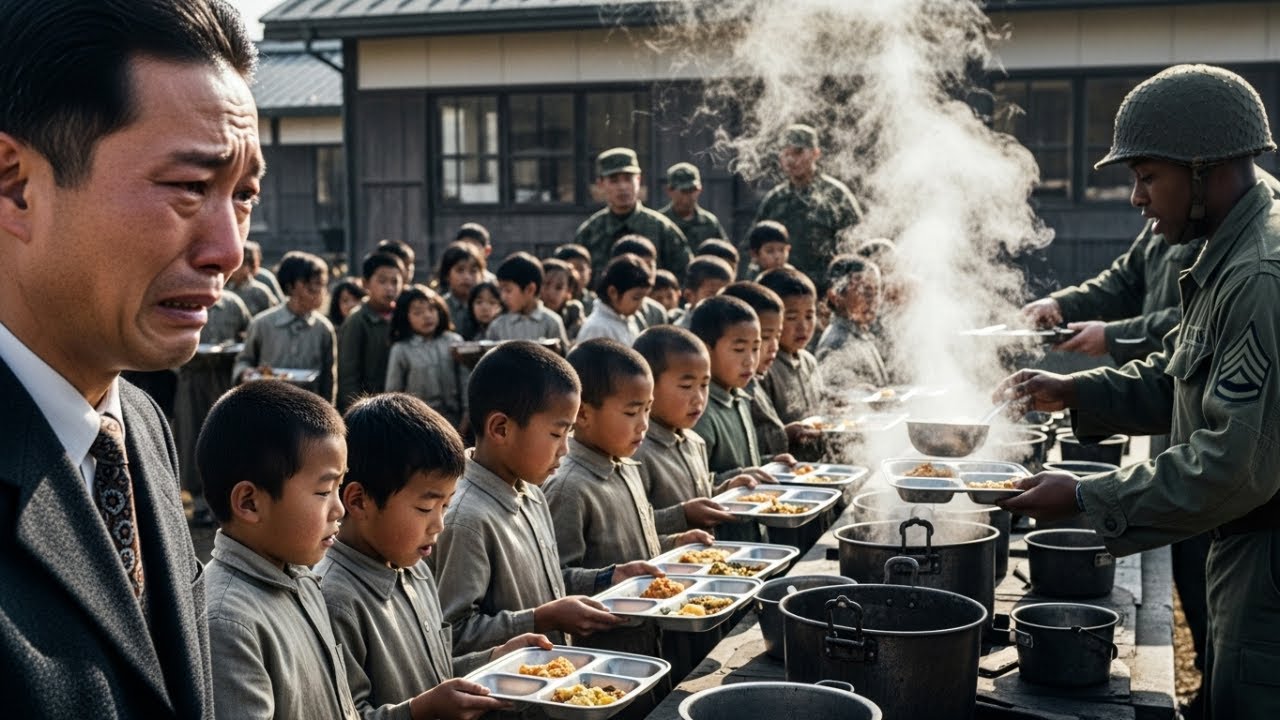
Over the following weeks, the Americans did more than protect us. They repaired our doors. They brought supplies—chalk, pencils, paper that Japanese schools hadn't seen in years. They established food distribution and fed starving children. They posted guards who learned our students' names and played ball with them during breaks.
Captain Henderson, a former missionary who spoke perfect Japanese, told me: "Children deserve education. That doesn't change because we won the war."
Private Miller, a nineteen-year-old kid from Texas, brought candy from the PX and taught children how to throw a baseball.
They treated us with more dignity than our own government had shown us in three years of war.
And I had to confront an impossible truth: the propaganda had been wrong about everything. The Americans weren't demons. We weren't the righteous victims. We'd started a war we couldn't win, believed lies our leaders told us, and sacrificed millions for nothing.
The enemy was being kinder to us than we deserved.
This is my story. The story of how American occupation broke me and remade me. How I learned that the real enemy isn't the person across the battlefield—it's the lie that says some people are less human than others. How a Texas private, a missionary captain, and a Japanese-American translator taught me that peace requires more courage than war.
I reopened Sakura Elementary on September 15th, 1945, with forty starving children and American guards at the gate. Over thirty-two years, I watched those children grow up in a Japan that became democratic, prosperous, and peaceful. I watched enemies become allies. I watched hatred transform into friendship.
And I never forgot the moment I froze—completely unable to move or speak—when American soldiers chose to protect Japanese children from their own countrymen.
That moment saved more than one school. It saved an entire generation. It saved me.
Because it taught me that helping your enemy requires more strength than defeating them. That the truest victory isn't destruction—it's reconstruction. That sometimes, the people we fear most are the ones who save us.
📚 SOURCES & FURTHER READING:
"Embracing Defeat: Japan in the Wake of World War II" by John W. Dower (Pulitzer Prize winner)
"The Occupation of Japan: Economic Policy and Reform" - SCAP (Supreme Commander for the Allied Powers) documents
"Education Reform in Occupied Japan" - National Archives
MacArthur Memorial Archives - Occupation policy documents
"Japan's American Interlude" by Kazuo Kawai
Oral histories from Japanese civilians during occupation period
Повторяем попытку...
Доступные форматы для скачивания:
Скачать видео
-
Информация по загрузке: