Cadences - Hands-Free Ear Training 26
Автор: Joe Luegers Music Academy
Загружено: 2024-06-15
Просмотров: 7199
Описание:
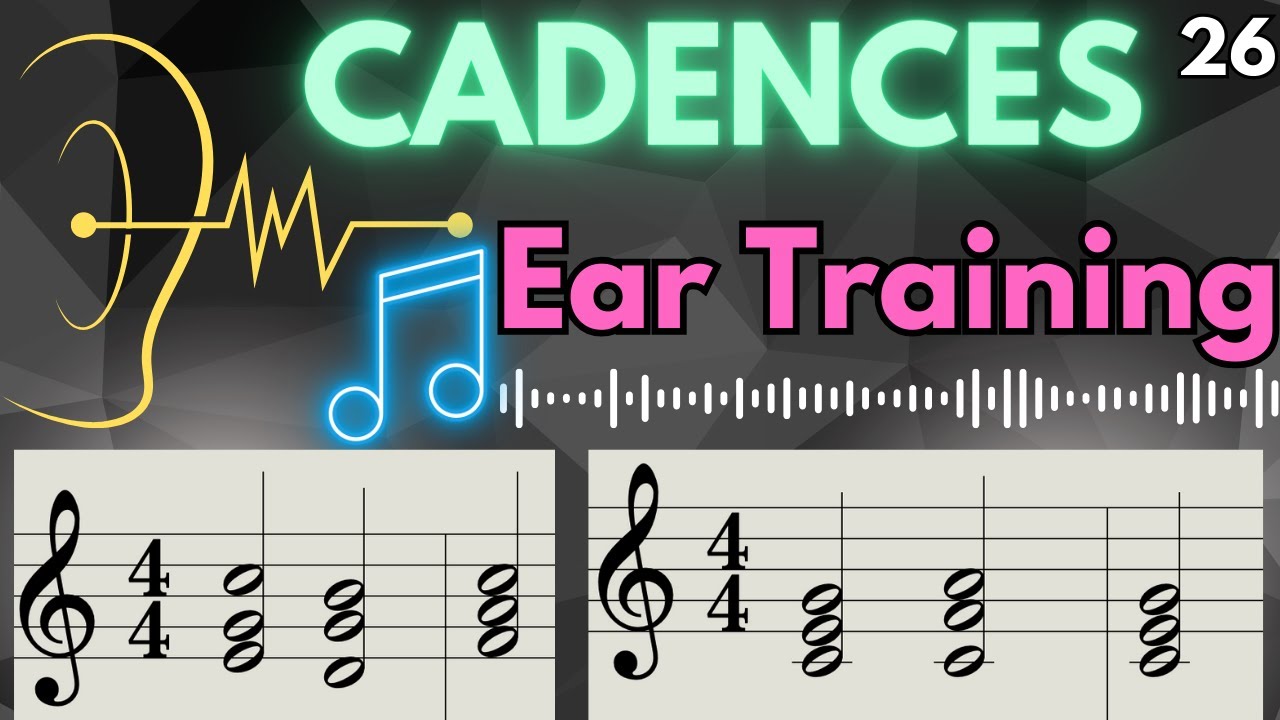
A cadence happens at the end of a musical phrase to create either a feeling of resolution or tension. The melody of a song can imply a particular cadence, but in this exercise we will focus on harmonic cadences, or short chord progressions.
To understand cadences, you need to understand where the chords in a key come from. If you harmonize the individual scale degrees in a major scale by stacking thirds on each root, you get this order of chords: 1 = major, 2 = minor, 3 = minor, 4 = major, 5 = major, 6 = minor, and 7 = diminished. This is true no matter what major key you are in. With Roman numerals, uppercase indicates major, lowercase indicates minor, and a little circle° on lowercase numerals indicates diminished. So, here is the order of major and minor chords using Roman numerals: I - ii - iii - IV - V - vi - vii°.
The I chord feels the most resolved, and the V chord feels the most tense. A V-I progression has the most feeling of tension and release, and this is known as a perfect cadence. If this cadence were a punctuation mark, it would be a period. The phrase is over, PERIOD.
IV-I also feels resolved, but there is less tension getting resolved. This is known as a plagal cadence, although I’ve heard it referred to as an “amen” cadence because these chords are commonly found at the end of hymns when they close on an amen. If this cadence were a punctuation mark, it would be a period, but, um… a more holy period. Did my analogy fall apart already with the 2nd example?
If a chord progression ends on V, you would call this a half cadence. It leaves you with a feeling that something is about to happen, or that the song should keep going. If the song doesn’t keep going, it might make you feel a bit on edge or uncomfortable. The song “For No One” by the Beatles ends on a half cadence, which fits the melancholy mood of the song. If this cadence were a punctuation mark, it would be a comma.
If a chord progression sets up an ending with a V chord, but at the last moment it goes anywhere other than I, you would call that a deceptive cadence. Arguably, a deceptive cadence can go anywhere, but it normally goes to a chord that contains the tonic note of the key. Some examples would be V-vi, V-IV, V-bVII, or even V-bIImaj7. If this cadence were a punctuation mark, it would be a question mark or an exclamation point.
I doubt most modern pop and rock composers are thinking about cadences in the classical sense when writing their music, but it is still useful to study these because it gets you started on learning chord progressions by ear and provides a tool for memorization.
AUDIO DOWNLOADS OF THESE EXERCISES ARE AVAILABLE ON PATREON FOR THE 1$ TIER: / 90196
FREE YOUTUBE PLAYLIST: • Hands-Free Ear Training
CONTACT: [email protected]
FOLLOW ME FOR THE LATEST NEWS ON CONTENT
Facebook: / joeluegersmusicacademy
Instagram: / joeluegersmusicacademy
Website: https://www.luegerswriter.com/
TikTok: / joeluegersmusicacademy
#joeluegersmusicacademy #eartraining #musictheory
Повторяем попытку...
Доступные форматы для скачивания:
Скачать видео
-
Информация по загрузке:


![Как определить размер на слух [ОБЪЯСНЕНИЕ]](https://image.4k-video.ru/id-video/CVRgEb4prQE)