Shaping and piercing techniques for red-hot steel blanks
Автор: Light And Life
Загружено: 2026-01-10
Просмотров: 11673
Описание:
🤗Welcome to my channel. Nice to see you here. Check out my latest videos and don't forget to Subscribe so you don't miss out on any great content!
●Video content
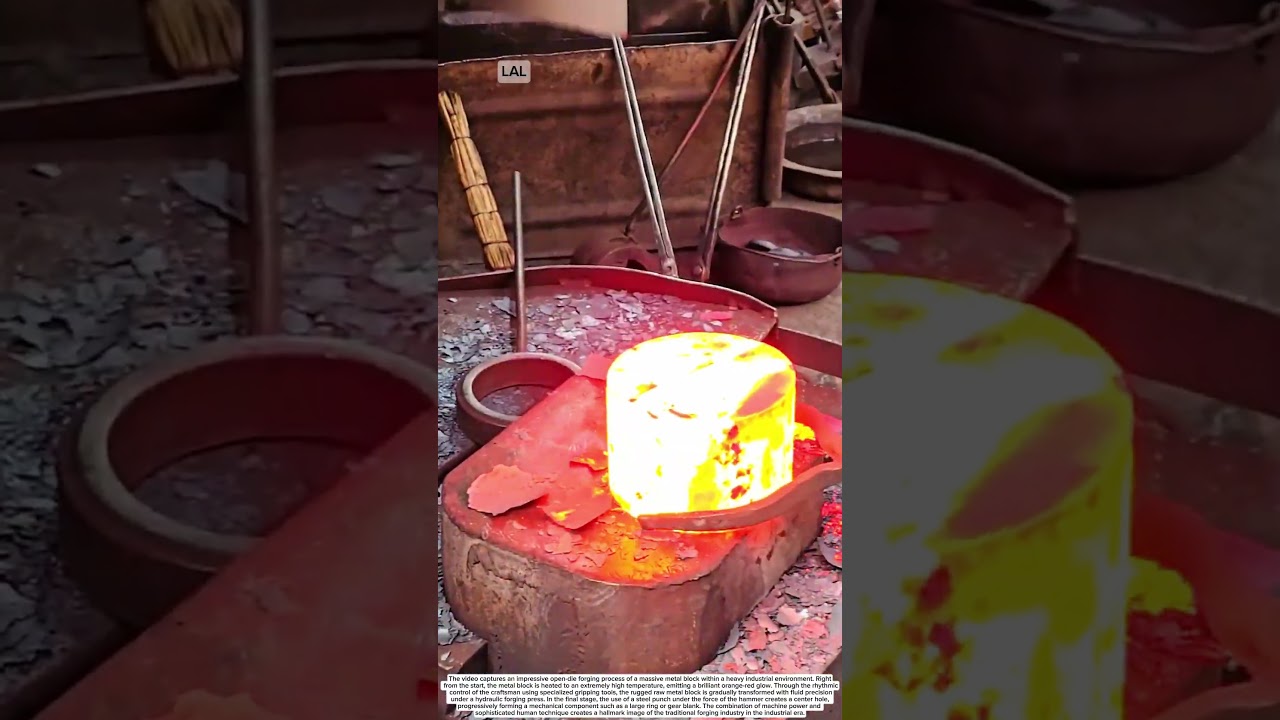
🥳The video captures an impressive open-die forging process of a massive metal block within a heavy industrial environment. Right from the start, the metal block is heated to an extremely high temperature, emitting a brilliant orange-red glow. Through the rhythmic control of the craftsman using specialized gripping tools, the rugged raw metal block is gradually transformed with fluid precision under a hydraulic forging press. In the final stage, the use of a steel punch under the force of the hammer creates a center hole, progressively forming a mechanical component such as a large ring or gear blank. The combination of machine power and sophisticated human technique creates a hallmark image of the traditional forging industry in the industrial era.
📈The primary purpose of the hot forging process using a hydraulic press is to deform and shape the raw metal block into mechanical parts with precise dimensions and geometries according to technical requirements. However, each blow that strikes down is not merely about shaping the metal as desired, but also helps to compress the internal structure, eliminate air pockets, and refine the grain structure, thereby creating products with superior strength and load-bearing capacity compared to casting methods. Consequently, this process is not simply about aesthetic shaping but is a pivotal step in manufacturing the "backbone" components of industrial machinery, ensuring safety and durable operation under the harshest conditions.
💥Key considerations
Ensuring proper forging temperature: The metal must be processed while still red-hot; if the temperature drops too low, the workpiece will harden, easily causing surface cracks and damaging the stamping machine system.
Controlling scale: The flaking black oxide layers need to be continuously removed; if these scales are stamped back into the workpiece, they will create impurities, directly affecting the purity and strength of the part.
Coordination between person and machine: The blacksmith must rotate the workpiece rhythmically with the hammer's striking speed; even a small deviation in position can cause uneven striking force, resulting in eccentric deformation or the workpiece being ejected from the anvil.
Lubricating the die-breaking tool: When performing through-hole punching, blacksmiths often use specialized lubricants (such as graphite); this reduces friction and prevents the punch tip from getting stuck in the metal block due to thermal expansion.
Повторяем попытку...
Доступные форматы для скачивания:
Скачать видео
-
Информация по загрузке:


