FREE Revision for the 2025 School of Law Entrance Examins-Session 1:General Guidelines- Part 1
Автор: GHANA LAW TV
Загружено: 2025-08-19
Просмотров: 1040
Описание:
Session 1: General Guidelines and Roadmap
1. Understanding the Structure of the Examination
• Format: Six questions are set—one from each of the following subjects:
1. Constitutional Law
2. Law of Contract
3. Law of Tort
4. Criminal Law
5. Land Law
6. Ghana Legal System and Legal Method
• Requirement: Candidates must answer four (4) questions only, each from a different subject.
• Implication: Students must be prepared across all six subjects, but can strategize to select their strongest four on the day.
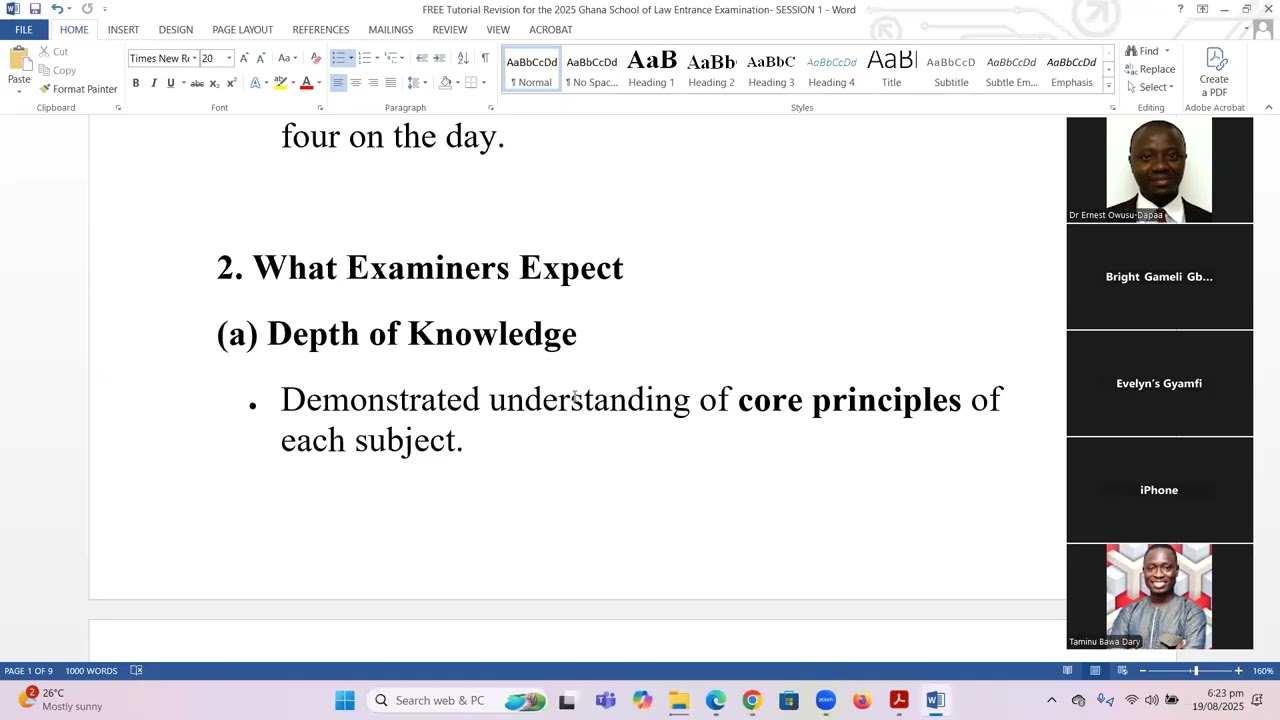
2. What Examiners Expect
(a) Depth of Knowledge
• Demonstrated understanding of core principles of each subject.
• Ability to define concepts, state rules, and explain them with clarity.
• Familiarity with leading Ghanaian and English cases and relevant statutes.
(b) Application of Law to Facts
• Examiners look beyond memorisation.
• Problem questions require applying the law to new factual scenarios.
• Answers should not merely recite the law but analyse and reason:
o Identify legal issues.
o State applicable principles/cases/statutes.
o Apply to facts.
o Conclude with a reasoned opinion.
(c) Analytical Skills
• Discern distinctions between similar principles.
• Recognise and resolve conflicting authorities.
• Demonstrate ability to argue both sides before concluding.
(d) Clear Legal Writing
• Organise answers in a logical structure:
o Introduction (state the issue and legal framework).
o Main body (analysis, authorities, application).
o Conclusion (succinct and justified).
• Avoid long, irrelevant introductions or padding.
• Use clear, concise sentences; avoid waffling.
• Cite cases and statutes accurately (even if brief).
3. Common Mistakes to Avoid
1. Irrelevant “bookish” introductions that do not address the question.
2. Failure to cite cases or statutes to back legal principles.
3. Poor time management—spending too long on one question and neglecting others.
4. Superficial answers that describe rather than analyse.
5. Writing Act as “act”, spelling errors, poor structuring.
6. Failure to conclude clearly—always give a reasoned end point.
4. Strategy for Preparation
• Cover all six subjects, but know at least five well so you can choose comfortably in the exam.
• Revise with a balance of essay-type practice and problem-based scenarios.
• Past questions should guide revision: they reveal examiner trends (often recurring themes).
• Prepare a case bank for each subject (7–12 leading cases per key topic).
• Practice writing within time limits
5. Roadmap for the 30 Sessions
I will walk them through each subject systematically, while integrating exam technique.
• Sessions 1–2: General exam techniques, case-law citation, structuring answers.
• Sessions 3–10: Constitutional Law (foundations, separation of powers, rights, judicial review, emerging case law).
• Sessions 11–15: Law of Contract (formation, terms, consideration, vitiating factors, breach & remedies).
• Sessions 16–20: Law of Tort (negligence, strict liability, trespass, defamation, remedies).
• Sessions 21–23: Criminal Law (elements of crime, inchoate offences, defences, specific offences like homicide & theft).
• Sessions 24–26: Land Law (interests in land, stool/skin lands, registration, family land, recent Supreme Court decisions).
• Sessions 27–29: Ghana Legal System & Legal Method (sources of law, hierarchy of courts, precedent, statutory interpretation).
• Session 30: Final mock examination and review.
6. KEY POINTS TO PONDER
• Success is not about knowing everything, but about organising knowledge persuasively under exam pressure.
• Treat this as both a knowledge test and a skills test (legal reasoning, writing, and analysis).
• Consistency is key: attend all sessions, practice actively, and refine case/statute recall.
Повторяем попытку...
Доступные форматы для скачивания:
Скачать видео
-
Информация по загрузке:


