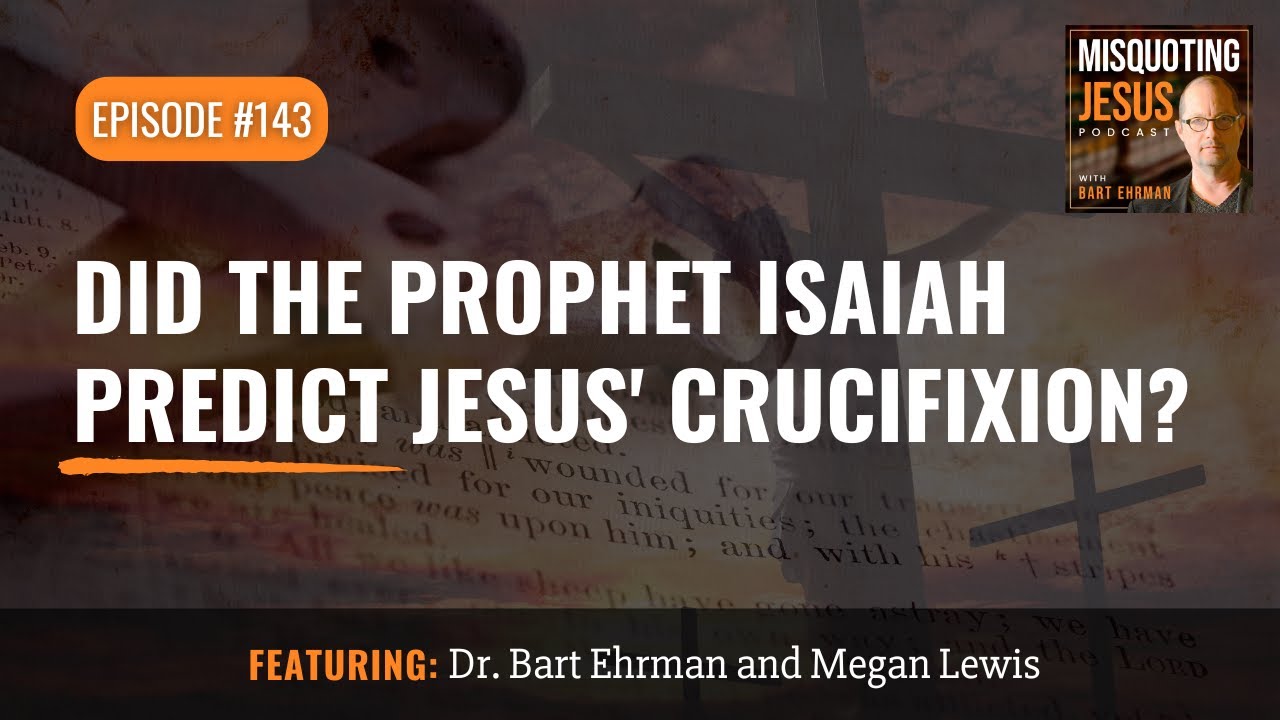
Did the Prophet Isaiah Predict Jesus' Crucifixion?
Автор: Bart D. Ehrman
Загружено: 2025-07-15
Просмотров: 42943
Описание:
Links Mentioned in this Episode:
http://bartehrman.com/didjesusexist - In this free course Bart will give us the best evidence for Jesus as a historical individual and deal with some of the claims made by mythicists
• God's Problem - Bart vs. Richard G. Swinburne - Richard Swinburne vs Bart Ehrman debate on suffering
https://bartehrman.com - Use the code MJPODCAST for a special discount
Episode Description:
In Episode 143, Megan Lewis and world-renowned Bible scholar Bart Ehrman confront one of the most familiar and contested texts in Christian-Jewish dialogue: the famous “He was pierced for our transgressions” passage from Isaiah 53. For many Christians, these words unmistakably foreshadow Jesus’ crucifixion and the doctrine of substitutionary atonement. But is this how the original audience would have read and understood Isaiah’s message?
Understanding Isaiah: A Book in Three Parts
Bart lays the foundation by breaking down the Book of Isaiah—not as the work of a single prophet, but as a composite text written by at least three different authors, each responding to the historical circumstances of their times:
First Isaiah (chapters 1–39): Set in the 8th century BCE, focusing on the Assyrian threat.
Second Isaiah (chapters 40–55): Written during the Babylonian exile, offering hope of restoration.
Third Isaiah (chapters 56–66): Written after the return from exile, expressing disappointment and calling for renewed faithfulness.
Isaiah 53, as Bart notes, is found within “Second Isaiah,” composed during a period when Jewish elites were exiled in Babylon and yearning for redemption.
Who is the Suffering Servant?
Megan challenges Bart: Christian tradition claims the “suffering servant” is Jesus; what does the Hebrew Bible actually say? Bart explains the four “servant songs” in Isaiah and zeroes in on the larger literary and historical context. Remarkably, when the servant is identified, Isaiah sometimes explicitly names “Israel”—the nation—as God’s servant. In ancient Hebrew literature, it was common to use the metaphor of a person to depict an entire people, and Isaiah does just that. Rather than a singular prophetic vision of a future Messiah, the text laments the suffering and eventual vindication of Israel itself.
Messianic Expectations: Did Second Isaiah Predict Jesus?
The discussion also covers what “Messiah” meant in the ancient world. Bart points out that the only explicitly named “Messiah” in Second Isaiah is Cyrus the Persian—called the anointed one (mashiach) because of his role in ending the Babylonian exile. There is no reference to a coming, suffering, future Jewish Messiah in these passages. In fact, before Christianity, there is no record of any Jewish group interpreting Isaiah 53 as predicting a suffering Messiah. The idea that Isaiah 53 is about Jesus is a uniquely Christian innovation, retroactively reading Jesus’ passion into an ancient Jewish lamentation.
Sacrifice, Sin, and the Origins of Christian Interpretation
A key part of the episode delves into the ideas of vicarious suffering and sacrifice for others’ sins—central to both the Israelite sacrificial system and later Christian theology. Bart explores how New Testament writers, grappling with the unexpected crucifixion of a would-be Messiah, turned to passages like Isaiah 53 as theological templates to make sense of Jesus’ death.
Key Takeaways
Isaiah 53, in its original context, refers not to a solitary, future “Messiah,” but to the collective suffering and hope of Israel during the Babylonian exile.
There is no ancient Jewish precedent, prior to Christianity, for reading Isaiah 53 as a literal prediction of a suffering Messiah.
The New Testament writers, processing Jesus’ shocking death, reinterpreted Hebrew scriptures like Isaiah 53 to craft the foundation for Christian understandings of atonement and Messianic prophecy.
Key Points
The Book of Isaiah is composed of at least three major divisions, each reflective of different time periods and authors.
Second Isaiah (chapters 40–55), including the “suffering servant” passages, addresses Jewish exiles in Babylon.
“Suffering servant” appears in four main “servant songs” (Isaiah 42, 49, 50, and 52:13–53:12), which must be read in the context of the whole book.
The servant is sometimes explicitly identified as Israel (e.g., Isaiah 49:3).
Ancient Jewish literary tradition often uses the singular to represent a whole people or nation.
Second Isaiah names Cyrus, the Persian king—not Jesus—as “Messiah” (anointed one).
Jewish prophets, including Isaiah, generally focus on contemporary events, not on distant future figures like Jesus.
Before Christianity, there is no evidence of Jews expecting a “suffering Messiah.”
Early Christians, seeking to understand Jesus' death, found scriptural support in passages like Isaiah 53.
Acts 8 and 1 Peter reference Isaiah 53 as fulfillment in Jesus, showing how this interpretation took hold.
Повторяем попытку...
Доступные форматы для скачивания:
Скачать видео
-
Информация по загрузке:


