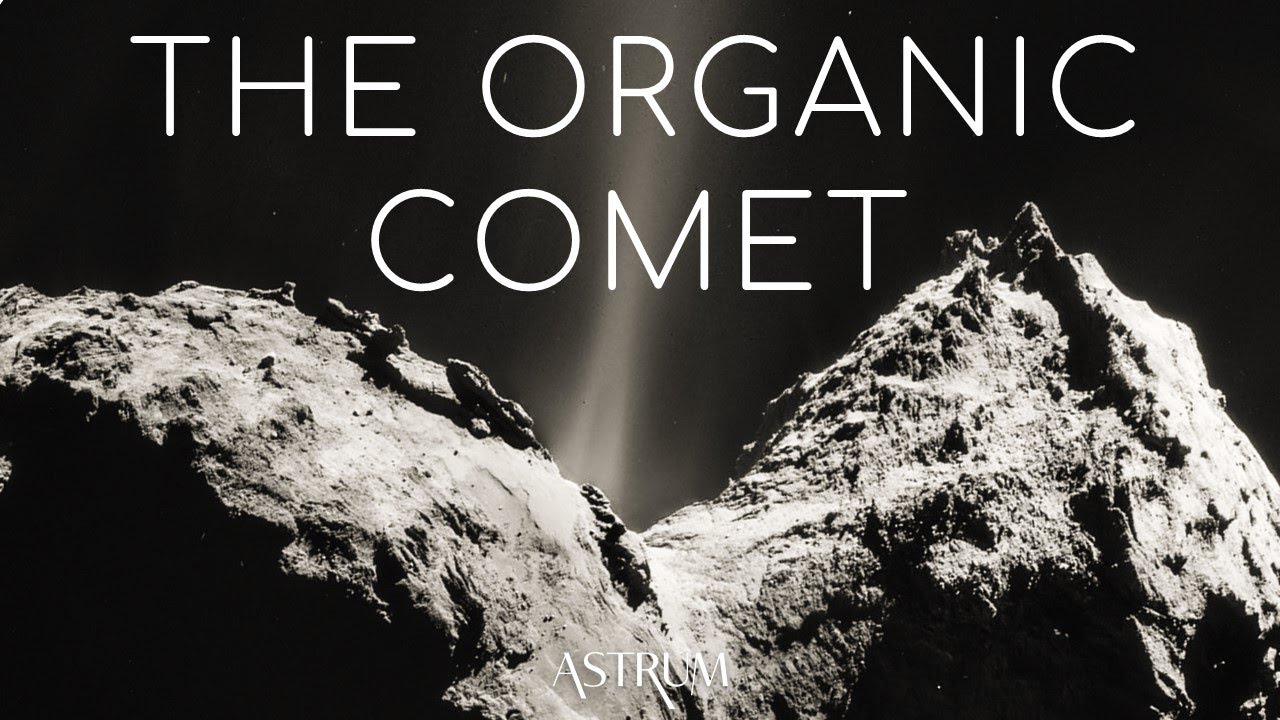
Tracing the dust trails of Comet 67P/Churyumov-Gerasimenko
Автор: ESA Space Science Hub
Загружено: 2016-09-27
Просмотров: 6934
Описание:
When a comet approaches the Sun, ices on the comet's surface turn to gas and escape, dragging dust along in the process. Separate tails of gas and minuscule dust particles form, and the largest particles – with sizes from 0.1 mm to a few cm – remain close to the comet's orbit, trailing behind it like contrails behind airplanes.
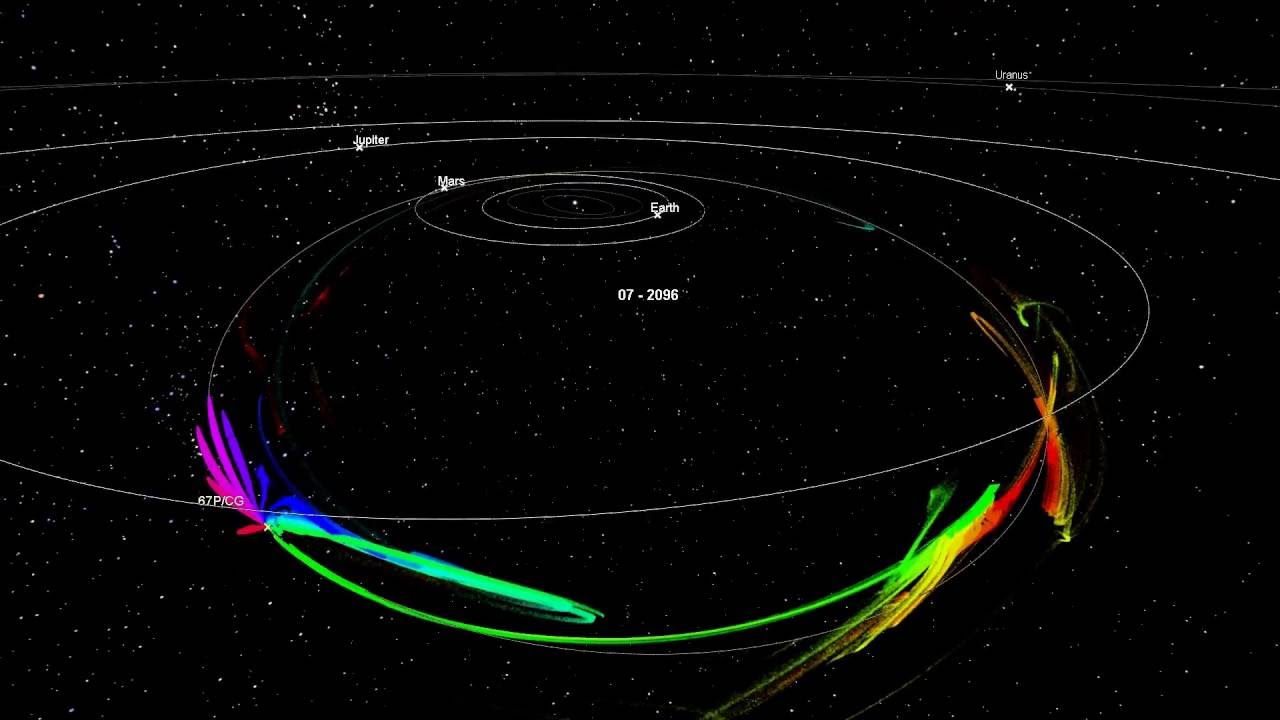
This animation, which traces the orbit of 67P/Churyumov-Gerasimenko from 1954 to 2099, shows how these dust trails evolve. It was created using the Interplanetary Meteoroid Environment for Exploration (IMEX).
Each time the comet enters the inner Solar System, it releases a new batch of dust particles, represented by different colours: red and orange are the oldest trails and blue marks the youngest. The Sun's gravity plays the lead role in defining the orbit of both the comet and its dust trails, but the planets, especially Jupiter, can also disturb the dust, forcing it away from the main orbit and causing the trails to curve. In 1959, as seen at the start of the animation, a close encounter with Jupiter modified the orbit so that 67P/C-G currently completes one orbit of the Sun every 6.45 years.
The simulation also shows the launch of Rosetta in March 2004 and the spacecraft's orbit until it arrived at 67P/C-G in August 2014, after which time it remained in the vicinity of the comet. However, it is not until after the end of the mission, in 2016, that things start to get interesting for 67P's dust trails.
According to the IMEX model, several encounters with Jupiter will cause the trails to spiral and take strange shapes as the comet continues to orbit the Sun over the following years. Other planets also play a role in deforming the trails: after about 2040, the animation shows small gaps in the trails resulting from Mars' gravitational influence.
The team has used IMEX to study the trajectories of dust particles from over 400 comets. The aim is to better understand how dust trails evolve and how the particles are disrupted and dispersed by interactions with the planets as the comets orbit the Sun.
When comet trails intersect the orbit of a planet they can create meteor storms – these are meteor showers with high rates of meteors that last for less than an hour. Since meteoroid impacts can damage, or even completely destroy, spacecraft, it is important to have precise models for the paths that dust particles follow – this is essential knowledge to avoid collisions with Earth-orbiting satellites and other spacecraft.
Eventually, cometary particles become part of the interplanetary dust cloud (the cosmic dust that permeates the space between the planets), losing the connection to their parent comet. From the Earth, we can see this interplanetary dust as the zodiacal light, caused by the scattering of solar light by the particles.
The Interplanetary Meteoroid Environment for Exploration (IMEX) is funded by ESA's General Studies Programme. IMEX used the Constellation distributed computing system and orbital data from the NASA JPL HORIZONS service. The SpaceEngine software was used for some aspects of the animation.
Credits: R. Soja et al., A&A, 583, A18, 2015, reproduced with permission © ESO; acknowledgement: ESA / ISS, U. Stuttgart/Aerospaceresearch.net /SpaceEngine, M. Sommer. Soundtrack: Drone 2 by Altars Altars (Moritz Leppers)
More information about this video can be found at http://sci.esa.int/rosetta/58304-trac...
Повторяем попытку...
Доступные форматы для скачивания:
Скачать видео
-
Информация по загрузке:





![Марс и Долины Маринер. Как появился самый большой каньон Солнечной системы? [Космос 2024]](https://imager.clipsaver.ru/RP7ZE8vwWdE/max.jpg)