When the Loudest Voice in the Room Architects Your Future
Автор: Virtual Domain-Driven Design
Загружено: 2026-03-02
Просмотров: 4
Описание:
We often assume that bad architectural decisions come from bad architects. But what if there are no architects at all—just a team of software developers trying to do their best, with no one in the room who knows how to facilitate a decision of that magnitude?
That's the situation Gien Verschatse found herself in early in her career. The team had just been pulled off a Phoenix project—a fresh-start initiative killed after six months—and reassigned to maintain a legacy system built on technologies that were outdated even then. Eager to modernise, Gien organised an EventStorming session to map the technical debt from an emotional angle: what frustrates you most? What makes your job difficult? The session was, in her words, an absolute disaster—she couldn't get people to step away from how the system currently worked. Meanwhile, a developer with a dominant personality pushed hard for an event sourcing implementation. It was cutting-edge technology, exciting, new. And that was enough. "The person who was the loudest in the meeting got their way. There was no plan. There was no sitting down and thinking this through. It was just 'this is the latest and greatest and we're going to do that.'"
The event sourcing system got built entirely alongside the existing codebase. The emotional wall of technical debt stayed untouched. QA didn't know how to test the new system. IT didn't know how to deploy it. People started leaving. Gien eventually left too—after a massive burnout, feeling like she'd failed. It took fifteen years and a career as a consultant to see it clearly: the problem wasn't the technology. It was that nobody in that room knew how to make architectural decisions together, and nobody was there to facilitate the ones that needed to be made.
This conversation explores what happens when dominant personalities fill the vacuum left by absent facilitation, why value-based heuristics are a more effective lever than emotional appeals, and what Gien—now co-author of a book on decision-making—would do differently today.
Key Discussion Points
[00:01] The Phoenix That Died: Gien's team is pulled off a promising fresh-start project and reassigned to a legacy system with outdated technology
[03:00] The EventStorming That Failed: An attempt to map technical debt emotionally collapses—the team can't imagine beyond how the system currently works
[04:00] The Loudest Voice Wins: A dominant developer pushes event sourcing through with no plan, no consequence-mapping, and no one with the skills to push back
[05:00] The Architecture That Solved Nothing: The new system is built alongside the old one; QA can't test it, IT can't deploy it, the technical debt remains untouched
[06:00] The Exodus and the Burnout: People leave one by one; Gien leaves after burnout, carrying a sense of personal failure that took years to reframe
[09:00] Quit Sooner: Gien's hard-won advice—it's okay to leave bad environments, and finding one is not a personal failure
[20:00] Digging Into the Preference: How Gien now uncovers the value-based heuristics driving strong positions—fear of skill obsolescence, career anxiety—without triggering defensive reactions
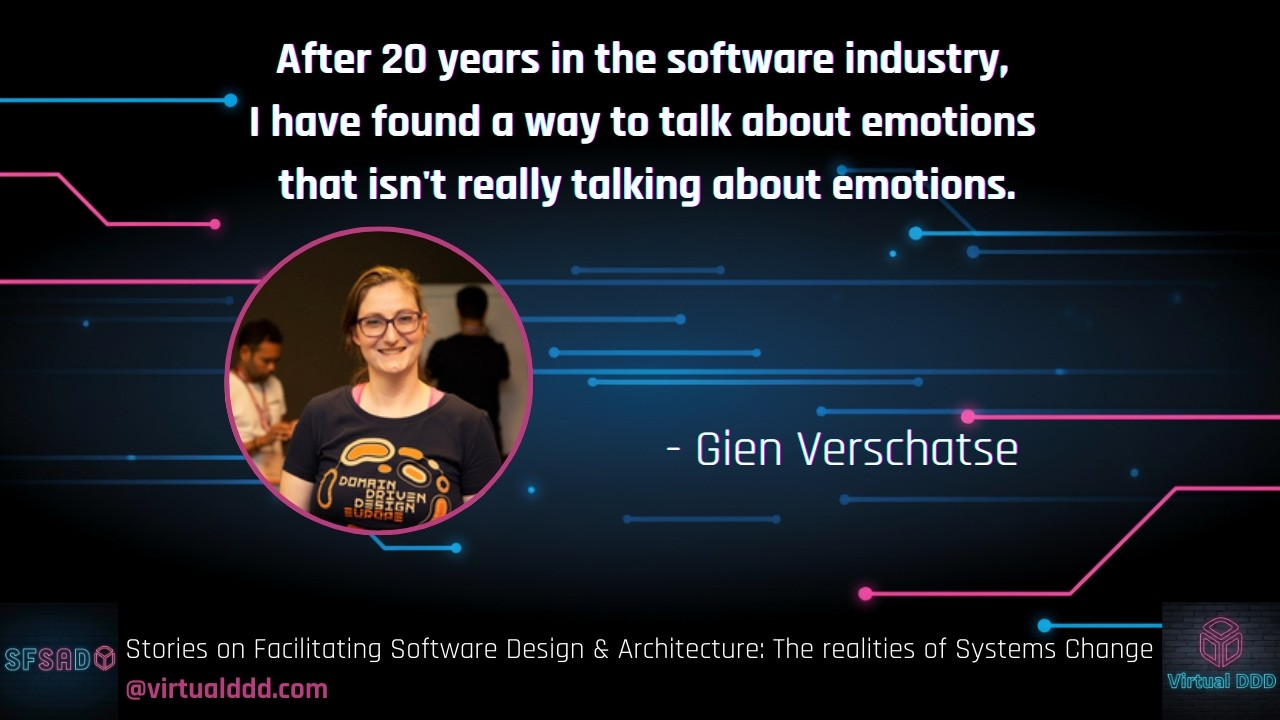
[22:00] Talking About Emotions Without Talking About Emotions: After 20 years in a male-dominated industry, Gien's approach to surfacing emotional drivers through values-based framing
Guest: Gien Verschatse, Evelyn van Kelle
Hosts: Kenny Schwegler, Andrea Magnorsky
Повторяем попытку...
Доступные форматы для скачивания:
Скачать видео
-
Информация по загрузке:



![Код, написанный ИИ: Армин Ронахер об агентах ИИ и будущем программирования [Полный выпуск]](https://imager.clipsaver.ru/4zlHCW0Yihg/max.jpg)