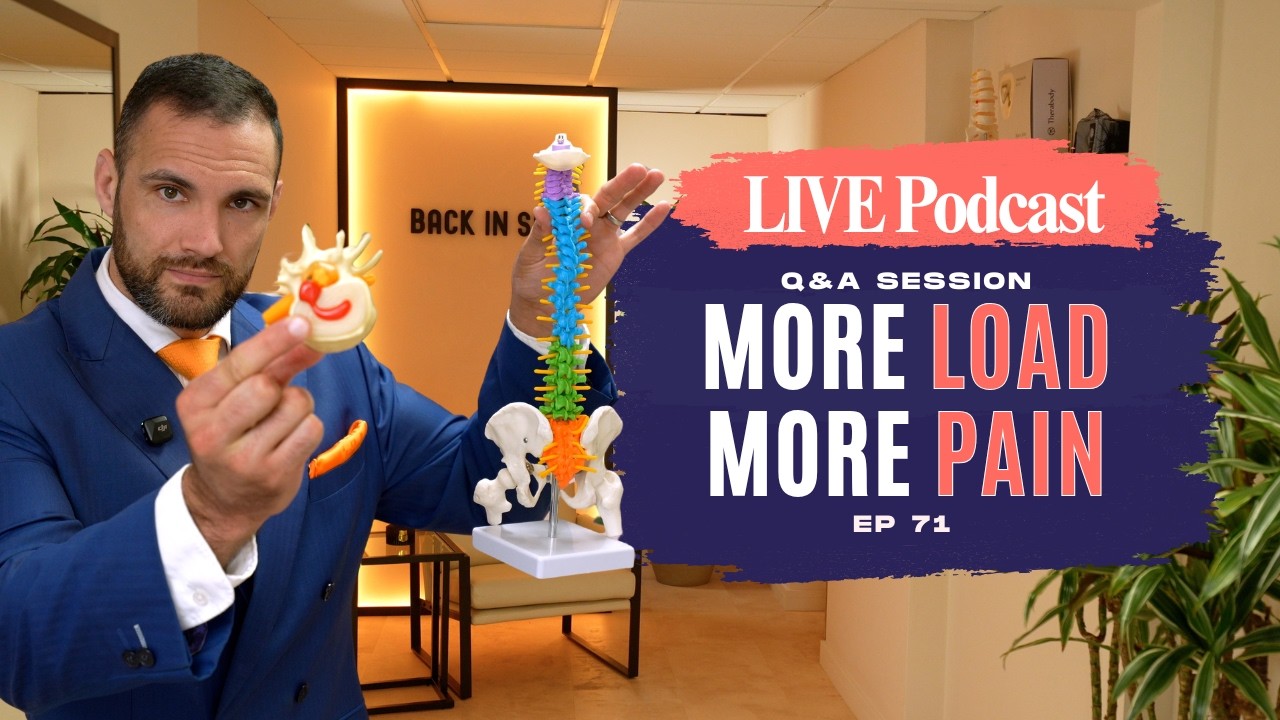
How to Rebuild Load-Bearing Capacity After a Herniated Disc
Автор: Back In Shape Program
Загружено: 2026-02-05
Просмотров: 302
Описание:
In this session, we dive deep into the concept of objective load-bearing and why it is the missing link for those struggling with persistent sciatica and herniated discs. Many people spend years "spinning their wheels" with generic stretching and mobility work, yet they find that their back remains vulnerable to daily activities like sitting or getting out of bed. We explore the reality that sitting actually increases the load on your lumbar spine by 40% to 90%. If you aren't training your body to handle those specific forces through progressive resistance, you are essentially leaving your recovery to chance.
We use the success story of Paul, a member who went from barely being able to perform a hip hinge to lifting over 40kg for multiple sets, to illustrate that the annulus fibrosis—the ligamentous structure of the disc—can indeed adapt and heal when given the right stimulus. The focus must shift from simply "chasing pain relief" to building physical resilience. By standardising your movements and gradually increasing the weight you can handle in a neutral spine position, you create a buffer that makes daily life safer and flare-ups less frequent.
We also address the common "flexibility trap." Many people believe they need to stretch their hamstrings or pull their knees to their chest to fix their back pain. However, we explain why limited range of motion is often a protective signal from the brain due to a lack of stability. By prioritising load-bearing capacity over deep stretching, you allow the spine to stabilise and heal, which often results in your "tight" muscles relaxing naturally without the need for aggressive or risky flexion exercises.
Key Topics Covered
📈 The Load-Bearing Spectrum: We break down why reaching 20%, 45%, and 75% of your body weight in exercises like the squat and hip hinge is critical for out-pacing the daily strain of sitting and standing.
🏗️ Healing the Annulus Fibrosis: A detailed look at how the disc's ligaments remodel over time and why progressive loading is the only way to build a spine that is stronger than it was before the injury.
🪑 The Squat as a Daily Tool: Why we view the squat not as a "gym exercise" but as an essential skill for getting off the toilet, out of chairs, and moving safely through a free-weight environment.
check out the article: https://backinshapeprogram.com/2026/0...
Chapters
00:00 Introduction and Paul's 45kg Progress
01:35 The Power of Recording Your Progress
02:44 The 4 Numbers of Load-Bearing Capacity
03:52 Why Sitting is So Taxing on the Lumbar Spine
05:33 The Squat as an Evaluation Tool for Stability
06:55 Why GPs Focus on Pain Management vs Root Cause
08:48 The Traditional "Treatment Funnel" and Its Limits
10:40 Solving the Injury vs Chasing Nerve Pain Relief
11:55 Why Your Flexibility is Bad (And Why Not to Stretch)
13:58 Operating Within Your Zone of Competence
14:50 Anatomy 101: How a Microdiscectomy Affects the Disc
17:48 Troubleshooting Hip Hinge Flare-ups
20:45 Post-Surgery Rehab: When to Start
22:24 Bear Crawls and Advanced Stability Work
23:30 Weak Legs and Phase Two Progression
25:00 Squatting After a "Burst" or Herniated Disc
26:38 Do Discs Actually Heal? Understanding Ligament Repair
28:40 Transitioning from Dumbbells to the Barbell
31:00 Applying Exercise Technique to Daily Life
33:52 Why Load Matters More than Range of Motion
37:25 Stenosis and Spondylolisthesis Management
48:00 Muscle Memory and Maintaining Your Gains
51:00 Neutral Spine Positioning Explained
58:50 The Problem with Hack Squat Machines
01:01:30 Sensitisation and the Chronic Pain Nervous System
01:07:35 Can You Reverse Degenerative Disc Disease?
01:11:30 The Truth About the Roman Chair for Back Pain
#HerniatedDisc #SciaticaRehab #BackInShape
Повторяем попытку...
Доступные форматы для скачивания:
Скачать видео
-
Информация по загрузке:


![Лучше для поясницы НЕ придумаешь [ТОП комплекс в 2026]](https://image.4k-video.ru/id-video/vQmdkKzwPPA)