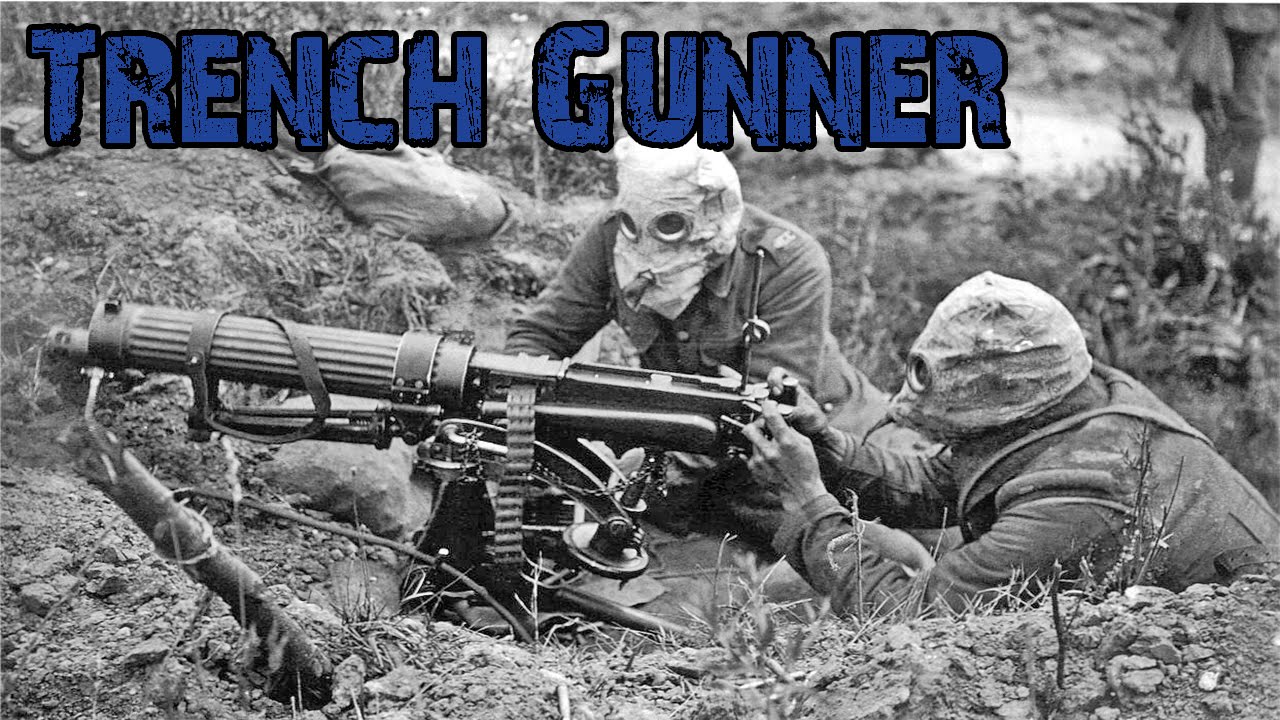
Verdun 1916: Trench Gunner
Автор: General-Jordan
Загружено: 2014-12-11
Просмотров: 615
Описание:
Holdin the line, killin alot
The game is Verdun.
The Battle of Verdun (Bataille de Verdun, IPA: [bataj də vɛʁdœ̃], Schlacht um Verdun, IPA: [ʃlaxt ˀʊm vɛɐdœŋ]) was fought from 21 February – 18 December 1916 during the First World War on the Western Front between the German and French armies, on hills north of Verdun-sur-Meuse in north-eastern France. The German Fifth Army attacked the defences of the Région Fortifiée de Verdun (RFV) and those of the Second Army garrisons on the right bank of the Meuse, intending to rapidly capture the Côtes de Meuse (Meuse Heights), from which Verdun could be overlooked and bombarded with observed artillery-fire. The German strategy intended to provoke the French into counter-attacks and counter-offensives, to drive the Germans off the heights. French attacks would be relatively easy to repel with massed artillery-fire, from the large number of medium, heavy and super-heavy guns, brought into the area and supplied with large amounts of ammunition on excellent pre-war railways, which were within 24 kilometres (15 mi) of the front line.
The German strategy assumed that the French would attempt to hold on to the east bank of the Meuse, then commit the French strategic reserve to recapture it and suffer catastrophic losses from German artillery-fire, while the German infantry held positions easy to defend and suffered fewer losses. The German plan was based on the experience of the battles in Champagne (Herbstschlacht September–October 1915) when after early success, the French offensive was defeated with far more French than German casualties. Poor weather delayed the beginning of the German offensive (Unternehmen Gericht/Operation Judgement) until 21 February; French construction of defensive lines and the arrival of reinforcements before the opening attack, were able to delay the German advance despite many losses. By 6 March, 20 1⁄2 French divisions were in the RFV and a defence in depth had been established. Pétain ordered that no withdrawals were to be made and that counter-attacks were to be conducted, despite exposing French infantry to fire from the German artillery massed in the area. By 29 March, French artillery on the west bank had begun a constant bombardment of German positions on the east bank, which caused many German infantry casualties.
In March, the German offensive was extended to the left (west) bank, to gain observation of the ground from which French artillery had been firing over the river, into the flank of German infantry attacks on the east bank. The German troops were able to make substantial advances but French reinforcements contained the attacks, before the Germans reached positions from which they had ground observation of the French artillery sites. In early May, the Germans changed tactics and made local attacks and counter-attacks, which gave the French an opportunity to begin an attack against Fort Douaumont, which was partially occupied, until a German counter-attack reoccupied the fort and took numerous prisoners. The Germans changed tactics again, alternating attacks between both banks of the Meuse and in June captured Fort Vaux. The Germans continued the offensive beyond Fort Vaux, towards the last geographical objectives of the original plan, at Fleury and Fort Souville. German attacks drove a salient into the French defences, captured Fleury and came within 4 kilometres (2.5 mi) of the Verdun citadel.
The German offensive was reduced to provide artillery and infantry reinforcements for the Somme front, where the Anglo-French relief offensive began on 1 July. During local operations, the village of Fleury changed hands sixteen times from 23 June to 17 August. A German attempt to capture Fort Souville in early July, was repulsed by artillery and small-arms fire. To supply reinforcements for the Somme front, the German offensive was reduced further, along with attempts to deceive the French into expecting more attacks, to keep French reinforcements away from the Somme front. In August and December, French counter-offensives recaptured much of the ground lost on the east bank and recovered Fort Douaumont and Fort Vaux. An estimate in 2000 found a total of 714,231 casualties, 377,231 French and 337,000 German, an average of 70,000 casualties for each month of the battle; other recent estimates increase the number of casualties to 976,000. The Battle of Verdun was the longest and one of the most costly battles in human history.
Повторяем попытку...
Доступные форматы для скачивания:
Скачать видео
-
Информация по загрузке:














![Из Беларуси в Китай за 100$ челлендж [1]](https://imager.clipsaver.ru/WFJwxTlc36U/max.jpg)


