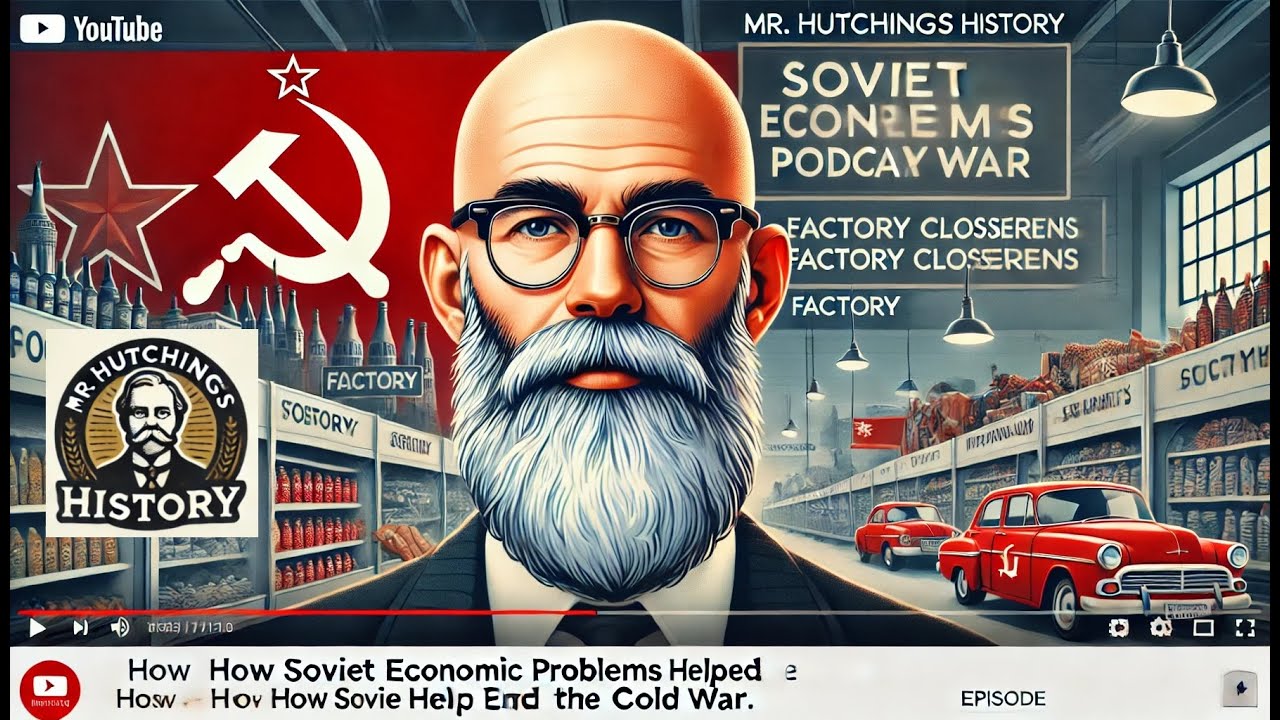
How Soviet Economic Problems Helped End the Cold War
Автор: Мистер Харольд Хатчингс
Загружено: 2024-12-02
Просмотров: 31
Описание:
Welcome to Mr. Hutchings History, where we dive deep into key historical moments. In today’s episode, we examine how the Soviet Union’s economic troubles were crucial in bringing the Cold War to a close. Alongside the diplomatic efforts of Reagan and Gorbachev, internal economic decay played a decisive role in the collapse of the USSR. We explore:
• The Soviet Economic Crisis: By the 1980s, the USSR was grappling with stagnation and inefficiency. Gorbachev’s reforms like perestroika and glasnost attempted to address these issues, but ultimately failed to deliver results.
• Global Economic Factors: The sharp decline in oil prices in the 1980s further exacerbated the Soviet economy’s problems, reducing vital revenue and increasing the pressure to reform.
• The Economic Collapse: By 1991, the Soviet economy was in free-fall, triggering political instability and hastening the USSR's dissolution.
• Historiographical Insights: We explore how different historians interpret the role of economic decay versus external pressures in the end of the Cold War.
Join us as we analyze how economic forces, along with the decisions of key leaders, shaped the final chapter of the Cold War.
#Paper2WorldHistory #ColdWar #SovietEconomy #Gorbachev #Reagan #Perestroika #Glasnost #EconomicCollapse #EndOfTheColdWar #USSR #ColdWarHistory #SuperpowerRelations #IBHistory #SovietUnion #EconomicFailure
Works Cited
Gorbachev, Mikhail. Memoirs. Doubleday, 1996.
Kotkin, Stephen. Armageddon Averted: The Soviet Collapse, 1970-2000. Oxford UP, 2001.
McMahon, Robert J. The Cold War: A History in Documents and Eyewitness Accounts. Oxford UP, 2003.
Chapters
(0:00) Introduction: The Cold War’s Unexpected End
The Soviet Union didn’t collapse with a bang—it crumbled under economic pressure. Let’s explore how.
(0:22) The Role of Economics in Superpower Strength
Beyond military power, economic health determines a nation’s survival—even for superpowers.
(0:52) The 1980s Soviet Economic Decline
Decades of economic stagnation, declining industrial output, and military overspending weakened the USSR.
(1:26) Gorbachev’s Reforms: Perestroika and Glasnost
Gorbachev tried to save the economy through restructuring and openness, but did it work?
(2:32) The Challenges of Reforming a Rigid System
The Soviet economy relied on strict central planning—could it survive major changes?
(3:06) Inflation, Shortages, and Public Discontent
By the late 1980s, inflation skyrocketed, savings vanished, and public trust in the system eroded.
(3:44) The Oil Crisis and the Soviet Economic Crash
The USSR depended on oil exports—when global prices collapsed, so did their financial stability.
(4:30) Did US Pressure Force the USSR’s Economic Collapse?
Some historians argue Reagan’s military buildup drained Soviet resources—was this the final blow?
(5:07) Internal Weakness vs. External Pressure
Was the Soviet Union already doomed, or did the Cold War arms race accelerate its fall?
(5:56) The Human Cost of Economic Collapse
Behind economic policies were real people—shortages, unemployment, and lost hope.
(6:27) The Soviet System: A House of Cards?
The Cold War ended not with a war, but with an economic crisis—was it inevitable?
(7:00) Lessons from the Soviet Union’s Fall
What can today’s leaders learn from the USSR’s mistakes? Economic policies shape history.
(7:37) Conclusion: Economics as a Superpower’s Achilles Heel
When the economy fails, even the strongest empires can collapse. What lessons remain?
Повторяем попытку...
Доступные форматы для скачивания:
Скачать видео
-
Информация по загрузке:


![Global Capitalism: The Changing World Economy [May 2023]](https://image.4k-video.ru/id-video/WcI4XQA5nzA)