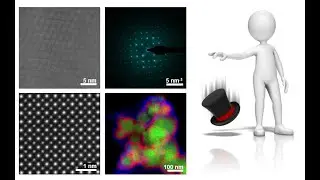
Beyond 2D Imaging: How 4D-STEM Maps the 3D Crystallography of Materials
Автор: Research Lounge
Загружено: 2025-03-01
Просмотров: 87
Описание:
Ever wondered how we can map 3D atomic structures with stunning precision? This breakthrough 4D-STEM method unveils atomic displacements at atomic resolution, unlocking insights into complex oxides and heterostructures. Watch now to explore the future of nanomaterial imaging!
FAQ:
1. What is the significance of this research?
This research introduces a novel methodology using 4-dimensional scanning transmission electron microscopy (4DSTEM) to map the direction and magnitude of atom displacements in three dimensions at atomic resolution. This goes beyond traditional 2D projection imaging in STEM, providing a much deeper understanding of the 3D crystallographic structure of materials, especially in nanoscale heterostructures like thin films and interfaces. This approach is particularly valuable for optimising functional materials where interfaces exert significant control over structure, chemical ordering, and properties.
2. How does 4DSTEM contribute to this advancement?
The advent of fast-readout direct electron detectors for 4DSTEM allows for recording diffraction patterns at each scan point, enabling new imaging modalities. This research leverages the information contained in high-angle electron diffraction patterns, specifically from the First-Order Laue Zone (FOLZ), to determine the 3D orientation of a unique axis of the unit cell and the magnitudes of atom movements along it. This approach eliminates the need for sample tilting, making it a significant step forward in understanding nanoscale heterostructures.
3. What are anti-parallel atom displacements, and why are they important?
Anti-parallel atom displacements, especially of larger cations, coupled with octahedral tilting, are common features in functional oxides like perovskites. These displacements affect the material's properties. The ability to visualise and quantify these displacements in 3D, especially at interfaces and within strain fields, is crucial for understanding the growth mechanisms and optimising the desired properties of complex oxides. Projection images cannot distinguish between different 3D orientations resulting from these anti-parallel displacements.
4. How is the azimuthal diffracted intensity variation fitted to achieve atomic resolution?
Unidirectional atom modulations create periodic azimuthal intensity variations in the FOLZ ring. Fitting these variations to a mathematical function enables precise determination of modulation direction and strength, revealing crystal structure details beyond conventional STEM imaging.
5. What parameters are extracted from the diffraction pattern fitting, and what do they represent?
The fitting process extracts parameters such as:
A1: Amplitude of the 2-fold intensity modulation.
ϕ1: Peak angle of the 2-fold modulation.
A2: Amplitude of the 1-fold intensity modulation.
ϕ2: Phase of the 1-fold modulation.
These parameters provide information about the strength and direction of the atomic displacements, revealing details not accessible through traditional STEM imaging. The A1 map, for instance, shows that the strength of the 2-fold oscillation doesn't peak at the position of atom columns, but appears elongated on either side, while the A2 map highlights unidirectional intensity modulation, peaking away from La column centres.
6. How are theoretical simulations used to validate and interpret the experimental results?
Multislice simulations (e.g., via Dr Probe) model expected diffraction patterns, allowing direct comparison with experimental 4DSTEM data. Applying the same transformations ensures validation and deeper insight into crystallographic parameters.
7. What insights were gained from mapping atomic displacements across an interface?
Mapping atomic modulations in LCMO/LSAT revealed that the LCMO b-axis aligns in-plane, with modulation strength increasing away from the interface. This orientation likely minimizes strain.
8. What is the broader impact of this work on materials science and crystallography?
This research enables atomic-resolution 3D crystallography mapping via STEM, allowing the study of atomic-scale variations near interfaces, defects, and complex compounds. It is especially valuable for systems with a fixed crystal orientation, such as epitaxial structures and domain formations.
Video Title:
'Beyond 2D Imaging How 4D-STEM Maps the 3D Crystallography of Materials'
📖 Resources:
Read the paper 'Atomic resolution imaging of 3D crystallography in functional oxide thin films' written by Ian MacLaren, Aurys Silinga, Juri Barthel, Josee Kleibeuker, Judith L MacManus-Driscoll, Christopher S Allen, Angus I Kirkland: [https://arxiv.org/abs/2412.16297]
🎥 Watch Next:
Physics: [ • Physics ]
💡 Please don’t forget to like, comment, share, and subscribe!
#science #4dstem #electronmicroscopy #crystallography #atomicresolution #materialscience #nanotechnology #thinfilms #aipodcast
Повторяем попытку...
Доступные форматы для скачивания:
Скачать видео
-
Информация по загрузке: